World-class
experts, creators and performers, right in our own back yard
By the students of the USU communication department
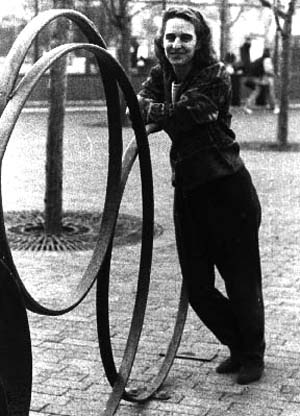
TOIL AND TROUBLE:
Kirstie Rosenfield takes a break from directing at her favorite sculpture
in the Chase Fine Arts Center. She's an expert on witchcraft in dramas
from Shakespearean times. / Photo by Lynnette Hoffman
One
of them can tell you all about why messages about teen sex don't always
motivate teen-agers. Another can tell you all about lies, lies, lies.
(And, first impressions to the contrary, those two don't do research
together.)
Another can trace
her career in green marketing research to the time she made trips to
the grocery and broke a pickle jar in a small Kansas town. A fourth
wonders how goats learn what to eat and what to avoid.
These professors
are an informally constructed cross-section of the experts at Utah State
University.
For an assignment
in Dr. Michael S. Sweeney's advanced news-feature writing class at USU,
students were asked to find and profile a world-class expert on campus.
Photo students from Mitch Mascaro's classes supplied several images.
The results below
are both informative and surprising.
Click
the links and learn about our most precious campus resource: the power
of the human mind to expand the envelope of knowledge and inspire other
minds to follow. --
the Eds.
Kirstie
Rosenfield, researcher of witchcraft in Renaissance drama
(01/25/00) The
director of Much Ado About Nothing at USU studies the way female
characters are often accused of witchcraft in plays from England between
1560 and 1640. "I don't believe that women who were accused of witchcraft
were practicing this organized religion," says Kirstie Rosenfield. Instead,
she said, these women were probably practicing the dominant religion
of Christianity, but because some of them were healers or seemed to
have some other powers, the Puritans labeled them witches. / By Doug
Smeath
John
Seiter, who knows when you've been fibbing
(01/27/00) John
Seiter has made an academic career out of liars, truth twisters and
deceivers. And guess what -- it's a huge subject for a professor. "Quite
a bit of research shows that deception is very common in our day-to-day
lives," Seiter says. "So my thought is that if we really want to understand
the process of human communication, we need to be looking at not only
the good and the peachy, but also the darker sides of communication
too." /
By Emily Parkinson
Denise
Conover, military historian who doesn't believe in tests (or easy A's)
(01/27/00) She
reminds you of a popular TV cooking instructor. Denise
Conover scampers back and forth between the overhead projector and the
VCR, swapping transparencies and videocassettes while throwing out tidbits
about the United States' involvement in World War II. This video is
done. Pop on the overhead. Let the ideas simmer for a while. And then
ask: "Was Truman justified in dropping the Bomb?" / By
Casey Hobson
Carol
O'Connor, historian of prosperous suburbs and some unprosperous times
(01/26/00) She
strides to the side of the classroom. Slumping her shoulders and shuffling
her feet, Carol O'Connor sluggishly moves across the floor. Her suddenly
cold hands reach for a newspaper. Coughing twice, she unfolds and shakes
out the newspaper. Then, hoisting herself unto the table, O'Connor spreads
the newspaper across herself as she lies down to sleep. "And that, is
a Hoover blanket," she says. The class erupts in laughter. /
By Emily Jensen
Cathy
L. Hartman, advocate of Green Marketing
(01/14/00) Arma,
Kan., was a town of 400 people with a grocery store to suit their needs.
To Hartman, however, the store was huge, filled with rows and rows of
colors and shapes. She took the items to the check-out and watched as
the cashier added together her purchases. "I thought it was such a marvel
to find products. I was fascinated when the clerks would count my change
back," Hartman says. "I thought that when I went to school that is basically
what I was going to learn, that is, how to locate things such as products
and learn money exchange."
/ By Valerie Vaughan
Brian
McCuskey, investigator of the monsters of British literature
(01/14/00)
When he showed up
at USU to interview for a job in the English department, Brian McCuskey
was asked to describe an ideal course. He did, and now he teaches it.
His students examine Frankenstein's creation, Dracula and Dr. Jekyll-Mr.
Hyde in their original 19th century texts and compare them with the
20th century filmed versions. Their findings? Dr. Frankenstein perhaps
was more of a monster than
the thoughtful, emotional man he made in his laboratory. And Dracula
is sexy. / By Suzanne Galloway
Brent
Miller, family and human development department head
(12/04/99)
In order for any
teen-age sexual education program to work effectively, culture, family,
school and religion all need to work together, this longtime researcher
of teen sexual behavior says. The "just say no" message of
abstinence,
by itself, is inadequate.
/ By Jodi Mitchell
Nancy
Warren, assistant professor of English with expertise in medieval literature
(12/04/99)
When her parents
put the 8-year-old Nancy Warren to bed in Tennessee, they would read
to her. "Loke who that is most vertuous always, Privee and apert,
and most entendeth ay." Who knows what dreams came of this
. . . but Warren's early introduction to Chaucer may have set her on
the path to researching the roles of women in Chaucer's times. /
By Melissa J. Bloyer
Patricia
M. Lambert, bioarchaeologist (especially human bones and the stories
they tell)
(12/04/99)
She teaches anthropology
classes, studies the causes and consequences of human violence and warfare
and collects road kill in her spare time. The bones of animals, some
of which she bleaches in the sun in her back yard, have their own stories
to tell, but mostly she's interested in ancient human bones and the
tales of warfare they yield to the trained eye of a bioarchaeologist.
/ By Kathryn Summers
Fred
Provenza, graduate mentor extraordinaire and rangeland researcher
(12/04/99)
He finds life's lessons
in goats that won't eat blackbrush and the hard work of hauling hay.
When he spoke at a seminar at Texas A&M, a witness recounts, "It
was standing room only, the biggest crowd I have seen at a seminar,
and people are still talking about his visit. It was also the only seminar
to combine mythology, philosophy, physics, business, and sociology in
a discussion about research." / By Esther Yardley
MS
MS
|


