|
||||


 |
Witchcraft in Renaissance theater a platform for ideas about women, director says
By Doug Smeath
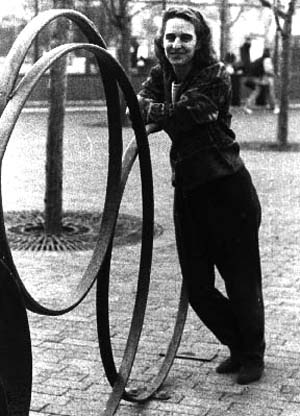
Kirstie Rosenfield takes a break from her work at her favorite sculpture in the Chase Fine Arts Center. / Photo by Lynnette Hoffman Editor's note: This story was produced for the USU mass communication class "Beyond the Inverted Pyramid," COMM 3110. It is one of a series on USU professors who are experts in their field, or world-class creators or performers.
It's just two weeks before opening night, but everyone's giggling. Utah State Theatre -- the production arm of the Utah State University Theatre Department -- is preparing for its next major production, William Shakespeare's Much Ado About Nothing, but Kirstie Rosenfield, USU professor and the show's director, isn't showing any signs of stress. "I'm having a great time with Much Ado," says Kristie Sessions, a USU student and one of the show's lead characters, Beatrice. "It is very carefree." It's Thursday, Nov. 18, exactly two weeks before Dec. 2, the night the play is scheduled to open, and the whole cast is gathered in the Morgan Theater for rehearsal. They are trying to work out a glitch in one of the scenes. "I was thinking," Rosenfield begins. Her thoughtful gaze melts briefly into a puzzled face of confusion, her brow slightly crumpled and her head cocked to the left. The confusion is immediately replaced by a huge grin as she shrugs her shoulders. "I can't remember what I was thinking." And everyone giggles. "Actors
are notoriously It's not hard to understand why Rosenfield's inspirations would leave her as quickly as they come. She has a lot on her mind these days, with the upcoming production and the semester winding to a close. And of course she has the routine department meetings and student conferences that any professor is familiar with. She hardly has any time to think about witchcraft. Rosenfield's research specialty is witchcraft in Renaissance drama. Specifically, she studies the way female characters are often accused of witchcraft in plays from England between 1560 and 1640, a time she said used to be called the English Renaissance but is now more often known as the Early Modern period. "I don't believe that women who were accused of witchcraft were practicing this organized religion," Rosenfield said. Instead, she said, these women were probably practicing the dominant religion of Christianity. But because some of them were healers or seemed to have some other powers, the Puritans labeled them witches. The plays she studies are mostly by Shakespeare, though there are a few other authors she looks at, as well. Rosenfield said that at the end of the 16th century, the public became extremely interested in witchcraft. In real life, more and more women were being tried as witches. This reality was reflected in art, especially drama. The theater played to the public's interest in witchcraft often with what Rosenfield called "sensationalist . . . titillating witchy dances for the audience." However, though witchcraft was often used as a tool for authors to comment on women, Rosenfield said the question is not whether Shakespeare was sexist. "(That) is a question loaded with our own cultural assumptions," she said. Instead, Rosenfield said Shakespeare used witchcraft as a metaphor for theater, art, and storytelling. "Isn't it interesting that he uses the very crime with which his art is accused--Puritans thought theater was a form of witchcraft--as a metaphor within his plays?" she said. "And that he takes on a feminized metaphor for the theater?" While witchcraft as a subject of study can suggest many things about the scholar, in this case, most such assumptions would be incorrect. Rosenfield is not a witch. She is not New Age or mystical or into the occult. She is a scholar. Rosenfield said she does not focus on actual witches in plays. Instead, she is interested in the way women are accused of witchcraft and how that is represented in drama. "I read the text using issues raised via the representation of witchcraft," she said. "This is often related to gender, but not always. In Othello, for example, it strongly relates to race and ideas about monstrosity." Looking at witchcraft from an academic perspective, she said she has not been influenced by it the way some others have. A fairly well known superstition is the so-called "MacBeth curse," named for a Shakespeare play with witches for characters, as well as ghosts and hallucinations. To ward off the curse, actors and directors producing MacBeth avoid using the name of the play. Instead, they call it "the Scottish play." Legends abound about people who did not use discretion and fell victim to some disaster. "Actors are notoriously superstitious," she said. "I'm not." However, she conceded, "there are plenty of stories that support their superstition." Rosenfield said she has never directed MacBeth, but the superstition has come up in her work. "In fact, in Much Ado, there is a line that is very similar to Lady (MacBeth's) hand washing line, so the play name came up in rehearsal," she said. No disasters yet. In other ways, however, Rosenfield's research into witchcraft has found its way into her directing. Student Kristie Sessions said that while she has never had any experience with Rosenfield's work concerning witchcraft, "at least not in concentrated form," it has been addressed. Sessions was in Rosenfield's previous production of A Winter's Tale, another work by Shakespeare. In it, most female characters are accused of witchcraft for one reason or another. Like Much Ado About Nothing, Rosenfield set A Winter's Tale in the 20th century, modernizing the themes-often themes about women's roles and identities. "Even though it is Shakespeare, she puts such a new light on it by changing the time period, and adding in things, that it is a new experience, even though I have seen Much Ado a hundred times," Sessions said. "(Rosenfield) is a smart woman who knows her stuff." Rosenfield's interest in witchcraft is not related to her own personal religious beliefs. A practicing Jew, Rosenfield is only interested in witchcraft -- some current but mostly historical -- as a scholarly subject. "Partly it was luck," she said, concerning her becoming interested in witchcraft. "It was a confluence of events." Rosenfield grew up in London, England. As a young girl, she used to go with her parents to see the Royal Shakespeare Company. "I loved it, even though I never imagined I would work in theater, or as a Shakespeare scholar," she said. After attending an international school in London, she left for Cornell University, where she majored in biology. "I thought I wanted to be a veterinarian or a doctor," she said. "I was really wrong." So, she returned to England and got her master's degree in theatre at Lancaster University. She worked as artistic director in what she calls a "very small off-off-Broadway-type theatre," called the Fringe in England. Growing up in England, and later attending different colleges across the United States, Rosenfield said she was eventually exposed to Wicca, a modern religion that claims to be descendent from historical witchcraft. However, Rosenfield said her research indicates that witchcraft did not become an organized, practiced religion until recently, with the creation of Wicca. "I was interested in forms of women's spirituality, and the English contemporary Wiccan movement," she said. "Of course, what I found out is that witchcraft didn't exist as an organized religion except in the minds of current practitioners, so from there I became interested in the persecution of women as witches and how that relates to women's speech, et cetera, et cetera." Most of Rosenfield's research is based on established works of other researchers. She said that rather than searching for actual documents and evidence concerning witchcraft, she has familiarized herself with other scholarly findings and then used them to draw her own conclusions and relate them to her experience. "I consider myself first and foremost a theater practitioner and an academic now," she said. In 1992, after getting her master's as Lancaster, Rosenfield returned to the United States and got her doctoral degree at Stanford University. Stanford is the only university in the country that offers a program of directing and theater criticism as a combined doctoral degree, she said. At all other American schools, students must choose between actually practicing theater or just studying it. Her husband, a physician who works with low-income, "under-served" people, got a public health scholarship that landed them in Idaho. In Idaho, Rosenfield directed community theater and taught acting to children. "I also used the time to have our son," she said. This past January, she moved to Utah to teach directing, theater history, and Renaissance drama at USU, though she temporarily left her husband behind in Idaho. "It was a good job offer, and we wanted to stay in the Mountain West," she said. "Now we just need to get my husband here." Her husband had a contract in Idaho that didn't end till September, and he has yet to find work in Utah, she said. There are no clinics in Logan that work with low-income people that are currently hiring. Rosenfield said she hopes he'll be able to move with her this summer, though they may have to live in Ogden. • • • "Um, what's wrong with this picture?" Rosenfield asks her cast with a laugh. "You guys should have been out about five minutes ago." But she keeps laughing. The rehearsal goes on, through little flaw after little flaw. But they all keep laughing. "Even when we have giggling fits, she usually joins in, but she also has complete control," Sessions said. So they continue to dwell on a scene that Rosenfield said is "only about three minutes." They rework the blocking, and then Rosenfield moves to a new seat. She watches the scene from her new vantage point, and then they rework again. "I have found working with Kirstie an enlightening experience," Sessions said. "She has a very powerful presence which encourages you as an actor to do the best you can .... (S)ome directors will listen to your idea, say they think it is interesting, and then make you do it their way. "Kirstie always lets you try it once."
|
Archived Months:
September
1998 |
||