|
||||


 |
Love of U.S. history extends from 'You Are There' to the drama of a Hoover blanket
By Emily Jensen
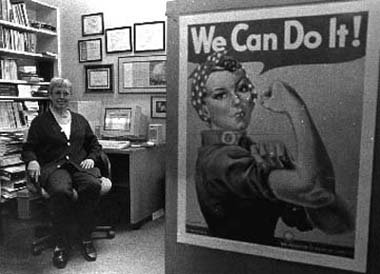
Carol O'Connor, in her USU office, has taught 20th century and U.S. Western history since 1977. The "We Can Do It!' poster is a government-sponsored image of women workers in World War II. / Photo by Satoru Koyabu.
Carol O'Connor, a professor of 20th century United States history at Utah State University, stands in front of her class wearing a look of contemplation. "I'll right, I'll do it," she decides. She strides to the side of the classroom. Slumping her shoulders and shuffling her feet, O'Connor sluggishly moves across the floor. Her suddenly cold hands reach for a newspaper. Coughing twice, she unfolds and shakes out the newspaper. Then, hoisting herself unto the table, O'Connor spreads the newspaper across herself as she lies down to sleep. "And that, is a Hoover blanket." The class erupted in laughter. Herbert Hoover, U.S. president from 1929 to 1933, refused to give handouts to the American people during the Great Depression. O'Connor continues, "Hoover's name became synonymous with the American people suffering during the Great Depression." The students file the demonstration into their brains inter-connected with the knowledge of what people thought of Herbert Hoover. Professor O'Connor loves to teach and learn about United States history. With loose, comfortable clothes, wire-rimmed glasses and boy-short hair, O'Connor prepares for her classes with pages of notes, overheads, demonstrations and the occasional video, excited to impart her knowledge and mingle it with student comments. In placing the class into discussion groups, she will hover over each student circle. Then with a suppressed smile, O'Connor will sneak in among the students and silently observe the proceedings, ever willing to answer questions and redirect the conversations back toward history. "She's down-to-earth, fun and not boring," said student Melissa Hurst. "She will take the [history] and relate it to us." Born in Chicago on Valentine's Day and raised in New York, O'Connor would classify herself as a Midwesterner. She enjoys visiting New York City, but feels her personality does not reflect the aggressive, loud and domineering personalities easily found there. When O'Connor was little, she dreamed of dancing ballet. Her mother enrolled her in ballet lessons at the age of 3. When she was 4, her family moved to New York. Regretting starting her daughter so early in ballet, O'Connor's mother told the young girl that they didn't have ballet in New York. But when O'Connor met a neighbor girl named Nancy, she was thrilled, for Nancy had dancing lessons. O'Connor took Nancy home and excitedly told her mother that there were dancing lessons in New York. "I
pledged allegiance to one nation Her dancing lessons continued until a knee injury at age 16. O'Connor first recalled becoming excited about history when she was 3. Her family took a boat across Baltimore Harbor to see Fort McHenry, and although she was afraid she would fall into the ocean, she loved the historical experience. She also remembers watching a television show of the late '40s called You Are There, which transported the viewer to various points of time, re-enacting historical moments such as the burning of Joan of Arc. Along with her brother and father, O'Connor would sit engrossed in front of the TV each Sunday night as You Are There took her on historical adventures. As she grew up, O'Connor explains that she lived in quite a sheltered atmosphere comparable to the television show, Leave It to Beaver. The problems of the world, including fights for rights in the South, seemed far away to O'Connor. "My town included a rich mix of Catholics, Jews and all sorts of Protestants, but rarely did I see a non-white face unless I counted the black women who slipped into town to clean houses and the black men who showed up to mow lawns. My parents didn't have to tell me: these people didn't 'belong' in my town," she said. With her interest in history fixed, O'Connor jumped into her higher education pursuits at Manhattanville College of the Sacred Heart after only three years of high school. At this Catholic institution, O'Connor experienced a shift in beliefs. At college, O'Connor would learn that there were many different people and ideologies to be found if one would open their eyes. "In the early 1960s, I pledged allegiance to one nation under God, indivisible. I went to church every Sunday, and even in between. I believed almost everything everyone expected me to believe. And then I went to college," said O'Connor. President Kennedy's assassination, racial relations and exposures to different religions and ideas at Manhattanville "broadened my point of view," said O'Connor. Ten weeks into her college career, President Kennedy was killed. This event shocked the nation, but the teachers of Manhattanville decided to use it as a tool for enlightenment. One teacher, David Dilworth taught O'Connor to not blame the South for the president's death. The college she attended was just as class-and-race segregated as the South, he said. The college supported these ideas and invited a speaker named William Sloane Coffin who presented the idea of Caroline Kennedy and Martin Luther King III getting married. Coffin explained that the families might object because of religious differences, but that there was no moral ground for objecting based upon race. O'Connor also began questioning her religious beliefs. Before attending college, O'Connor explains that she was "thoroughly immersed in Catholic practice and dogma," she said. Various classes, religion, philosophy, political science, literature, biology and history, and an Italian film depicting endlessly drunken people and partying titled La Dolce Vita, all caused disturbing questions that left O'Connor's "faith in the value of life profoundly shattered. "It took years to rebuild," she said. After exploring other ideas and texts, she tried to "piece together the meaning of the choices I make everyday, choices that I hope are decent, honest, and fair," she said. O'Connor graduated from Manhattanville College with her bachelor's degree in history in 1967. After weighing different options and opinions, O'Connor proceeded to Yale University to begin her post-graduate work. In 1967, O'Connor entered Yale University to tackle her master's and doctorate degrees. She received her master's degree in 1970 and her Ph.D. in 1976. Her dissertation was titled Scarsdale, 1891-1933: The Rise of a Wealthy Suburb. During her time at Yale, she met Clyde Milner, II who was studying American Studies. It wouldn't be until 1976, at a Newberry Library Summer Institute cocktail party, that they would become reacquainted. Milner remembers looking across the room and seeing O'Connor's "bright blue eyes." "She looked really good," he said. They set a date to go to lunch at a restaurant called the Waterfront, where Milner laughingly recalled "everyone there but us was gay." Two weeks later, they agreed to become engaged. On Aug. 14, 1977, they were married. At the time, O'Connor was teaching at Knox College in Illinois as the first woman history teacher and loving it. Milner had been given a job at USU and so O'Connor decided to make the painful break with Knox College and follow her husband. She hasn't regretted it as she enjoys teaching at USU and says it is a "good place to raise our kids." Catherine was born in 1982, and Charles was born in 1987. "We support and appreciate each other whether it be taking care of domestic things like the kids, dogs or cars and we also respect each other's work and responsibilities," said Milner. Being private-schooled her entire life and even teaching at a private school before her years in Logan, O'Connor came to public agricultural-based USU to find that it was "quite a different experience." When she began in 1977, USU had a flexible open admission policy. This array of students and teachers taught O'Connor a lesson in attitude. "I wound up learning there were fantastic teachers who went to colleges that were not even on my radar map because of the poor recognition of the validity of their programs. There were wonderful students, some holding two jobs, with two kids, and going to school and were incredibly dedicated," she said. O'Connor began at USU as an assistant professor and worked her way up to full professor in 1986. She has received such honors as Advisor of the Year for 1998-99, Phi Theta Pi Teacher of the Year for 1996-7, Departmental Teacher of the Year for 1996-97 and her favorite distinction, she was the first pregnant full professor. "And after twenty-plus years of teaching at Utah State, Clyde and I are more impressed than ever with the quality of its students and faculty," she said. O'Connor also used her dissertation to write a book, A Sort of Utopia: Scarsdale, 1891-1981. She also co-edited a history text, The Oxford History of the American West. She is currently working with her husband on a biography of Granville Stuart, a pioneer who helped settle Montana. One of her greatest achievements was the opportunity to present the 24th Annual Last Lecture in April 1999. She is the first woman to give this speech and was chosen by the Associated Students of USU and the Honors Program students. Titled "Freedom Crashed Down on Me," O'Connor shared her experiences in college and how they changed her ideas and beliefs and inspired her to try and broaden her students' minds. "I don't think Carol O'Connor gets enough recognition for all that she contributes to students, faculty, and USU. She never takes students, the university, or the American education system for granted," said Anne Butler, a fellow history professor. "She is a remarkably good human being. She is sensitive, cares and has real strength of character," said Milner. O'Connor helps raise two kids, writes books, studies history, teaches students to love the past and was the first woman to give USU's Last Lecture. While looking back upon her achievements, she said, "I have been so
lucky during my entire profession to fulfill my ambitions." |
Archived Months:
September
1998 |
||