|
||||


 |
'What do you think?' Military history professor wants students to construct answers, not cram and spew
By Casey Hobson
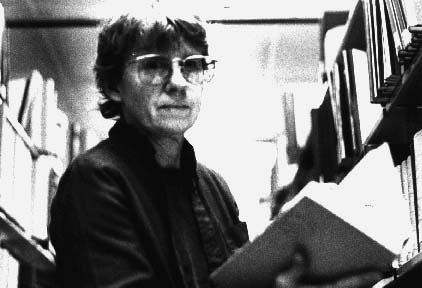
Denise Conover, who teaches about the history of combat and warfare, browses in the military section of the Merrill Library Reserves at USU. Connections to military history run in her family -- her father served in World War II, and her grandfather was a Civil War buff. / Photo by Cameron Bailey Editor's note: This story was produced for the USU mass communication class "Beyond the Inverted Pyramid," COMM 3110. It is one of a series on USU professors who are experts in their field, or world-class creators or performers.
Denise Conover scampered back and forth between the overhead projector and the VCR, swapping transparencies and videocassettes while throwing out tidbits about the United States' involvement in World War II. Her mannerisms were like those of chef Julia Child, who educates anyone who will listen on how to properly prepare and serve Alaskan lobster for dinner guests from China. Conover let the video clip run for 10 minutes, then, metaphorically, pulled it out of the oven. She paused briefly enough to explain what was happening, as Child would explain what ingredients she's using and why Italian seasoning is different from seasoning de Italia. She throws a new tape in the oven and lets it cook for five minutes, after which she stops it and lets it cool as she throws another transparency on the overhead projector. At first glance, Conover's teaching methods might look like something of a juggling act, as she bounces from visual aid to visual aid. However, there's method to her madness. She's been teaching history since 1978, when she graduated from Washington State University with a Ph.D. in American diplomatic history. She's been at Utah State University since January 1991. "So,
what do you think? Throughout the first 11 years of her career, Conover followed the stereotypical methods of college professors. She gave big reading assignments, big writing assignments and big exams. "Let's see how hard and difficult of tests I can give," Conover said of her initial approach to teaching. "Let's see how much I can cram down their throats." That philosophy changed when she went back to graduate school at Southern Connecticut University in New Haven, Conn., in 1990 to get her master's degree in library science. She said she realized that education isn't about testing, but retention, and sometimes the best way to retain something is to not have to worry about passing major exams. "I had a professor that said a student will only take that which is significant to them," Conover said. "They only study what they think you'll ask." This is the method behind the madness. Conover stops the video and turns the lights back on. She stands at the front of the class, engulfed by the white cinderblock walls and faded, forest-green chalkboards. This is the point when most professors would begin some long, monotonous spiel about heaven-only-knows what, and students normally begin to mindlessly scratch down all the notes they can, as though their very lives depended on filling 135 pages of loose leaf notebook paper with details on the reproductive patterns of the African jungle flea. Conover, however, takes a different path. She opens the floor for discussion. "So, what do you think?" she asks her class of nearly 40 students. "Was Truman justified in dropping the Bomb?" A student in the corner peers out from underneath his white USU ballcap and speaks his mind, triggering another cluster of raised hands. Conover pushes her glasses back on her nose and begins to take questions like an auctioneer. This wasn't her class; it belonged to the students. Conover was the expert tour guide -- along for the ride only to make sure the tourists didn't overstep their limitations. "They don't stress at what will be on the test," Conover said. "They just enjoy it for what it is. They're all saying they learn more and retain more." Why don't Conover's students stress out over the tests? Well, for starters, there aren't any. If most students cram for a test the night before they take it, then forget the information the next day, how beneficial are the exams? Especially if the students are only studying what they think will be asked, skipping all the other relevant information. "That's a cheap A," Conover said of students who cram. "I don't think they're really learning. They just know how to play the game." Instead of major exams, Conover uses writing assignments to stimulate class participation. Students are asked to complete reading assignments and turn in one to two page responses on what they've read and whether or not they agree or disagree with the choices of history's playmakers. "So far, it seems to have been valuable," she said. "Each class has its own chemistry and demands, but I always try and check (to see how they respond). "Overall, it's been rewarding, and I guess that's why I keep doing it. I've had several (students) come up to me and say, 'You've changed my attitude on history.'" And after 21 years, Conover says the end is nowhere in sight. She plans on teaching as long as she can, knowing that so long as she's teaching, she's learning. "I have no plans to stop," she said. "(I'll teach) till I drop dead,
or until they decide they don't want me to teach anymore. I can't imagine
not teaching in some form or fashion."
|
Archived Months:
September
1998 |
||