|
||||


 |
Hard to satisfy everybody with road construction in Logan Canyon
By Kathryn Summers
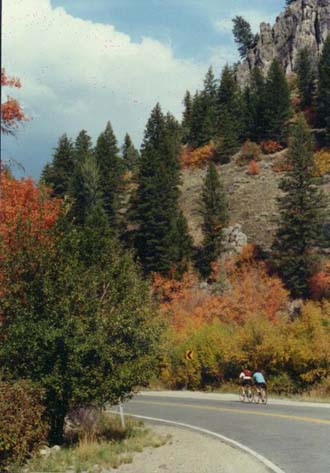
"Safety is the major driving force behind highway [construction]," says Todd Weston, who was a state highway commissioner for 12 years. Bikers on the narrow road can make commuting from Bear Lake to Logan risky for drivers in cars and trucks. / Photo by Nancy Williams Editor's note: This story was produced for the USU mass communication class "Beyond the Inverted Pyramid," COMM 3110. Road construction in Logan Canyon is a hot topic and opinions are strong. "Damned environmentalists," fumed Elwin Allred. "Use them for a fill in the low spots," he suggested with the laugh. Allred, a conservative activist who started a group called the Logan Canyon Improvement Group in April 1997, is for construction, and against anyone who disagrees. He said the Utah Department of Transportation could have finished the road from Logan to Garden City for $1.5 million, if not for the environmentalist groups. "All they do is keep increasing the cost," he said. People who drive U.S. 89 through the canyon, some of them tourists or people who live in Garden City and work in Logan, spend millions of dollars on travel costs and they deserve better roads, said Allred. "Safety is the major driving force behind highway [construction]," said Todd Weston, who was a state highway commissioner for 12 years. He's retired now, but still keeps up on the canyon issues. Weston said construction in the canyon to fix the road started in 1963 and has been on and off ever since. The main concern on the Garden City side is widening the road. The road is basically finished from Logan to Beaver Creek. A few more passing lanes are needed, but the deep part of the canyon will be left pretty much untouched, Weston said. Mike "Big Mike" Thevenin, who commutes from Lake Town through the canyon to Logan for work, agrees that more passing lanes are needed. He said a majority of the crashes he sees in the canyon are single-vehicle accidents caused by drivers trying to avoid on-coming traffic on the narrow, winding road. The highway was originally built in the 1930s and cars were narrower then, he said. Once when he was driving his pickup truck, he passed another pickup on a narrow bridge and they "smacked mirrors." That was better than hitting fenders, he said, but the experience proved to him the road needs to be wider. Smacking mirrors on a narrow bridge was better than a head-on crash. For Thevenin, the scariest thing about the canyon is the students who go running and riding along the road. There's no place for foot traffic, he said. "In the winter, the highway department keeps the canyon really clean of snow," said Thevenin. In fact, he said it's more difficult to drive the canyon in the summer than winter because of all the slow-traveling sightseers. Two organized groups are concerned about the environmental impacts of construction on the Logan Canyon and the Logan River that runs through it. One group, Citizens for the Protection of Logan Canyon, was formed shortly after construction started in the '60s. Kathy Gilbert, the current president, said the construction on the lower seven miles of the canyon destroyed a fishery. The road and river were straightened out, which made the water run too quickly for the fish. The citizens group formed to protect the canyon and make sure the Utah Department of Transportation followed environmentally sound procedures in the future construction in the canyon. Since UDOT gets federal money for construction, the Citizens for Protection wanted to make sure the money was used wisely. Gilbert said the citizens group protested and talked to UDOT about the road, passing lanes and width of the bridges. UDOT was very "receptive to input," and made "many concessions," she said. The citizens group took the conservative approach to construction. Members agreed bridges needed to be fixed, but their main priority was to protect the river. "Let's get the best improvement we can," Gilbert said. "Not wide and straight." The goal of Citizens for Protection is to keep the canyon as beautiful as possible. She said the new bridges are "pretty good," but the stone work on the old bridges was more aesthetically pleasing. "So far, so good," she said of all the improvements. Relations between Citizens for Protection and UDOT are pretty friendly. Not so with a splinter group of CPLC called the Logan Canyon Coalition, the second group concerned about the environment. The Logan Canyon Coalition was founded in 1995 by some members of the original the citizens group. The coalition is considered by some people to be the more radical of the two conservation groups, said L.J. Western, who works at the Logan Ranger District Visitor Center. "I don't think we're radical at all," said Kevin Kobe, a co-founder of the coalition. "We're tying to protect the canyon. I think we've done a pretty good job." Retired Transportation Commissioner Weston said he thinks LCC would rather stop construction than help. The coalition has made the work slow and expensive, and it's going to be a long time before "anything of consequence is done," he said, because the coalition fights almost everything UDOT tries to do. "We're not opposed to construction in the Logan Canyon," Kobe said in response. "Most people know that if they've followed the issues." He said LCC is opposed to special interest groups, people who want to "tow their toys up the canyon," and the big money spent on the construction. The transportation department will "cut corners based on what watchdogs are out there," Kobe said. "Taxpayers deserve every possible safeguard." Logan Canyon Coalition is there to make sure UDOT follows the laws, which costs the department more money, and that contributes to animosity, said Kobe. There are environmental groups whose main concern is protecting the canyon. Then there are people whose main concern is the safety of the people driving through the canyon. Stephen Bodily of Lewiston is one of seven transportation commissioners in Utah. He has jurisdiction over Cache, Box Elder and Rich counties. The job of the transportation commissioners, who are appointed by the governor, is to rank building projects according to priority. When UDOT feels a need for improvement on a section of road, it brings it to the commission. "There are a lot more projects than money," said Bodily. "[We] decide when a project is to be built then leave it up to the engineers." Over the last few years, Bodily said, the commission has looked at Logan Canyon to determine general needs. The commission had an Environmental Impact Study done by BIO/WEST Inc. of Logan, which was approved by the Federal Highway Administration on Feb. 24, 1993. Weston said the study cost $1 million, the highest price in the state, costing more that a similar study for Interstate 15 through Salt Lake City. After the Environmental Impact Study was completed, the transportation commission brought all the environmental groups together to discuss the different proposals. Everyone finally agreed on a course of action. Then the Logan Canyon Coalition broke off and started to fight again, said Bodily. "Damned environmentalists. Use them for a fill in the low spots." "When you think you've reached an agreement and a splinter group doesn't want to talk," it gets frustrating, Bodily said. Since UDOT and LCC don't agree on much, things move slowly. In Logan Canyon the most critical thing has been to rebuild the bridges. Bodily said they were about 70 years old. Two bridges have been rebuilt in the first 15 miles of the canyon -- Lower Twin Bridge and Burnt Bridge. The concrete was breaking away, leaving bare reinforcing steel sticking up along the side. They were in pretty bad shape, he said. The new bridges are solid-looking. The cement still looks new and bright, which contrasts with the guard rails. When the new bridges were put in, UDOT had to comply with a special construction provision. The guard rails weren't made of the usual galvanized steel, but were rusty looking. Environmentalists thought the shiny metal would detract from the canyon, so they wanted something a little more "rust-ic," said Bodily. In the current phase of construction, one more major bridge, Upper Twin Bridge, will be rebuilt, a turnoff at Franklin Basin will be added, and a smaller bridge at Red Banks will be built. Right now they are still in the design stages, Bodily said. For the fiscal year 2000, $8.5 million of federal money has been allocated for construction between Tony Grove and Franklin Basin, said Bodily. He anticipates the highway commission will take bids on the current phase in the spring. After this phase is completed, the next phase, scheduled for fiscal year 2002, will be to start engineering and redesigning the highway from the summit to Garden City, Bodily said. Until the 1990s nothing had been done on U.S. 89 since the 1970s except improvements on the pavement. Twenty-five years ago the road was rebuilt through the lower canyon to Right Hand Fork. The current phases have been and will be focused on the road from Right Hand Fork to Garden City. Bodily predicted it will take at least 15 years for all the agreed-upon projects to be completed. U.S. 89 is rare because of its position, Bodily said. "It stirs up some controversy -- and it's been a struggle to satisfy all the different groups." The Logan Canyon Highway was designated as a Scenic Byway by Utah in 1988. Because of this designation, UDOT has some "pretty tight restrictions on how to design and built it," Bodily said. One rule is that during construction barriers have to be put up so workers and equipment stay a certain distance away from the river. In Provo Canyon, for example, the barriers were accidentally put 3 feet closer to the river than they should have been. An environmentalist group filed a complaint and it cost the contractors several thousand dollars in fines, said Bodily. "The river is the most sensitive part of the [Logan Canyon] project," Bodily said. When the two bridges were replaced, constructin workers had to tear down the old bridges so pieces didn't fall into the river. The rules protect wetlands and add tremendous cost to construction, Bodily said. Another concern is that Maguire's primrose, found only in Logan Canyon, has been listed as an endangered species. This leads to restrictions on how wide the road can be so it doesn't disturb the plant's habitat. Rules also restrict cuts in mountainsides and how much soil can be taken from each cut. The controversy surrounding construction in Logan Canyon isn't likely
to go away, but the road does have to be maintained. As long as the
Utah Department of Transportation continues to work on the road through
the canyon, the Logan Canyon Coalition, Citizens for the Protection
of Logan Canyon, and other northern Utah residents will do everything
they can to make sure UDOT preserves the wild natural beauty of the
canyon. |
Archived Months:
September
1998 |
||