|
||||


 |
Can Logan have its cake and eat it too? Balance of a river and a highway is at issue
By Emily Jensen
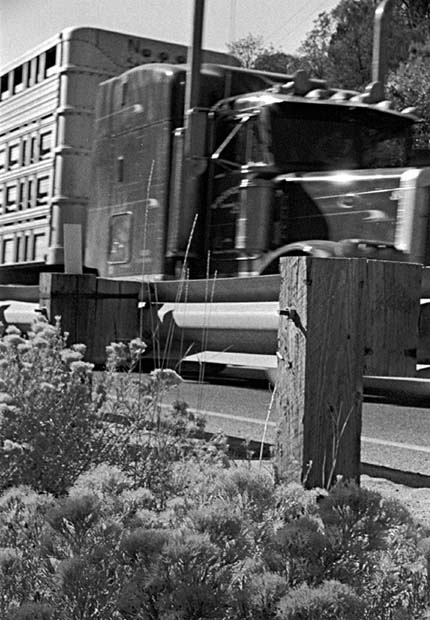
U.S. 89 in Logan Canyon carries lots of traffic daily. The highway is the center of debate between the Logan Canyon Coalition and the Utah Transportation Commission. / Photo by Zak Larsen Editor's note: This story was produced for the USU mass communication class "Beyond the Inverted Pyramid," COMM 3110. It is fall in Logan Canyon and all around the leaves are on the verge of turning colors. If you stop the car on the side of U.S. Highway 89, you can feel a brisk breeze ruffling the hair on the nape of your neck. When you tune an ear, you can hear the Logan River splashing across the rocks and sloshing up the sides of the canyon. The river is flowing on, as it always has, while a fight is waged over the very road beneath the wheels of the parked car. Earlier this year, a U.S. Forest Service study endorsed making the Logan River eligible for designation, under the Wild and Scenic Rivers Act, to have protection of the river's scenic traits. But a group called the Logan Canyon Coalition is afraid that the proposed U.S. 89 highway improvements will jeopordize the Logan River's chance of passing the upcoming final study and gaining the Wild and Scenic Rivers status. And on Sept. 16, the Utah Transportation Commission agreed unanimously to a resolution that opposes any attempt to give the designation of a Wild and Scenic River and its tributaries. The coalition With its motto proclaiming "Working for the Protection of Logan Canyon" the Logan Canyon Coalition was formed in 1994 as "a grass-roots citizens organization dedicated to protecting Logan Canyon and Logan River. The LCC is concerned with highway construction in the canyon, and with other issues such as grazing and commercial development in the canyon," said Gordon Steinhoff, LCC member and associate professor of the Utah State University's language and philosophy department. The LCC tried and failed in 1995 to appeal to the U.S. Forest Service over the Utah Department of Transportation's modified plans for U.S. 89 through Logan Canyon. Yet the coalition fights on. The LCC responded to the Transportation Commission's Sept. 16 decision with a press release calling the resolution an "act of desperation born out of ignorance of wild and scenic legislation." The legislation So what is the legislation concerning the Wild and Scenic Rivers Act? Passed in 1968, the Wild and Scenic Rivers Act declares "that certain selected rivers of the Nation, which, with their immediate environments, possess outstandingly remarkable scenic, recreational, geologic, fish and wildlife, historic, cultural, or other similar values, shall be preserved in free-flowing condition and that they and their immediate environments shall be protected for the benefit and enjoyment of present and future generations." The eligibility Logan River was recognized in this first eligibility study for its scenic qualities and the Bonneville cutthroat trout. Steinhoff explained that the Bonneville cutthroat is a rare species designated as an U.S. Forest Service "sensitive" species, meaning that the fish and its habitat are of special concern to the Forest Service. In this first eligibility study, the U.S. Forest Service wrote that the population of Bonneville cutthroat in the Logan River is essential to the species' long-term survival. The Logan River was also said to have recreation, geological, hydrological and ecological values. The river has a long way to go before gaining wild and scenic status. But the Logan River is now supposed to be protected as if it had the federal designation until the final study can be performed. And under the Wild and Scenic Rivers Act, no road building is allowed that changes river or the surrounding habitat. The resolution The Transportation Commission agrees that the Logan River meets the technical requirements for designation under the Wild and Scenic Rivers Act, but believes if the designation is authorized by Congress, the additional time and money used in a final study will only confirm the highway design parameters that the commission has already established. The Transportation Commission's resolution explains that UDOT "has protected the outstandingly remarkable values of the Logan River and tributaries in the design and construction of the current improvements to U.S. 89 without additional guidance or legislation of the Wild and Scenic Rivers Act." UDOT's proposed highway modifications include widening sections and installing turnabouts on U.S. 89 between Right Hand Fork and Garden City. The confusion The Transportation Commission's resolution is not considered permanent, just a recommendation. Melissa Blackwell, assessment and planning facilitator for the Wasatch- Cache National Forest, said there is a lot of misunderstanding about what will be required once a river is designated as wild and scenic. She explained that the proposed Forest Service plan revisions would include standards for Wild and Scenic River's classifications. The designation does not the same level of protection as that declaration of a national park and does not lock up a river or halt its development or use. The Wild and Scenic River Act's goal is to preserve the character of a river, and the Transportation Commission said the highway improvements would protect the river. The fear But the LCC asserts that certain parts of the modified U.S. 89 parallel to the river may hurt the river's chances of gaining the wild and scenic designation. Former LCC president Dan Miller argues that if what the Transportation Commission said was true, then "why are they afraid of national designation? Obviously they haven't gone far enough." The LCC explains that the importance of the designation is the river serves thousands of people who explore Logan Canyon each year: hiking, fishing, camping, picnicking and enjoying many other outdoor activities. Without the protection of the Wild and Scenic Rivers Act, the coalition believes that all of the things that make Logan Canyon beautiful will be lost over time. "The river must now be managed as a Wild and Scenic River," Miller said, "until the time comes that the river passes the suitability study." The arguments Members of the LCC attend the monthly UDOT advisory team meetings and although not official team members, these representatives may ask questions. "I am in favor of highway construction," said Steinhoff. "But I can tell you that what they're planning now is not consistent with the Wild and Scenic River designation." Steinhoff went on to explain that places in the canyon are "tremendously sensitive." For example, he said that the highway improvement proposals for around Middle Canyon near Temple Fork need to be scaled back. "It is gorgeous up there," said Steinhoff, referring to the limestone cliffs, "and one of the most sensitive areas in the canyon. UDOT needs to cut back on what they are planning." Commissioner Stephen Bodily said that most people he had talked to were opposed to anything that would stand in the way of the planned road construction. Richard Williams, a team leader on the eligibility study, said that a wild and scenic designation would not stop the U.S. 89 development project. "Unless there's an earthquake or volcano, there's no way this federal highway is going to be shut down," Williams said. "If the people in Cache Valley and surrounding areas knew exactly what UDOT's planning, how straight and how wide the highway modifications proposed are, more would be upset and ask for cut backs," said Steinhoff. MIller added, "The Logan River was there long before the current highway and will hopefully be there long after the new road is torn up and re-paved five times over." Bodily's view is succinct: "We've reached an agreement on Logan Canyon. We don't want any more roadblocks." The decision The final decision regarding the Logan River receiving protection under the Wild and Scenic Rivers Act cannot be reached yet, for the Forest Service is not currently staffed to conduct the study, officials said. Steinhoff said the final study would not take place for at least a year. Then, after the study, the river designation requires congressional approval, which can take additional years. The Logan Herald Journal reported that the only way this process would speed up is if community members urged their leaders to contact Utah's congressional delegation about the study. Utah is known for unique natural arches, towering mountains, miles of national forest and even a Great Salt Lake. But, along with Nevada, Utah is one of two Western states, not known for a Wild and Scenic River. The highway developments will continue to go forward, but the Logan Canyon Coalition hopes to change this as it follows its motto in protecting Logan Canyon. "We must recognize what the river gave our forebears, what it has
given us and what it will give our children's children," said Miller
in a letter asking for community support of the Logan River gaining
Wild and Scenic designation. "We must give something back in the form
of permanent recognition and protection."
|
Archived Months:
September
1998 |
||