Twin
Towers memorial needs 'great vacancies' to reflect losses,
winning designer says
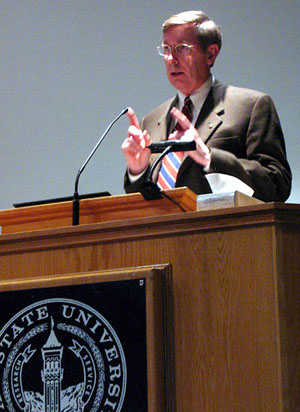 |
Utah State University
President Kermit Hall addresses the Tanner Symposium
Wednesday. / Photo by Josh Russell |
By Loni Stapley
November 8, 2004 | Peter Walker, the
landscape architect working on the new World Trade Center
Memorial, spoke Wednesday at the Eccles Conference Center
as a part of the Tanner Symposium put on by the College
of Humanities, Arts and Social Sciences at Utah State
University.
Walker, 72, graduated from the University of California
at Berkeley and the Harvard School of Design. His career
has spanned four decades and taken him from the United
States to Japan, Australia and China, designing landscapes
for everything from small gardens to new cities and
academic campuses. He was awarded the American Society
of Landscape Architects Medal in Salt Lake City two
days before speaking in Logan.
Walker's lecture, "Preparation for the World Trade
Center Memorial," chronicled his background as
a landscape architect and the things that have influenced
him as a designer and led to his design for the Memorial.
"I can't imagine attempting this with any
less experience than I have," Walker said.
Walker's career began in the 1960s, his first project
being at Foothill College. He was only 23 years old
when he and his partners won an award for their design
at the college. Walker said his first success gave him
confidence, but didn't guarantee further accolades for
his work.
"Our egos were pretty pumped up," he said.
"I didn't win another award for 10 years."
After 20 years of architecture, Walker said he began
to have a problem with what they were doing and the
types of materials they were using. He began collecting
and enjoying minimalist art (basically art made in landscape)
by artists such as Carl Andre. He couldn't quite figure
out how to relate what he saw in this type of art to
landscape architecture, but was struck with how particular
images created by these artists had the ability to stick
in one's memory.
"I hadn't done any landscape up to that
point that was that powerful," he said.
Walker left his practice and took a job teaching at
Harvard, wanting to be closer to these minimalist artists
and "think through what I was doing."
He and his students traveled extensively to different
sites where famous ancient gardens were located and
a light bulb went off in Walker's mind, allowing
him to see how he could create gardens in a different
way.
"The strength of the gardens really affected
me," he said.
Walker used inspiration from these ancient gardens
to change his designs. He began noticing how shadow
and the sun changed landscape and incorporated that
into his creations, gradually becoming more sophisticated
with the way he utilized natural materials to make his
designs richer and more beautiful.
The key idea of the World Trade Center Memorial is
to have "great vacancies" representing the
absence of the buildings as well as the absence of the
people who died in the attacks on the World Trade Center.
Walker said the design process for the memorial was
extensive and included meeting with survivors as well
as family members of those killed to get an idea of
what they wanted the memorial to be like.
"When you see that hole and you talk to the families,
it is very emotional," Walker said.
For that reason, he wanted his design to be meaningful
and powerful. Walker used lots of trees as a symbol
for life.
"I want the trees, the living part itself, to
be something that you focus on," he said.
The memorial, "Reflecting Absence," essentially
has two different "worlds" – one representing
death and one representing life. According to the official
statement written by Walker and Michael Arad, the architect
of the site, the memorial is inside a field of trees
interrupted by two large holes containing recessed pools.
The pools, Walker said, are fountains cut down into
the landscape to serve as waterfalls. Bordering each
pool are ramps that take visitors down to the actual
memorial spaces, where the names of those who died in
the World Trade Center attacks both in 1993 and 2001
will be arranged on plaques. Traveling from one world
to the other will hopefully give visitors the ability
to move past the terrorist attacks and heal.
"You leave the world of life and go down and face
death," Walker said. "That process gives you
a boon, that you can go back up to life."
Nine months into the project, Walker said he anticipates
physical and technical complications to arise, but feels
they will be relatively easy to solve. It's the "spiritual
problems" he spends most of his time thinking about.
"It isn't the story that's in my head, it isn't
the sequence that I know about which is important,"
Walker said. "It's the sequence and the story that
someone [who] comes there [has], that knows about the
awful experience but doesn't have this redeeming quality
. . . of going to the depths and then coming back up
to the life again. That's what's important. That's what
I spend most of my time thinking about."
MS
MS
|


