|
By Jennifer Despain
September 13, 2006 | In Cusco, Peru an old Quechua
woman sits on courtyard steps knitting her family's
livelihood into a floppy winter hat.
Surrounding her is an array of sweaters, gloves
and tourists. Nearby a child dressed in traditional
Quechua garb leads an alpaca down a cobblestone
street as his sister greets passers-by with an
opportunity to take a photo or buy a finger puppet;
each for "un sol" (30 U.S. cents).
Thousands of miles away a couple waits as young
male alpaca is placed in a stall with his female
counterpart. Over the next two weeks the two alpaca
will mate, trying day after day until the process
is complete. The specifics surrounding this conception
will ultimately lead to a healthy, expensive baby
-- a baby that will provide the couple's income.
Alpaca. The word seems to conjure all sorts
of images for different people: a cheesy sweater
brought back from someone's vacation down South;
those funny looking animals chillin' in fields
like rastafarians; that crazy character Kuzco
from The Emperor's New Groove -- oh wait,
that's a llama...
For the majority of people, alpacas will only
hold to these images, but for families in both
North and South America they help pay the bills.
Off the shores of Lake Titicaca on Amantani Island
in southeast Peru, Estiban Calsin leads a tourist
couple up the hill to his home. A three-hour boat
ride away from the mainland has made earning a
living on the island difficult. For families like
the Calsins, hosting tourists brings in vital
money.
Typically the Amantani islanders only get a
fraction of what the tourist pays to stay there.
So, Estiban and his family make the bulk of their
profit primarily by selling hand-knit alpaca products
to their guests.
At 4 on a Saturday afternoon, Debbie and Steve
Jesse speak about raising alpaca to a group of
people gathered at their ranch in Manhattan, Mont.
The Jesses began breeding alpaca as a retirement
business. While families in South America earn
money from alpaca by selling the meat and fiber,
the Jesses make their money by breeding high-quality
alpaca that will then be sold to other breeders
for a pretty price tag.
Whether it's a $3 hat or a $15,000 baby, alpaca
have more to offer than what meets the eye. No
matter what the circumstances, alpaca fiber, photos,
meat and babies sustain the lifestyles of people
from Peru to Montana. |
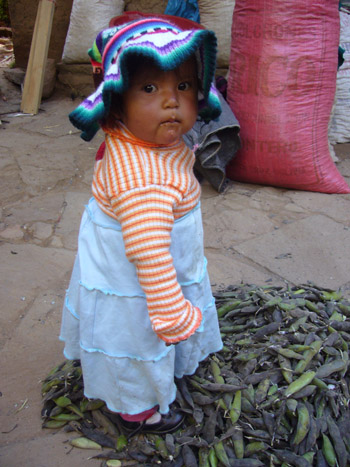
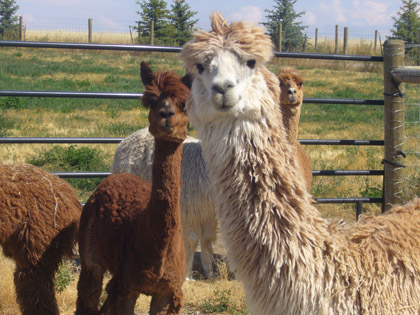
AN ALPACA STORY:
Julie Calsin of Amantani Island, above,
wears alpaca knit hats for warmth in the high
altitude.
Below, alpaca at home in Manhattan, Mont.
|


