|
Text and
photos by Shauna Leavitt
September 8, 2005 | If life is
getting too worrisome and you're starting to feel
like a potato taking root in front of the computer,
a visit to Yellowstone National Park might be
just what you need.
Recreation and relaxation are abundant, while
functioning cell phones, Internet access and televisions
are scarce.
"It's nice not to have my husband's cell
phone ringing or a television on. It's quite refreshing,"
said Janet Barker of Sandy, Utah.
If your home is Logan, the picturesque scenery
begins as soon as your vehicle heads into the
Bear River Mountains stretching down the east
side of Cache Valley.
The 250-mile drive from Yellowstone Park to Logan
will take the average driver five hours. Curving
mountain roads make up most of the trip.
"It is beautiful up here -- so majestic,"
said April Barker of Logan.
Yellowstone Park was established
in 1872 to protect the regions distinct environment.
There are more than 10,000 thermal formations
in the park including geysers, mudpots, hotsprings
and steam vents.
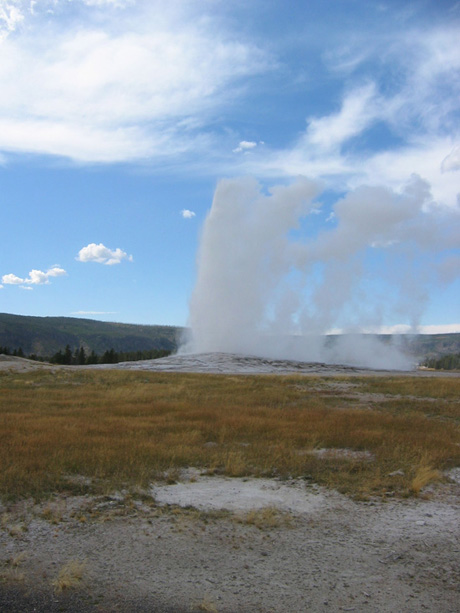
Old Faithful is the world's most famous geyser.
It shoots 3,700 to 8,400 gallons of water about
130 feet into the air every 90 minutes. The water
registers at 204 degrees Fahrenheit before eruption.
"It's pretty amazing how all this works,"
said 11-year old Will Barker of Sandy, Utah .
The National Park Service's mission is, "to
preserve [ Yellowstone Park ] . . . for the enjoyment,
education and inspiration of this and future generations."
Yellowstone stretches over two million acres
of wilderness.
The park is open to the general public from mid-April
to the Monday after the first Sunday of November.
The
fee for a private vehicle to enter the park ranges
from $10-$20.
To have the best experience, Sandy Barker of Evanston,
Wyo. suggests, "Take more than a one day
to tour the park, and come in the fall when there
is less people."
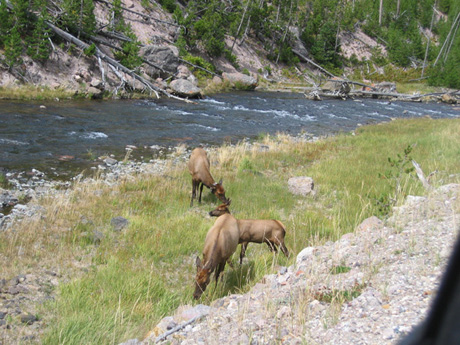
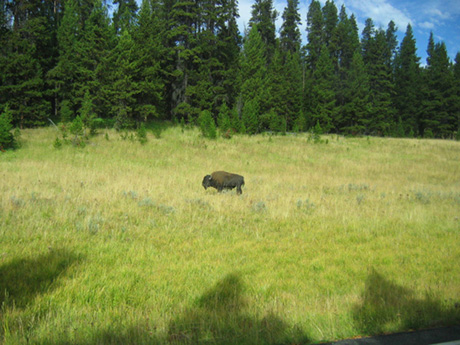
Visitors can count on seeing buffalo and elk.
They may also see coyotes, pelicans, otters, wolves,
birds of prey and possibly a bear. To protect
the public it is now illegal to feed bears so
they no longer gather along the roads.
"I saw a ton of Buffalo ," said 10-year
old Mackenzee Barker of Sandy.
"That was the coolest thing we've seen so
far," said April Barker after watching a
hawk catch a fish.
What should a guest plan to see while there in
Yellowstone Park ? Here are a few suggestions
from Yellowstone Rangers:
"Drive to the Old Faithful area and walk
around the geyser basin; drive to the Canyon area
-- stop at several overlooks and walk along part
of the rim."
"Add Hayden Valley to the above route --
especially at the beginning or end of the day
-- to look for some of the park's large animals."
"Visit lesser-known features such as Artist
Paint Pots south of Norris, Roaring Mountain north
of Norris and Terrace Springs near Madison Junction."
The park has 251 miles of paved roads that form
a figure eight in the center of the park. Almost
1,000 miles of hiking trails cover other areas
of the park. Ninety-seven percent of the park
is wilderness- untouched by facilities or roads.
Road
construction in Yellowstone Park is extensive
since federal funding was received to bring the
roads up to standard for the traffic volume and
weight it supports.
Guests will find plenty of lodging
and camping
in and around the park. For more privacy, Sheri
Anderson from Smithfield, Utah, suggests staying
in the cabins.
"The cabins are out in the middle of nowhere
and they're comfortable," said Jenn Barker.
To plan your get-away, go to the Yellowstone National
Park website at http://www.nps.gov/yell/
"Everyone has such a stressful life, but
when you're in the park life is laid-back,"
said April Barker. |