|
Photos and text by Jerome le Carrou
September 6, 2005 | Heading to Croatia, I was
expecting a country full of contrasts, a geographical
paradise in a land still marked by the tears of
war.
I knew that 10 years ago, it would have been
impossible to drive freely through the countryside
as a terrible war was blowing everything apart.
But I wasn't expecting to find such a beautiful
country, from vast plains to rocky mountains.Croatia
also is the country of islands, more than a thousand
surrounded by crystal-warm water.
I started my trip a Thursday night with two friends.
We drove throughout France, Switzerland, Italy,
Slovenia and finally crossed the Croatian border
after 20 hours spent in the car. During this trip,
we crossed beautiful European cities as Paris,
Bern, Milano, Breccia, Venezia, Trieste.
We arrived late at night in Rabac, a small town
in a peninsula called Istria. We rented an apartment
in the hills facing the seaside and the little
port. We were first surprised when the owner just
let us stay in the room without paying immediately;
she told us we could pay the next day, no credit
card, no ID, she just trusted us.
The night was short as we hit the road again
early morning. It took us two hours to cross the
city of Rijeka. There were so many old cars, mixed
with a desert-dry heat, and the result was clouds
of gas we smelled for too long. When we finally
entered a brand-new highway, the anger left and
we started smiling again. The landscapes we passed
by during that day were amazing -- arid deserts,
flooded lands, green fields. . . .
Our first objective was to cross the country
from north to south, but the highway ended in
Split, which is half of the road. We first thought
we had done most of the road, but we were far
from the South. The city of Dubrovnik was only
200 miles far from Split, but at this point, just
a small road packed with enormous trucks from
Russia, Hungary, Italy, Bosnia. . . .
After leaving the highway we drove through the
deep inside of Croatia, close to the Bosnian border,
where everything is still slowed by a big disorder
named war.
This part of the trip was probably the most interesting
one, even though driving at 40 miles an hour for
couple of hours wasn't that cool.
This whole afternoon was like a travel into the
past, eyes wide-open. It didn't bother us anymore
to drive slowly.
The first towns we crossed all looked the same,
houses completely destroyed, amounts of stones
crushed on the ground, roads full of holes.
In this brown, dusty universe, we saw a lot of
women, all dressed in black, they were staring
at us because of our license plate, we understood
later than the black they were wearing, was for
the husband they had lost during the war.
When crossing the center of these little towns,
there were usually a lot of people sitting outside,
talking, staring at some tourists like us. The
cars parked there were from the '80s -- old Mercedes,
small trucks with three wheels, cars without windows.
The atmosphere was relax but with a bitter taste
that make you realize you are really not home
and have to be careful and respectful.
The advertisement we saw on the big boards in
the middle of the town, were not for your favorite
fast food or supermarket, but rather for some
glorious army general, you could barely see the
face and read the name of the hero, the time had
erased most of the colors.
Even if Croatia's economy is getting better since
the war, because of the huge flow of tourists,
the country is still divided into two parts. A
beautiful and popular coast, and a poor countryside.
We left behind us all the heavy past and felt
like we left a battle field. The war trauma is
not completely over, we understood people were
still not ready for flows of foreigners.
Heading to the coast side, it was a different
story, we still drove into small roads facing
the ocean and the thousands islands, we thought
we enter a different country.
Our goal was to reach Dubrovnik, we arrived there
at night time, found a decent apartment and slept.
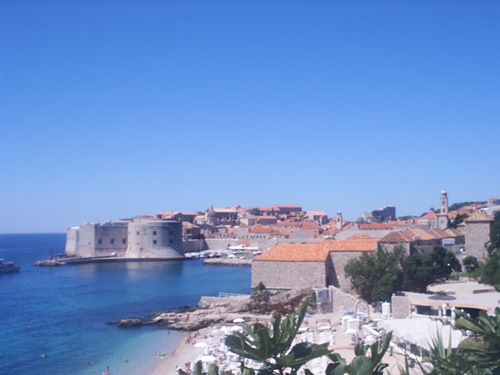
Dubrovnik is one of the most beautiful cities
in Europe. Ten years ago, the inhabitants were
under the fire of the Serbs. To understand how
people live in Dubrovnik, you have to be aware
that hundreds of people under 30 years old gave
their lives for the city. Dubrovnik is not only
a beautiful city, that look like an old castle
surrounded by the ocean and the mountains, but
it's also an economic, cultural, meaningful spot.
We spent a week in Dubrovnik, one night we met
this old person from Bosnia, he was speaking french
and started crying in the pub in front of us,
he told us about all the children and women he
saw dying in front of him, and how he had to kill
people in order to save his life. When you walked
into Dubrovnik , you know everything is loaded
with emotions, the ghosts of the past sometimes
can come back.
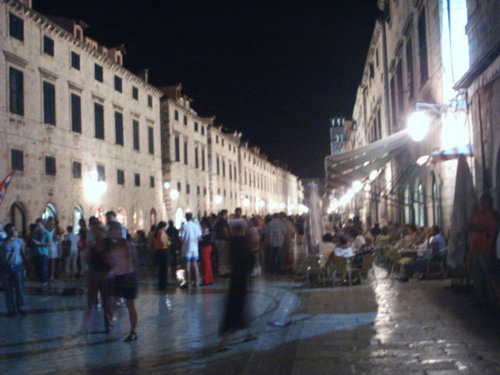
The nightlife in Dubrovnik is a must see, it's
one of the most popular spot, cheap drinks, it's
the place where all the students population from
Italy, France, Russia, Poland, Czech Republic,
Germany, Slovenia mingled. . . .
We haven't been disappointing by all the places
we went to, we even found the best bar we had
ever been to.
We were lost in a Renaissance-style street with
ramparts on both sides; the ground made of clear
white stones was bright enough to guide us in
the dark. On the left side, we saw written on
the wall "cold drinks" with an arrow,
then we saw a little black door. We thought there
was nothing but rocks and water as the ramparts
are on the ocean side. We opened the door and
heard some jazz music: Duke Ellington. As it was
midnight, some candles were the only sources of
lights in this surreal place. Build on the rocks,
we had to step down some stairs to reach it. We
found the paradise, the sound of the waves crushing
against the rocks, jazz music, candles on the
tables and fresh beers.
The food was a pretty bad experience in Dubrovnik
as the city is packed with tourists during the
summer, owners of restaurants know they have two
months to make a lot of money. The prices are
rising, but it's still affordable as you can get
a big pizza for 50 kuna, which is $7. There are
no real food from Croatia besides grilled seafood.
You can eat Italian food such as pizza, risotto,
pasta, but it's not the finest European food you
will find there, it's just tourist food. I don't
even want to count how many times I and my friends
could not even eat a piece of what we ordered.
I was also disappointed by the way people behave.
The people working at the restaurant, shops, bar,
shops are not really friendly, they know we are
tourists and they just try to make money but they
lack politeness. I try to understand why. I may
have had a bad experience, but apparently it happens
to a lot of people.
I understand they had a hard time and they don't
want to be really nice but at the same time, tourism
is helping Croatia to live better days.
This country is still trying to find its place
among Europe, it might become one of the members
soon.
Crushed by the war, Croatians didn't expect they
will have to face the flow of thousands of tourists.
Some parts of the country are ready for it but
not all of them, highway have to be build, electricity
has to be modernize. Croatian have to learn how
to manage the tourist issue and tourists have
to learn how to be patient.
I am glad I had the opportunity to go to Croatia
while it still somehow natural because in a few
years the coast will be packed with new hotels,
housing for tourists, restaurants.
And probably no one would still pay attention
to these old ladies carrying their burden, and
to the old man selling watermelons, but if you
take the time to talk to him, he might pay you
a glass of its home made liquor, a blast in the
middle of the deep countryside.
MS
MS |