|
||||


 |
Cricket made simple (or reasonably so) By
Leon D'souza
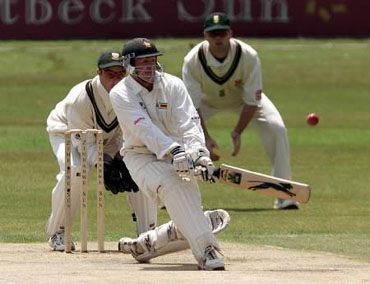
WHAT IT LOOKS LIKE: Zimbabwe batsman Andy Flower reverse sweeps watched by South African wicket keeper Mark Boucher and slip Jacques Kallis last weekend. Flower was undefeated on 64 runs with Zimbabwe at 255 runs for 3 wickets at lunch on the third day of the second Test at the Queens Sports Club. / Photo by REUTERS/Howard Burditt It is India's national religion. Nothing else can rouse the passions of India's 1 billion in the same way, not even the threat of a thermonuclear Armageddon. Nothing else can freeze an already soporific nation into dead inaction. Nothing else can cause millions to walk out on work and head straight for the nearest television set. Cricket propagates a kind of collective dysfunction throughout India. Nothing else matters. The game is all that counts. Even thousands of miles from home, the game remains a ritual of sorts for Indian students at Utah State University. They congregate on the grassy Quad every weekend to play out their passion. H.S. Satyanarayana, an avid cricketer and organizer of many campus cricketing fiestas explained the rules of the game to the Hard News Café. Nuts and Bolts "There are two teams with 11 players each. As opposed to four bases in baseball, there are only two in cricket. These are located in the middle of the field and are spaced about 22 feet apart. All running is between the bases, referred to as 'wickets.' There are four match referees including two on the field and one 'third umpire,' who is a sort of last-resort decision-maker. Unlike baseball, each team does all its batting in a single inning. The team scoring more runs wins the game." Bowling "Bowling is the cricketing term for pitching. Pitchers are called 'bowlers.' Each six-pitch set is called an 'over.' A bowler is limited to 10 'overs' in a one-day match. Unlike baseball, the bowling rotates after every six pitches. The pitch plays a bigger part in cricket than in baseball. The ball can pitch on the wicket and turn, swing, or even bounce over the batsman's head." Batting "Batsmen, as batters are called in cricketing lexicon, have considerable freedom in that they can hit the ball in any direction and run at will, rather than each time the ball is hit, which is the rule in baseball. A batsman is safe as long as he protects his base. He is declared 'out' only if the bowler hits any of the three wickets marking his base. In this situation, he is said to have been 'bowled.' If the ball is hit into a fielder's hand without making contact with the ground, he is said to have been 'caught.' If he is running between the wickets, and a fielder demolishes the base he is running toward before he crosses a 'safe line' in front of the wickets, he is declared 'run out.'" Scoring Plays "A batsman can score by hitting the ball and running safely between the wickets. A hit that carries the ball to the fence along the surface scores four 'runs,' and is referred to as a 'boundary.' A knock that carries the ball over the fence without making contact with the surface is referred to as a 'sixer,' and scores six runs." Progress of Play "The day begins with a 'toss.' Opposing captains toss a coin to decide who is to bat first or second. The game begins. Two batsmen, referred to as 'openers' are sent in, one for each base. If a batsman strikes out, the next in the batting order is sent in to take his place. The inning is finished when either 10 batsmen have struck out, or 50 overs have been bowled, whichever is earlier. After the first inning has been played, the second team chases the target score. The target is one run more than what the first team has scored." On The Web: Dictionary of Cricket Terms http://members.tripod.com/~sccwa/cktlist.html Beyond the Basics: Cricket Strategies http://members.tripod.com/~sccwa/strategy.html
|
Archived Months:
January
1999 January
2000 January
2001 |
||