|
||||


 |
Keep your head up and your 'eggbeater' going, and you might just play water polo • Wanna play? Meet at 6:30 p.m. Tuesday in the HPER lobby By
Dusty Decker
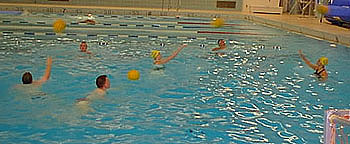
Objectives: 1. Put the ball in the net. 2. Do not inhale water. / Photo by Dusty Decker Intimidation: a word I combat despite humiliation and lack of confidence. One Monday morning I found myself cutting my lap swimming short to join a bunch of guys I didn't know for water polo practice. In the deep end of the pool I learned how to swivel my legs "eggbeater" style, an effective way to tread water for a long time. Next I tossed back and forth a bright yellow ball to one of the guys. For the first four tosses to me, the ball slipped past my pool-soaked fingertips and bounced easily onto the tiled floor. I had to heave myself from lapping waters, retrieve the ball and muster the determination to try it again. Tossing the ball was the fun part. That day we did some "conditioning." We did some sprints where you swim fast to the other end, do 10 arm dips off the side, then sprint back, crawl from the pool and do 10 sit-ups. Then we did it again. I was slower that day than everybody else, but I didn't give up. We also practiced treading. First we have our hands out of the water, then our elbows and then our whole arms. By the time my arms are straight, my face barely breaks the surface, but I do not go under. When we play follow the leader, we tread around the pool, practicing our eggbeater sideways, backward and forward. When we go under the diving board we try to reach up and grab it. I didn't even come close. That Monday was the first day of practicing water polo, and for some crazy reason I went back. As for the origins of water polo, the term "polo" is the English pronunciation for the Indian word "pulu," meaning ball. The first form of the game, in the mid-1800s. was rugby football played in rivers and lakes with the goal of carrying the ball to the opponents' side. Over the years different forms of the game with different rules have been played. By 1880 in Scotland, the game changed to a soccer-style of play. Players could only be tackled if they had the ball, and they could only touch the ball with one hand. The United States started playing in 1888 when John Robinson, an English swimming instructor, organized a team at the Boston Athletic Association. Two years later another team was started at the Sydenham Swimmers club in Providence, R.I., and in the fall of 1890 the New York Athletic Club introduced the game. That year in the first American championships, Sydenham Swimming Club defeated the Boston Athletic Association, 2-1. The sport became a popular spectator event by the turn of the century. In the 1900 Olympics, water polo was included as an exhibition at the Paris Games. Only club teams participated. After disagreement on rules in 1904 the English-Scottish rules became mandatory in 1911 for all member nations. It was in 1920 that the game became internationally represented. Germany, Austria and Hungary did not participate at that time because they were rebuilding from World War I, but in 1928 they began a reign of dominance that lasted until the 1980s. As for water polo rules, a team can have 13 players. Six players and a goalie play at one time. Players tread water the entire time and cannot touch the bottom or sides of the pool. Except for the goalkeeper, they can only handle the ball with one hand at a time. There are four periods in a game and each period is seven minutes with two-minute intervals between each one. Each period starts with the teams lined up on opposite goal lines. When the whistle blows the teams sprint toward the center pool where the referee releases the ball into the water. Whenever the whistle is blown for a foul or stop of the game, the clock time is stopped. Physical contact is common as players maneuver position. Substitutions can be made after a goal is scored, between periods, during timeouts, for an ejected player or during running time. The referee indicates the fouls by blowing a whistle and using hand signals to point out the direction of attack and where the ball is put into play. A goal (1 point) is scored when the ball is thrown or pushed past the face of the goal. Last year at USU the attempt was made to organize a team, but it fell through because there weren't enough people dedicated to it. This year, the team is scheduled to play Ricks College at the end of October.The team is still struggling for strong leadership, but those already practicing don't want to see it die again. There have already been a few hold-ups for the team. Last week we started practicing in the HPER swimming pool during lap swim that goes from 6:30 a.m. until 8. Some lap swimmers complained and the team is no longer allowed to practice with the balls at that time. Starting Oct. 11, we do have an evening time set up three days a week. Meanwhile we resort to a lot of conditioning and practicing on Saturday. Those who are serious about playing realize that organization is essential. There have been some women who have taken interest and that encourages me to keep going. Overall I enjoy the practices and even the conditioning. We play leapfrog and sharks and we do a lot of different drills and drives and practice shooting goals. When we do drills and drives I feel like I'm rushing into a tangle of bodies with water splashing and arms flailing around. At that point I panic slightly and then become more determined to do better. At least I'm getting into good shape, I can catch the ball most of the time and I reach the diving board usually when we play follow the leader. You can find us from 6:30 to 8 a.m. Monday, Wednesday and Friday, conditioning at the HPER pool during lap swimming. Also we're having a meeting at 6:30 Oct. 3 p.m. in the lobby of the HPER.
|
Archived Months:
January
1999 January
2000 |
||