|
Next few weeks are prime time
to get flu shot
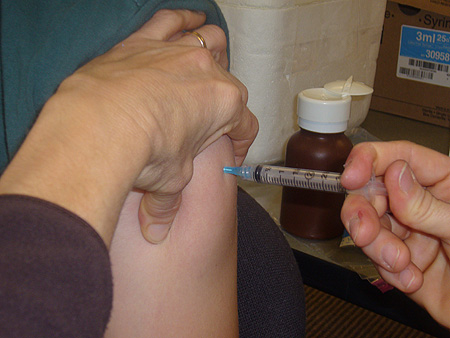
A LITTLE JAB:
Flu shots can prevent nasty complications from the disease.
/ Photo by Jenny Despain
By Jenny Despain
October 24, 2006 | As the leaves continue to turn
and snow begins to cover the mountains, flu season is
fast approaching.
The Department of Health and Human Services Center
for Disease Control and Prevention (CDC) states that
every year on average of 5 percent to 20 percent of
the U.S. population gets the flu. Of these people more
than 200,000 are hospitalized from flu complications
and about 36,000 people die from the virus.
One simple procedure -- the flu vaccine -- could eliminate
many of the complications and deaths that result from
the flu.
While many people associate the flu with later winter
months doctors recommend people get the flu vaccine
in October or November. This is because immunity needs
to be built up in the body before the flu vaccine is
effective. In most people the vaccine takes full effect
two weeks to one month after it is put into the body.
"The idea is to get coverage through the end of May"
says Lisa Miller, an RN in Bozeman, Mont., who administers
the vaccine.
Children, pregnant women, the elderly and people with
weak immune systems are highly encouraged to get the
flu vaccine, however; anyone who wants to decrease their
chances of getting the flu this season should get the
shot.
"Now days it's pretty much recommended for everyone,"
says Miller.
The shot is easy to get and is frequently administered
on campuses and in office buildings. It is even available
at stores like Wal-Mart.
According to the CDC the main way the flu virus spreads
is from respiratory droplets in coughs and sneezes.
This happens when the droplets of a person's sneeze
are carried through the air and deposited on the mouth
or nose of another person nearby. The virus can also
be spread from human contact between objects although
this happens less frequently.
Because the specific strains of the flu cannot be
determined before flu season, scientists predict which
strains have the highest chance of making it to the
U.S. in a given year. The killed flu viruses of these
strains comprise the flu vaccine. The vaccine is effective
when scientists successfully match the strains in the
vaccine with the same strains that make it to the U.S.
"Usually they're pretty on," says Miller.
While it is not a sure guarantee, people who get the
flu vaccine have a much lower risk of getting the virus.
Common sense and practicing good hygiene also aid people
in staying healthy through flu season. The CDC recommends
people: cover their nose and mouth when sneezing, wash
their hands frequently, get plenty of sleep and drink
lots of fluids. For more information got to www.cdc.gov/flu.
MS
MS |


