| Journalists
always needed even when primary news media are changing,
former senior executive of Tribune Co. says
By Jason A. Givens
October
10, 2006 | A former vice president of the Tribune
Company, the publishing company that owns the
Chicago Tribune and Los Angeles Times, spoke to
a USU journalism class Friday.
Joseph "Andy" Hays spoke about the
future of newspapers and offered some advice for
aspiring journalists. Hays is a USU alumnus and
a member of the advisory board for USU's journalism
department. |
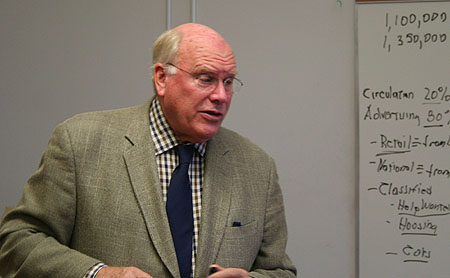
ADJUSTING ONLINE:
Hays explains how the Internet
is changing the way news is consumed by the public |
Hays said when radio came along everybody was predicting
that it would be the end of newspapers. Then TV came
along and everybody said that would for sure be the
end. He said the real demise for newspapers happened
in the 1970s with the introduction of the personal computer.
He said newspapers get about 80 percent of their income
from advertising and the other 20 percent from circulation.
Newspaper circulation is down nationwide. Hays said
circulation at the Los Angeles Times declines by 10
percent every month, and advertising, newspapers most
profitable part, is going to Internet sites like Google
and Yahoo.
"Mass media is the heart and soul of commerce,"
Hays said. Advertisements need to be where there are
"eyeballs and ears." However, he said "eyeballs
and ears" can be in so many places that newspapers
no longer dominate.
"There's no better source in the world for news
and information than The New York Times," Hays
said. However, it is an expensive process with a declining
circulation, and he is uncertain how long they can continue
to do it.
All the changes are being caused by the way that media
is being transmitted, he said, the Internet being the
most revolutionary.
"A lot of young people are not getting news
from newspapers," Hays said. "The electron
has eliminated the middle man."
He said newspapers have had to maintain high profit
margins of around 70-75 percent, but thinks a lot of
them will go private, allowing them to not be pressured
by such high margins.
With circulation's and advertising declining at newspapers
around the country, a career in print journalism may
seem like a bleak prospect.
However, Hays said, "There can never be a replacement
for people who can consolidate news and information
into readable form."
He said there will always be a source of news around
and a need for journalists, but he is unsure what type
of medium will be used.
Hays advised journalism students to take more creative
writing courses and scientific writing. "You
have to know how to write effectively and universally,"
he said.
Hays said in his opinion, the ability of students to
write is not being challenged enough.
"You must be able to write," he said. "Don't
be lazy about it; get into the tough classes."
RB
RB |


