
|
||||


 |
To the men he served with, he was Richard Hastings France; to me he is grandpa By
Mykel France 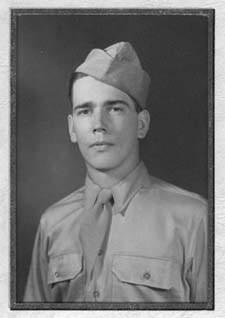 A TRUE HERO: Richard Hastings France at age 18. France was a member of the 482nd Ordinance Evacuation Company that stormed the beaches of Normandy. /Photo courtesy of Mykel France
He probably didn't read the words printed on the side of the food rations box that said, "For security, hide the empty can and wrappers so that they cannot be seen." He had eaten thousands of dehydrated meals from those boxes. Today would be chicken, but he couldn't bring himself to eat it. It was June 7, 1944, the day after D-Day, and he was sitting on a tank with his head down and shoulders fallen, not able to raise his eyes to look at the thousands of bodies that lay cold on Utah beach on the shore of Normandy. He would later describe the scene that lay before him saying, "There were dead bodies everywhere, not a tree standing that had a leaf, and the ships and beach had been blown to hell." He was part of the 482nd Ordinance Evacuation Company. To the U.S. government he was known by his serial number, 39-913-401; to the handful of men he served with, he was Richard Hastings France; but to me, he is Grandpa. My grandpa and his company had been fixing 10 to 15 ships and tanks per day for three months preparing for D-day, the battle that would become the turning point of World War II. At 20 years old, Grandpa was living a life he never could have anticipated. Referring to that generation, Tom Brokaw said, "At a time in their lives when their days and nights should have been filled with innocent adventure, love and the lessons of the workaday world, they were fighting in the most primitive conditions possible across the bloodied landscape of France, Belgium, Italy, Austria and the coral islands of the Pacific." My grandpa's story is no different. Sept. 1, 1939, is the date recorded as the first day of WWII, but at that time Grandpa said he was a "weak boy that had never left home." Even the attack on Pearl Harbor was too early to interrupt his teen-age life. He recalls hearing news of Pearl Harbor when he was sitting in a movie theater with his friends in Centerville, Utah. As Grandpa approached his 18th birthday and graduation from high school, he also neared his impending registration and draft to the war. He was not alone. Together with all of his cousins, brothers and friends (75, to be exact), he reported to his local draft board at Farmington, Utah, at 7 a.m. on the third day of May, 1943. While there, he would sign his last will and testament, leaving everything to his mother, Edna France. >From there, Grandpa's family and friends were scattered throughout the world; His brother Charlie, his Uncle Jay, cousins and friends, Don, Rex ... all 75. They would carry different weapons and carry out different tasks. But the faces they saw carried the same expressions of war. There would be no more movie theaters of the kind he knew. Instead, he would play a major role in the European Theater, which meant he would spend the next three years in Europe fighting on the Western battlefront against Hitler. >From Centerville, Grandpa went through basic training, which included boot camp and a series of tests that would determine each soldier's call to duty. He received the highest overall mechanical and engineering scores at Fort Knox, Tenn., which resulted in a call that would put him within 20 miles of the front line for the rest of the war. Because of his skills, Grandpa was trained to fix and drive all land equipment used in combat, including tanks. His responsibility was to fix tanks and deliver them to front lines, where he would retrieve and evacuate broken ones. This took him through what he called a lifetime of horrors and hardships. Though the task was the same, the locations were always different. Grandpa started in Bristol, England, where he prepared for D-day, which granted him the call to Paris the day it was liberated. While in Paris, Grandpa recalled a woman coming toward him and placing a French franc in his hand, her way of thanking him for his bravery and service. From that day, Grandpa made a coin and bill collection of all of the places he fought, feeling they represented the people he was fighting for. By the end of the war, he would have a tin full of bills, coins and stamps from Europe. After his service in Paris, Grandpa followed a difficult path through Switzerland, Belgium, Holland and Germany where he continued to shoot machine guns, drive tanks over land mines, build bridges called "pontoons" and see more people die. When asked if he had friends, Grandpa said, "Making friends only put me in the position to lose them. You learn quick that you don't make friends during war, because they all die." However, the war afforded Grandpa the opportunity to meet and lose many people he cared for. This was the case for most everyone involved in WWII. From the 28 countries that participated in the war, there were 20 million military casualties of war, not including civilians. Grandpa was one of 13 million military persons that were wounded but not killed in WWII. He said he considers himself lucky among men and women that served in the war. Generally, soldiers were given "points" for a variety of things; five points for each wound sustained, five points for each battle fought, and points for each presidential citation and campaign star for bravery (which included metals and ribbons). As a general rule, a soldier would be discharged after 35 points. However, by the end of WWII, Grandpa had attained over 100 points. But Grandpa's points and travels all became insignificant when the war when Grandpa boarded a ship to head home in 1946. Three weeks later, he would walk, unannounced, through the back door of his house in Centerville, for what would be the best surprise his father would recall in his lifetime. During the 60 years that have since passed, France has fought with flashbacks and infirmities. But he holds neither grudge nor guilt. It is no coincidence that his entire generation shares the same sentiment. In fact, France's generation holds a patriotism that cannot be imitated. They fought through hell, lost best friends, suffered sickness and sacrificed all personal desires in the name of freedom. And they are not angry. "They answered the call to save the world from the two most powerful and ruthless military machines ever assembled, instruments of conquest in the hands of fascist maniacs," Brokaw said. "They faced great odds and a late start, but they did not protest. They succeeded on every front. They won the war; they saved the world." Richard France truly is part of what's been called "the greatest generation." For more information see www.skalman.nu/worldwar2/links.htm.
|
Archived Months:
January
1999 January
2000 January
2001 |
||