|
||||||


 |
Indian festival of Diwali more than just fireworks and food By
Leon D'souza
Diwali, or the Indian Festival of Lights, is perhaps the most prominent of Indian fiestas. It is celebrated all over India, as well as in Indian communities throughout the diaspora. A time of great rejoicing, the festival is enthusiastically commemorated by people of every religion and from all walks of life. The doyen of the anti-apartheid African National Congress, Nelson Mandela, once described Diwali as a symbol of triumph. Diwali, Mandela said, represented the victory of "enlightenment over blind faith, prosperity over poverty, knowledge over ignorance, good health and well being over disease and ill health, and freedom over bondage." Diwali means many things to different people. For the Indian Student Association (ISA) at Utah State University, Diwali presents an opportunity to share India with the Logan community -- from traditional finery and the history of a land so ancient and diverse, to lip-smacking cuisine. Partho Choudhary, the association's Webmaster, spoke to the Hard News Café Saturday about Diwali, and how the ISA hopes to make the evening of Nov. 10 a memorable one. Excerpts. HNC: Tell us about Diwali. What makes this festival special? Diwali is a five-day-long Hindu festival celebrated predominantly across South and Southeast Asia, which includes India, Nepal, Sri Lanka, Malaysia, Thailand and Indonesia. The word "Diwali" is a colloquialism of the Sanskrit word "Deepawali," meaning "a row of lighted lamps," and the festival is aptly called "The Festival of Lights." Diwali is celebrated on the 15th day of the month of Kartik in the Hindu lunar calendar. This falls sometime in mid-fall every year. This year it is being celebrated on the 14th of November. During the festival, homes are thoroughly cleaned and windows are opened to welcome Lakshmi, the celestial deity of wealth. Candles and small earthen lamps, called "diyas," are lit to welcome the deity, as also to (symbolically) banish the darkness in our lives. Gifts and greetings are exchanged and festive meals are prepared. Diwali is to Hindus what Christmas is to Christians. HNC: What is the story behind Diwali? Diwali, like all other Hindu festivals in India, has a mythological as well as a religious and social interpretation of its origins; and this too differs, based on cultural differences, from region to region in India. One of the enduring stories, narrated to every child in India, is the story of Prince Rama in the epic "Ramayana." Prince Ram was the heir to the throne of the kingdom of Ayodhya, in northern India. Due to the wishes of his stepmother, his father, who was the king, reluctantly sent Prince Rama into exile for 14 years. Prince Ram's wife, Sita, and his foster-brother, Prince Lakshman, accompanied him to the forests, where they battled demons and devils, and were befriended by a band of monkeys. The crux of the story is the kidnapping of Sita by the demon king Ravana, ruler of the land of Lanka, and the battle to rescue her, that ensues between Ravana's army and Prince Rama, ably supported by the band of monkeys, led by the monkey-god, Hanuman. The main theme of the story is the eternal struggle between the forces of vice and evil on one side -- symbolized by the many demons and devils, and the demon king Ravana -- and the forces of virtue and benevolence -- symbolized by Prince Ram -- on the other. It also tells the story of eternal and unconditional devotion to the almighty -- symbolized by the monkey-god Hanuman. HNC: Why is the darkest night of the year chosen? The festival of Diwali symbolizes the victory of good and benevolence, represented by light, over the forces of evil and vice, which represent the darkness in our lives. Hence, it is celebrated on the new moon night in the month of November, which is believed to be the darkest night of the year. HNC: How does the Indian Student Association plan to celebrate Diwali this year? Like every year, this year too the Indian Student Association at USU will celebrate Diwali in the form of its annual cultural expose, "Diwali 2001." The show begins at 6 p.m. on November 10th, in the Ballroom of the Taggart Student Center. The three-hour-long show will showcase the cultural and ethnic diversity of India. As is traditionally done, the program will begin with a prayer song, and will be followed by a wide range of songs and dances, representing different cultural groups in India. We shall also present a small skit explaining the mythological significance of Diwali. The program will include a thirty-minute fashion show, wherein dressing styles and apparel from different parts of India will be displayed. A fifteen-minute capsule titled "India: Then and Now" will take the audience through 250 years of modern Indian history, beginning with the occupation by the British, to the present. The highlight of the program, as it has been in the past several years, will be the sumptuous Indian dinner, which we have arranged for our guests. HNC: Something you would like everyone to know... The Indian Student Association will be selling tickets for the show beginning Monday, October 29th through Friday, November 1st, at the Taggart Student Center Lower Level. Tickets, priced at $12, will be sold on a first-come-first-served basis to the first 500 patrons.
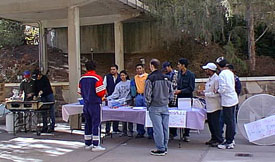
Pav bhaji, an Indian sandwich made with mashed vegetables, was sold to raise money for Diwali. / Photo by Leon D'souza
|
Archived Months:
January
1999 January
2000 January
2001 |
||||