|
Millville research center 'on
the prowl' for ways to reduce predator conflicts with
humans
PREDATORS:
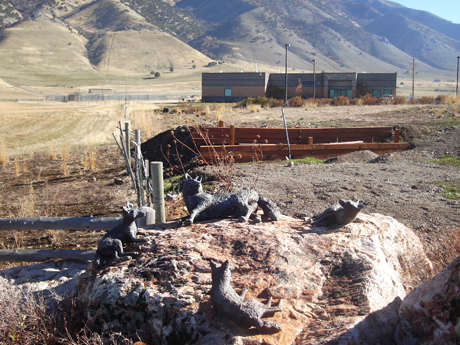
Coyote sculptures adorn a rock outside the Predator
Research Center. / Photo by Amanda Mears
By
Amanda Mears
November 19, 2007 | MILLVILLE -- Past the winding country
back roads of Millville lies a place where predators
roam the grounds.
The Predator Research Center in Millville is a partnership
between USU and the U.S. Department of Wildlife Services
that exists to examine the link and reduce conflicts
between predatory animals and humans, said biologist
Patrick Darrow.
"We try to find ways to reduce the conflicts between
humans and predators by learning about their behavior
methods," Darrow said.
Darrow is working on an electronic trap monitor that
will put out a signal when the trap has been sprung
so the trapper can get there quickly. He graduated from
USU with a degree in wildlife biology and said he began
working at the research facility six years ago as a
work-study student.
"The idea is to reduce the time [the animal] spends
in the trap," Darrow said.
Since its beginning in 1972, Darrow said the sprawling
165-acre research facility has been trying to learn
more about predators. Currently, they are focusing on
improved technology and non-lethal techniques for managing
predators. Darrow said the research includes studying
the physiology of maturing coyotes, nutrition, human
avoidance and fladry lines.
"A fladry line is basically a rope with strips of
flagging," Darrow said. "It's frightening to coyotes."
Darrow said researchers are currently testing the
fladry line to see if it is an effective method of protecting
livestock when placed around a pasture.
Although the Millville branch only houses captive
coyotes for research purposes, other branches of the
Predator Research Center include studying jaguars in
South America and black bears in the Midwest. However,
Darrow said there have been students from as far as
France and London that come to participate in research
at the Millville facility.
Darrow said that at the end of the day, the Millville
Wildlife Research Center just hopes to reduce conflict
and improve conditions for both coyotes and the people
who interact with them.
NW
MS
|


