|
Sigur Rós craft familiar a opus
like cotton candy -- a delight that doesn't linger
By Jon Jacobs
November 14, 2007 | Icelandic epic-post-rockers Sigur
Rós has never been shy on ambition for its music.
Whether it be the simplistic drift of Von,
the sweeping brilliance of the band's untitled magnum
opus, commonly referred to as ( ), or the bombastic
jubilance of Takk, Sigur Rós has always been
a centerpiece of modern progressive rock. The band's
abilities to craft achingly gorgeous albums has never
wavered, always hitting the mark with such an astute
precision that we often feel other post-rock bands owe
us an apology.
If Sigur Rós is guilty of any musically criminal behavior,
it can only be redundancy. While each of four studio
albums lacks nothing in poignant ingenuity, none pushes
the boundaries of the musical scope Sigur Rós has long
since adopted. This occurs to such a degree that one
could take a random selection of songs by the group
and it would have the feel of a full studio album. So
when word arrived of a two-disc compilation album by
Sigur Rós, most fans viewed it as a regular studio album,
because, well . . . it's going to sounds like one.
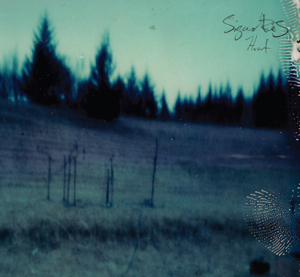
It is not surprising then to discover that Hvarf/Heim
sounds a great deal like a regular Sigur Rós studio
album. The album's flow is impeccably crafted; the tracks
are ethereal and breathtaking, often evoking a form
of spiritual reverence that we have come to expect from
the quartet. Yet, behind the lush production and the
empyreal arrangements, there is something considerably
alien at play here.
The change is first felt in the robust opener from
the album's first disc Harvf, where we find
the normally subdued group thrashing in full force.
Walls upon walls of distortion and instrumentation fill
the track to its brim, as though balancing a drink from
toppling during an earthquake and barely succeeding.
Though Sigur Rós has quite certainly let loose the chains
of distortion before, it has never felt so immediate
and stark. The result is startling.
As the band members are notorious for, they again
shift direction with arguably the most experimental
track they have ever attempted, the neo-ambient Hafsol;
comprised of 12 minutes of directionless, otherworldly
soundscapes. And yes, it's illustrious, and absolutely
so. The track's flow and resonance force you to lose
yourself in the sublimity of its artistic creation.
Even with its considerable length, the song ends before
you want it to, feeling as though it could have deviated
infinitely and still maintained yourattention.
If the five-track first disc wasn't enough to swallow,
the second disc, Heim, a collection of live
recordings, is the icing on the cake. For fans who haven't
seen Sigur Rós in concert, the tracks give a glimpse
of the uniquely sublime nature of the band's performances.
The songs are less dense, yes, but they are brilliantly
transferred from the tape to the stage. This occurs
to such a degree that in some cases the live version
surpasses the heart-wrenching power of the originals.
Such is the case with the minimalistic Samskeyti,
a pseudo-neo-classical instrumental piece that was brilliant
in its brevity to begin with. Here, it is beyond intimate,
reaching levels of emotional tenderness untouched by
a vast majority of modern music. The repetition of the
focal piano line cascades idiosyncratic imagery over
you, forcing you to lose yourself in the epic crescendo
of strings and ambience.
As with all Sigur Rós albums, there is a fairly strong
feeling of familiarity with the music. You may not have
heard the songs before, but somehow you know where it's
going. The tracks have a tendency to blur together without
signaling it has shifted. It is not to say that the
music is unmemorable; it isn't, but it lacks certain
characteristics that create lasting impressions on a
listener. The music may be remarkable, but after it's
over you can't seem to recall why.
And herein lies the problem with Harvf/Heim.
While the music is as magnificent as ever, vastly emotive
in its delicate finesse, it never buries itself in the
mind. As soon as the music is gone, you forget what
which melodic highlights you thought were so moving
and fascinating. With every grandiose disposition, with
every echoing, spectral lyric, the music drifts towards
space, but never truly settles on your mind.
The album may be a brilliant opus of modern music,
but don't be surprised if you forget why.
MS
MS
|


