|
Nine explosions and three Purple
Hearts
| By Trevor
Brasfield
The medals rest quietly undisturbed in their
original, velvet-lined boxes, tucked into a drawer
miles away from here, as if the recipient of these
medals wished to forget, if just for a moment
they, and what he did to receive them, never happened.
The Sunni Triangle is considered one of the
most dangerous areas in Iraq; it includes Baghdad,
Fallujah and Ramadi. In the middle of these cities
run two rivers believed by some to be the original
site of the Garden of Eden. This is where human
life is said to have began, and it is here where
democracy makes its push to bring stability to
a people who have not known peace since before
Jesus Christ roamed the hillsides just west of
here.
These rivers flow softly and gently through
this region, once a stronghold of Saddam Hussein,
the former dictator of this country. Now the river
provides the water for a cash crop of this region:
grass. Long thick blades dot the landscape of
this desert oasis. Palm tree forests are everywhere,
and if you took time to look around you would
see green among the sand.
Jordan Taylor saw a lot of the countryside in
the year that he was stationed in the Sunni Triangle.
He saw it from the gunner's turret of a RG-31,
a vehicle built by Land Systems of South Africa.
It is a fully armored wheeled vehicle that leads
a convoy of ominous armored vehicles whose sole
mission is to seek-out and destroy the number
one killer of troops in Iraq. That killer is the
improvised explosive device, or IED. You are bound
to have heard about it in the news; every time
you turn the TV on; reporters are describing another
IED attack that killed tens of hundreds of soldiers
and Iraqis. |
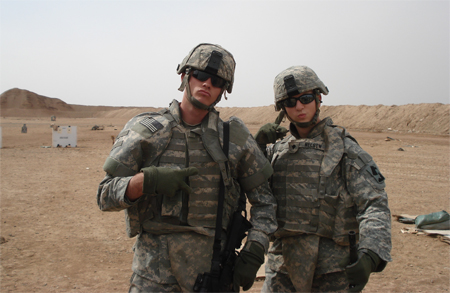
DOIN' OK: Jordan
Taylor, left, and a buddy. / Photos courtesy
of Jordan Taylor
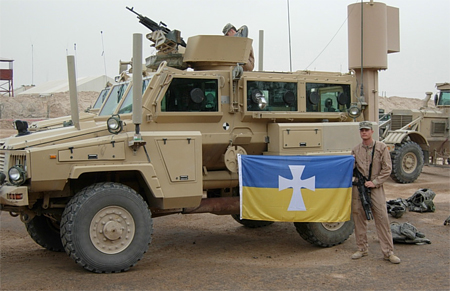
HOW IT SHOULD BE:
Taylor's RG-31, pre-blast. . .
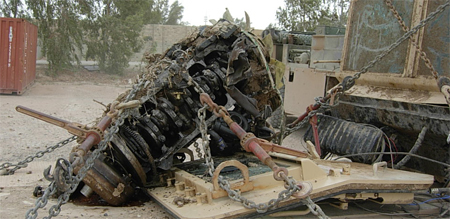
. . . and after the roadside explosion. That's
the engine in black.
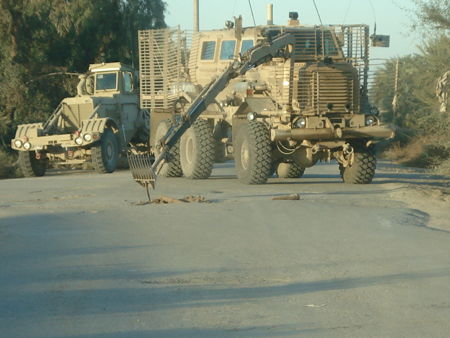
BOMB REMOVAL: A
vehicle removes an improvised explosive device. |
Taylor was a .240 machine-gunner, who perched his fully
armored body in the open-air turret of the lead vehicle
in these convoys. He scanned the countryside of the
Sunni Triangle from his perch high atop his vehicle
in the turret, which caused him to see a lot of what
went on in the triangle. He saw the farmers cutting
the long blades of grass with their scythes. He saw
the children running alongside the massive armored vehicles,
hoping that the soldiers would drop a few pieces of
candy. He also saw the immense sadness that war has
brought to the people of Ramadi and Fallujah.
Fallujah is often called the Mosque City because of
the hundreds of mosques that dominate the landscape
in this city of approximately 350,000. Fallujah is only
43 miles from the capital city, yet it feels like a
million miles away when you see and hear the carnage
of everyday life. The streets can be full of people
one day, and completely devoid of life the next. These
are the tell-tale signs of a possible attack.
One attack occurred on a religious holiday in a town
north of Ramadi. Taylor, once again manning the turret
with his .240 machine gun, witnessed a massive attack
on the hapless Iraqi army soldiers manning the outposts
in this town.
"It was a dump truck, and two cars that exploded
at the outposts," Taylor recalled. "We used
to let the dump trucks pass us on the convoys. They
never had meant any harm to us, until this day."
The vehicles were not targeting Americans. They were
targeting the Iraqi soldiers who had taken a break from
manning their posts to play a bit of soccer in the fields
behind the road. "I remember driving past them
and noticing their shoes were off, I knew that this
would bring trouble to them someday if they kept this
up. Little did we know it would be today."
The cars and dump truck exploded in a timed attack
throughout the tiny village, and small arms fire erupted
around the convoy. Several of the Iraqis were seriously
injured. It fell upon Taylor's convoy of Marines and
Army soldiers to recover the injured Iraqis and return
fire.
"We put three of the guys in a Cougar. Two of
the guys made it to the hospital, and one bled out and
died en route. I still have his blood on my boot. I
never heard if the other two lived."
Vehicles such as the Cougar and the RG-31 are part
of a convoy of four heavily armored vehicles designed
to save and protect lives. Two of the vehicles have
been in heavy use in many foreign combat zones. The
Buffalo and Cougar are the newest and most highly technical
bomb detection vehicles on the planet. These heavily
armored vehicles are built by Force Protection Services
in South Carolina. They have been featured on CBS Evening
News with Bob Schieffer and have been praised in letters
to the manufacturer from soldiers in Afghanistan and
Iraq, in how the vehicles have saved countless lives.
Taylor can testify to these amazing vehicles. He was
involved in many a gun battle from enemy small arms
fire, more than he can count, along with nine major
explosions from IED's. Three of which were direct reasons
he was given the Purple Heart -- and which may have
led to the medals being tucked away in a drawer in his
mother's house miles away from where he currently resides.
Taylor may want to forget these three major explosions
that miracioulously did not take his life. The worst
of these explosions led to Taylor not being allowed
on any more convoys. This day would turn out to be one
Friday the 13th he would never forget.
It was April 13, 2007, and Taylor had been assigned
this mission instead of another soldier. Taylor and
his convoy were to go to Karma, a village north of Fallujah,
a town he was all too familiar with. Taylor and his
convoy of 321st Engineers out of Ogden, Utah, had been
involved with three other explosions in Karma since
November of 2006. The 321st Engineers were using a particular
device that scans for explosives, yet this particular
explosive was placed in plain sight; it was a homemade
explosive like that of C-4 (a highly explosive plastic
used by many government agencies to blow many items
up). The enemy had placed this powerful explosive in
a hole in the road, in a plastic jug. The plastic in
the jug prevented the Husky's metal-detecting equipment
from sensing it.
Taylor's vehicle had drove over the bomb and it detonated.
The blast resulted in a direct blow to the RG-31's armored
hull. It was so powerful it lifted the RG-31 with Taylor
and his crew backward in the air 90 degrees and then
back down again onto the wheels. The engine was blown
off the vehicle and was found hundreds of feet away;
the back hatch blew off and was hundreds of feet away,
along with the soldier nearest to the door. Taylor was
blown into the vehicle from his perch in the turret.
He suffered, amazingly enough, only a split lip that
needed stitches, and massive bruising on both of his
legs. The rest of the occupants of the RG-31, including
the soldier blown out of the vehicle, walked away from
the blast with only minor cuts and bruises.
Some cats are said to have nine lives, it seems that
Taylor has many more than that. In addition to the constant
barrage of IED's that line the roads of Iraq, many soldiers
have to deal with small arms fire and rocket-propelled
grenades, better known as RPG's. Many of these are weapons
from the Cold War are inaccurate and antiquated. Yet
a weapon is still a weapon, and put in the right hands
can prove deadly. This could be the reason why Taylor
survived a rifle-fired grenade one day on patrol.
A firefight had broken out on the road after a Husky
in Taylor's convoy had succumbed to yet another IED.
This was the 15th IED they had found in a 32-hour period.
Taylor was with this platoon of soldiers patrolling
the streets of Karma for over a day when this IED struck,
and fatigue proved to be no laughing matter for the
soldiers of the 321st. While they waited for a recovery
vehicle, small arms fire broke out amongst the insurgents
on the ground and the soldiers in the convoy. Taylor
was manning his .240 machine gun when an insurgent on
the ground dispatched his old rifle grenade gun.
"It was like one of those video games where the
enemy uses the flash-bang grenade and everything on
the screen goes in, out, and slows down. I saw this
grenade coming toward me, and at first I could not react.
Then at the last moment I ducked and the grenade whizzed
over my head. I could feel the heat flash trail on my
head for hours afterward."
Taylor attributes a lot his resilience and tenacity
in these situations to his religion and his involvement
with the Sigma Chi fraternity. Taylor believes it is
these two passions that have taught him faith in mankind
and brotherhood. His faith is that of the Church of
Jesus Christ and Latter-day Saints, commonly known as
the Mormon church. This faith is deeply rooted in family
and community. His involvement in Sigma Chi a fraternity
on the campus of Utah State Universty, has shown him
brotherhood, one that forms a lifelong bond among men.
This bond helped him trust in his soldiers, and help
keep him and these brothers in arms safe.
Even though there seems to always be a constant barrage
of gunfire, and chaos that surrounds Taylor and his
brothers in arms, many believe what they are doing in
Iraq is a good thing, they can attest to the direct
impact the soldiers of the United States Army have on
many of the Iraqis. It is hard not to think after a
year of getting shot at and blown up that you are not
doing well. It is hard on the psyche to believe all
the terrible hardships you have endured that you are
not helping at least one person's life better. He said
he could see it in the faces of the children he saw
everyday, in the schools that were built for them by
the service members, he sees hope amid all the bloodshed.
"I believe that what we are doing over there for the
people of Iraq is a good thing. I see the looks on their
faces and see they want a better life. They want their
families to grow up safe and in a good environment,
just like we have. It is these ideals that make them
exactly like we are, and that is worth fighting for."
Taylor has very strong views about the war itself.
He struggled daily with why Americans are there, yet
he found solace in his faith, his brotherhood, and the
fact that there will be an end to this someday.
Will he find himself back in Iraq? Only time will tell.
He has no immediate plans to re-enlist. Someday, though
a, drawer will be opened and three boxes lined with
velvet will stare back at him. Inside those boxes will
be the proof that a soldier fought hard, gave all he
could, and that is all that matters.
MS
MS
|


