|
Natural birth control can be
effective, book declares
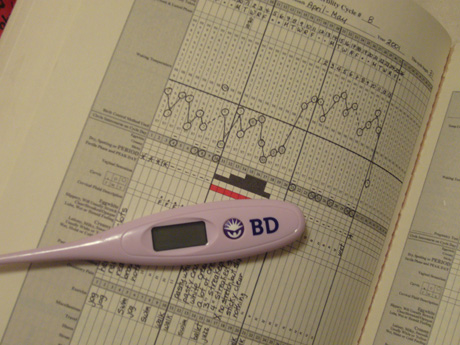
FOLLOW THE CHART: An
example in Weschler's book shows how women chart their
cycles in order to prevent or achieve pregnancy.
By Jennifer Lund
November 27, 2006 | A young woman says to her mother
"I'm thinking of doing natural birth control."
"Oh! Well you know what those natural birth control
women are called," says her mother.
"What?" the daughter asks.
"Mothers!" she responds.
Jokes about natural birth control have been told for
decades. Due largely to the low success rate of the
rhythm method, many people have negative attitudes about
natural birth control. The rhythm method involves a
mathematical formula that uses menstrual cycle lengths
to predict future fertile phases. This method, proven
to be less than effective, has largely been believed
to be the only natural method of birth control available.
But, there is another option for women who want to avoid
using hormones as a method of preventing pregnancy.
In her book Taking Charge of Your Fertility: The
Definitive Guide to Natural Birth Control, Pregnancy
Achievement, and Reproductive Health, women's health
educator Toni Weschler teaches women the ins and outs
of the Fertility Awareness Method (FAM).
"Women from all over the world have been drawn to
FAM simply because it is free of the chemicals associated
with hormonal methods such as the pill," Weschler says
in her book. "Most women are thrilled with the sense
of control they feel after spending just a couple of
minutes a day charting their cycle, cherishing the privilege
of finally understanding their bodies."
FAM is based on the fact that a woman is only capable
of getting pregnant for about one quarter of her menstrual
cycle.
"Given that women are fertile only a few days per
cycle, it's ironic that they're the ones that risk the
vast array of side effects and physical ramifications
of birth control," says Weschler.
By knowing when she is fertile and therefore capable
of getting pregnant, a woman using FAM can avoid and
achieve pregnancy. The method involves two primary fertility
signs—the waking temperature and cervical fluid. These
two signs are then recorded on a chart that allows a
woman to see when she has a risk of getting pregnant
and when she does not.
The waking temperature is used to determine when ovulation
(when the egg is released from the ovary) occurs. To
get her waking temperature, a woman must take her temperature
upon awaking every morning. She must do this before
she does anything else (getting out of bed, talking,
etc) in order to ensure accuracy.
A woman's temperature usually falls within the range
of 97.0 to 97.5 degrees Fahrenheit before ovulation.
After ovulation the temperatures rise to 97.6 to 98.6
degrees Fahrenheit. These temperatures will stay high
until her next period (typically 12-16 days later).
If the temperature does not drop back down after 18
days the woman is most likely pregnant.
The other fertility sign is cervical fluid, which
must be checked and charted on a daily basis. Cervical
fluid changes throughout a woman's cycle and must be
a certain consistency in order for sperm to survive.
During a typical cycle cervical fluid can go from nonexistent
to sticky, creamy and finally stretchy. Stretchy cervical
fluid is most conducive to sperm.
By following these two signs, along with other additional
indicators, women can successfully achieve or prevent
pregnancy. FAM; however, is not recommended for everyone.
Weschler points out that the method is best for monogamous
couples who have the maturity and discipline to follow
the method correctly—because, like any method, it is
very unforgiving if it fails. In addition FAM does not
offer any protection from STDs.
In the mix of the pill, the patch, condoms, IUDs,
hormonal injections, etc., FAM is one other birth control
option for women. With so many options available women
should do their own research and choose the birth control
method that best suits their needs.
MS
MS
|