|
|||||||||


 |
Study in India's tropical Shangri-La: Introducing the Manipal Academy of Higher Education By
Leon D'souza
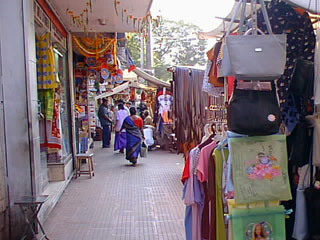
Street vendors in Bombay. / Photo by Leon D'souza I last visited Mangalore as a boy of about 10. I remember very little of that sojourn. I was perhaps too young to appreciate the sights and sounds that make this place a veritable wonderland for the weary city dweller. So the ride into Manipal recently was, for me, an opportunity to rediscover the extraordinary cornucopia that is Mangalore. My family traces its roots back to this tropical paradise, so in a way, returning to Mangalore felt quite like returning home.
The panoramic surroundings comprise rural farmlands, rain forests and inland waterways. I was in Mangalore to lay the groundwork for a dialogue between Utah State University and the Manipal Academy of Higher Education (MAHE) -- a reputed autonomous institution in the Mangalore area -- on possible faculty and student exchange opportunities, as well as outreach and twinning possibilities. For the uninitiated, a twinning program is a rather unique arrangement whereby undergraduate international students can complete two years of education in their home countries, following which all course credits earned can be transferred to an institution overseas with which the home institution has an articulation or transfer agreement. MAHE currently has similar agreements in place with Andrews University in Berrien Springs, Michigan, and the Milwaukee School of Engineering. More than 500 students have benefited from the program over the past seven years. Craig LaRocco, interim director of the Office of International Students and Scholars, also accompanying me on this trip, believes that the twinning program will be an excellent opportunity for USU to attract some of India's finest undergraduate students. "It is also an opportunity for USU to make a significant presence and profound influence in India," he added. MAHE's International Center for Applied Sciences, which administers the program, is seeking to expand its presence in several Indian cities. At present, the group operates sister institutions in three cities, as well as in the Hindu Kingdom of Nepal, Malaysia, and Dubai in the United Arab Emirates. According to LaRocco, a key element of working with MAHE is its already established presence in other Asian countries. "Cooperation between our two institutions will enable us to maximize possibilities elsewhere in the region," he said. The story of the Manipal Group is fascinating to say the least. Founded in 1942 as the Academy of General Education with the objective of retraining unsuccessful matriculates, the group has evolved into a multimillion-dollar conglomerate with a 12,500-strong workforce, 52 educational institutions and 42,000 students from around the world. More than 30 countries are represented on campus. Manipal is home to seven academic colleges -- medicine, dentistry, engineering, nursing, pharmacy, management, hotel management and communication. But education is not the only pursuit at Manipal. Here, the past has become an obsession. The institution operates a Heritage Village where ancient houses and temples are relocated for restoration and exhibition in a permanent 8-acre site near the Manipal Lake. The university also runs a planetarium aimed at increasing awareness about astronomy and stimulating interest in stargazing. Manipal is best known for its outstanding medical facilities. The group operates 12 hospitals with a whopping 7000 beds. The anatomy and pathology museums are among the finest worldwide. With more than 63,000 books and 30,000 bound journals, Manipal's medical libraries are among the best in the country. However, what is most impressive about this institution is the intellectual energy, and the passion that seems to propel the community forward. Even at the ungodly hour of 1 a.m., students can be found hunched over rather intimidating books in several libraries on campus. Professors speak of their research with passionate eloquence. One can truly sense a yearning for knowledge here. Manipal is an academicians dream come true. And decisions are made expeditiously. In less than a day, we have been able to open numerous doors for several USU entities. MAHE officials are in the process of drafting a tentative Memorandum of Understanding. The ball is now in our court.
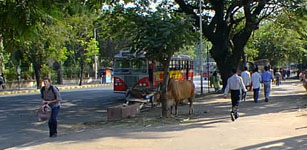
What would India be without a sacred cow, center? / Photo by Leon D'souza
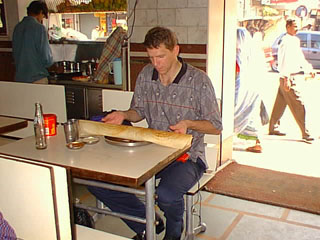
Craig LaRocco contemplates the size of that south Indian treat, his monster paper masala dosa. It's a spicy mix of vegetables, including potatoes. / Photo by Leon D'souza
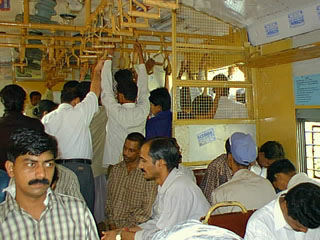
Inside the local train in Bombay. Kinda crowded, eh? / Photo by Leon D'souza
|
Archived Months:
January
1999 January
2000 January
2001 |
|||||||