|
||||||


 |
Bright lights, big city and Walter Cronkite make for a good day at Black Rock • Had he voted? Yes, three times By
Mike Sweeney
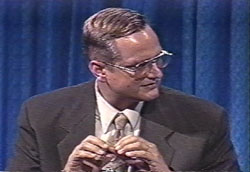
A panel of experts on World War II journalism and censorship comprises, from left, USU Assistant Professor Mike Sweeney, historian Williamson Murray, former CBS reporter Dick Hottelet (partially hidden), former United Press and CBS reporter Walter Cronkite, and moderator Dr. Robert Batscha of discussions at the Museum of Television and Radio. Sweeney speaks with Cronkite, below.
Richard C. Hottelet rolled in on a wheelchair. He had suffered a broken femur in a fall in Lisbon but was waiting until after his speaking engagements to have the bone set. Apparently, journalists are like letter carriers. Nothing stops them from their appointed rounds. In this case, that meant their going on television Nov. 14 with two academic fellows -- author Williamson Murray and yours truly, an assistant professor of journalism at Utah State University -- to talk about wartime censorship and the public's right to know. We were the four panelists in the first session of "Fighting the Last War," a seminar produced by the museum, which is next to Black Rock, the CBS headquarters in Midtown Manhattan. The talk was satellite-linked to more than 200 colleges and universities. Our group discussed World War II, in which Cronkite reported for the United Press and Hottelet for CBS radio. Murray, a historian of the war, discussed the big picture. That left me, a historian of censorship, to talk about the smallest, and probably most arcane, subject. Who wants to hear a professor exactly half of Cronkite's age talk about how the news was censored when instead he or she could listen to "Uncle Walter" describe daylight bombing raids over Nazi Germany or Hottelet recall his trip across the Rhine with advancing Allied troops? I enjoyed listening. And talking, too. It was an amazing, enlightening, fun time. Audience members said they enjoyed my part of the talk, and it was reeealllly cool to sit 4 feet from Cronkite, who served as anchorman for the CBS Evening News from the early 1960s to 1981, and chat as if we had known each other for years. Cronkite is easy to talk to. That's probably why he was such a good journalist as well as "the most trusted man in America." Before the lights and cameras went on, Cronkite shared with the panelists and the museum staff some election news. No, not from the unresolved presidential race of 2000. Rather, from a state election in Missouri in the 1930s. "I think the statute of limitations has run out on this," Cronkite told us in a conspiratorially low voice. "I voted three times." Seems that he voted before going to work at a tiny radio station in Boss Tom Pendergast-controlled Kansas City. Sometime that day, a police car pulled up at the station and the officers asked if Cronkite had voted. When he said yes, they said, "No, you haven't," he recalled. They took him to another part of town and gave him a slip of paper with an Italian name on it. Cronkite, of Dutch heritage, walked to the poll, announced that he was, in fact, Mr. Very Italian (he can't recall the exact name) and voted. "To their credit, they never told me how to vote," he said. But a vote for the Pendergast ticket -- which had vaulted an obscure Jackson County Democrat named Harry S. Truman to fame as a U.S. senator in 1934 -- was understood, he said. Cronkite said the police took him back to the station and left him alone. Until, of course, they came back and repeated the farce. Had he voted? Yes, he had. Twice. No, he hadn't. Another trip to another precinct, and another slip of paper with another name. Cronkite and Hottelet are smaller in real life than on TV. But they are every bit as human. You don't get the impression that you're talking to "stars" when you talk with them. That's good. It came in handy when the bright studio lights went on and suddenly Murray and I and everybody else were on TV. For me, it was the first time to do live television. We had been asked by the moderator, Dr. Robert Batscha, to prepare some informal opening remarks of about two to three minutes. About 20 second into my part (I spoke last) my mind went blank. I can't wait to see the tape that acting USU journalism and communication department head Penny Byrne made for me, to see what I looked like. An armadillo in the headlights of a pickup, I suspect. Fortunately, that was the extent of my nervousness. Something snapped into place in the overheated circuits of my brain, and from that point on I felt comfortable talking to the camera and to Cronkite and Hottelet. Maybe my lucky Aggie tie-clip gets some of the credit. It was a hoot. I'm told that at the end of the program, I smiled, punched the thigh of Murray in triumph and congratulations, and pumped his hand up and down. I'm glad I didn't injure him. But if I had, of course, he would have fit right in.
|
Archived Months:
January
1999 January
2000 |
||||