|
||||


 |
In university without walls, bugs have 'hairy arm pits' and fifth-graders are deer and wolves
By Esther Yardley
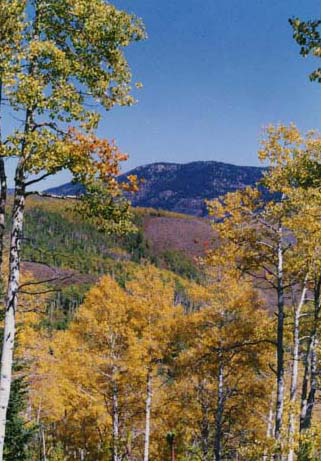
What is the real color of a leaf? Is it the green of summer, or the yellow of autumn, seen here in Logan Canyon? These are questions for fifth-graders to ponder at Guinavah-Malibu Campground. / Photo by Nancy Williams Editor's note: This story was produced for the USU mass communication class "Beyond the Inverted Pyramid," COMM 3110. The wind rustles the trees, pushing just hard enough to break a yellow box elder leaf from its death grip to the branch. The leaf rides the currents of the wind to settle feathery light on the gray compact soil at Guinavah-Malibu Campground. The box elder leaf goes unnoticed, for now, by the bunch of fifth-graders, on their knees. But they'll come back to it in a minute. They pull back pieces of water-plants, leaf material, and chunks of woody debris looking for "hairy arm pitted bugs" (stoneflies) or bugs with "wing on their abdomens" (mayflies), and occasionally finding mesquite larva or a fish smaller then the water bugs. Christy Shumway, an undergraduate student majoring in rangeland resources at Utah State University, is right in the middle of the group of fifth-graders. Oooos, aaahs and bright eyes come from the students as Christy points out that the inchlong bugs use those hairs, under their "arms," to breathe. The hairs are their gills; they use them just like a fish uses its gills, Christy explains. More than 1,200 Cache County fifth-graders took a day field trip to Guinavah-Malibu Campground, where they learned about forestry, range, soil and water. Here, professionals from the Forest Service, Natural Resource Conservation Service (NRCS) and Utah Association of Conservation Districts, as well as city of Logan employees, extension agents and specialists, undergraduates, graduate students and professors from Utah State University gave 50-minute presentations to the fifth-graders during conservation days. Conservation days is a highlight in students' lives, said Chad Downs, assistant superintendent of Cache County School District. Even when the students get into high school they still remember their trip as a fifth-grader to Guinavah-Malibu Campground and the things they learned. Third- and fourth-graders can't wait until they get to go on this field trip. When the fifth-graders arrived at the campground they separated into groups to study the four subjects and rotate to new locations every 15 minutes. What goes on in these locations to help students to learn about nature and its importance? In forestry, the students observe the difference between evergreen and deciduous trees, as well as learn about the different parts of a tree -- the trunk, roots, branches and leaves. Craig Pettigrew, who is the coordinator for the forestry area, said that a well-discussed question is, "Is the yellow leaf of the box elder or the red of a maple leaf the fake color of a leaf, or is it green that is seen during summer?" Many students would respond that the red and yellow is the fake color. Pettigrew explains to the group that chlorophyll produced during photosynthesis gives a plant's leaves a green hue. During the fall, trees prepare for winter by stopping the production of chlorophyll, and thus the fake color is the green that we see during the summer. So in the fall the true color of the leaves is displayed. Fire ecology is discussed in forestry as well. A charcoal burner is used to show how the lodge pole pinecone needs extreme heat to open up the cone, so the seeds can be dispersed and planted. The students also learn about how trees have developed different ways to cope with fire. They specifically look at the thickness of the bark. A hot coal from the burner is placed beside one side of a piece of quaking aspen bark. Third- and fourth-graders can't wait until they get to go on this field trip. Students place their hand on the other side of the bark. They can feel the heat coming through the aspen bark. Next, the aspen bark is replaced by ponderosa bark; students can't feel the heat from the coal. The students conclude that the ponderosa has developed a way to protect itself from fire with the thickness of its bark, said Pettigrew. The last section in forestry is the Web of Life. Students get in a circle and have tags to show what part they are to play in the web of life, such as the sun, water, soil, flower, grass, tree, insect, bird, deer or wolf. Each student passes a ball of string to another representative, which his or her organism needs to survive. For example, a student representing the sun gives the string to a student that is grass because the sun gives energy to the grass to grow. The game continues with the deer eating the grass (grass hands the string to the deer). Then the deer becomes food for the wolf (the wolf gets the string), who then dies and is decomposed by insects (string is given to the insect representative), who break up the nutrients in the wolf to be used by a flower. As the string is passed across the circle, from one student organism to another, it creates a spider-web shape that all are connected in. The horn blows, and the students are off to the next group. In the range area, students learn how to tell rangeland from forests, and also the importance of rangeland in the world. The students move into a campground that has a bridge in it where the group goes and looks at the north- and south-facing slopes of the Logan River drainage. Students describe the north-facing slopes as covered with trees, making it a forest and the south-facing slopes covered with grass and shrubs, making it rangeland. With a 100-foot marine-grade rope, the students create the state of Utah without talking. Some groups are able to do this without difficulty and others come up with something besides Utah, said Barbara Middleton, who works at Utah State University, instructor of this site. After creating the outline of Utah, students learn and show where different parts of Utah are. They put paper over locations that represent national forests. They name what states surround Utah. They discuss what these states have in common with Utah; these commonalties could be Bear Lake with Idaho, the Colorado River, which flows through Moab into Lake Powell and ends up in Arizona in the Grand Canyon, and Great Basin National Park with Nevada. "This is a nice refresher in the geography of the Great Basin, including Utah and the surrounding states," said Middleton. In the next section, the students learn how to tell range plants apart. The fifth-graders start this section by classifying five of their classmates. They do this by putting them into groups of similarities. The first grouping is boys and "not boys." By describing what something "is" or "is not" is the way that botanist identify what a plant is. Another example is brown hair and not brown hair. Other characteristics used to further categorize classmates are eyes, skin, height, glasses, etc. They are directed to look for characterization that will not change quickly, such as clothes. Next, the students move to a tarp where there are 12 different plants spread out: sagebrush, bitter brush, snowberry, grasses and forbs (fleshy plants). The students then do the same process they did with their classmates with the plants. During this time, Chris Call, a range professor at USU, tells the names of these plants and some of their importance to wildlife and livestock on rangeland. Brad Sampson, Cache County 4-H extension agent, heads up the last section for a few days. Here they play the Old Deer Game. This game is designed to teach children the relationship between wildlife and their resources. A couple of children are selected to be different resources that deer use. Chosen students that are deer go to claim their resource. When there are too many deer for the resources, a deer must die and become a resource, creating a balance in the system. Sometimes another part is introduced into the system, a predator such as a cougar. Students then talk about the relationship between wildlife and resources, exploring ideas of population and caring capacity. Time is gone, and the horn sounds for the students to move to water. Students do not stay dry in the water section. A trip to the Logan River to collect bugs fixes that. Students wade out into ankle-high water with a partner. One student kicks around in the rocks to disturb the water bugs, to be caught in a net that their partner holds. Then the bugs are placed in a container to be observed later, up close. Wet feet and shoes didn't make a few mothers very happy, said Superintendent Downs. Yet students rave about their experience in the river as their favorite. John Geirger, a range master student emphasizing in environmental education at USU, asked the talkative students as they returned from the river, "Who got wet in the river?" he said this though they where already convicted by their squeaky shoes and dripping pant legs. Geirger volunteers several days to instruct the fifth-graders, he teaches about the parts of macro-invertebrate (the fancy word for a water bug). Students receive large pieces of paper with different parts of a juvenile bug: a head, thorax (where the legs come out), or abdomen (bottom part of a bug). Students then pair up the rest of their juvenile bug and put them on a poster with its adult bug. Student then learn what makes these bugs unique and how they have their own food chain. The "shredders" (craneflies, stoneflies, and mayflies) take a leaf as it falls into the water and chew it up into small pieces. Bites of leaf float on down the river to be caught by the "gatherers" (caddisflies and blackflies). The caddisflies take these bits of leaf and debris and make a tiny log cabin out of it for a home. When a river rock is turned over and what looks like a square twig attached to the rock, it is the shell of a caddis fly. As this caddis fly is hanging onto a rock waiting for more food to come by, it's a possible victim of the "predator" (dragonfly or a water boatman). After this students, move to the next section in water where they look in shoebox-sized containers to see what a real live water bug looks like under magnifying glasses. Sometimes a magnifying glass is not needed for the bugs; they can be up to an inch long. In some areas, stoneflies can get up to four inches long. The horn sounds again for students to move to the last area of the day. The soil section, headed by Jennifer Hines at the Utah Association of Conservation Districts, share the course outline for the soil section. In soil the student stay the whole time with one instructor with a similar lesson plan as the other instructors. Students start out by observing just how much of the earth can be used for food production. One of the instructors, Jeff Barnes, who works for the Natural Resource Conservation Service, takes an apple representing the earth and cuts it into fourths. Three quarters of the apple are set aside in oceans. The quarter left is cut in half. One-eighth is not suitable to produce food. It is used up in deserts, swamps, mountains, and the Arctic and Antarctic regions. This leaves one-eighth of the apple. This piece is then cut up into four equal parts. The first section represents areas that are too rocky. The next section is too wet for food production. The third section is the land that is too hot. This leaves one-thirty-second of the apple (earth) that can be developed by humanity. He then skins the remaining piece. The skin represents the amount of soil that can be used for food production. Fifth-graders then get to feel different soil textures in three freezer containers, each holding a different soil sample of sand, silt or clay. Next, students get into two rows. Two students are picked to be water molecules to move through the soil. The first third of the remaining students represent sand particles. They stand facing each other touching fingertips. The next third are silt particles that stand elbow to elbow apart. The last third of students represent clay particles stand shoulder to shoulder. The water molecule students move through the students (soil particles). The students playing the part of sand give little resistance to the water molecules, by only touching fingers. as the water students continue, they meet more resistance from the silt and are stopped by the clay, unless water forces themselves through. Wayne Greenhalgh, who works for the Utah Association of Conservation District, likes to teach how vegetation holds down the soil, so it will not be eroded. Greenhalgh takes some of the soil that was in the containers and places it on a plate. He asks a student to be the wind and blow on the soil, so the soil will move off the plate. Then Greenhalgh puts a dandelion on the soil and has the student blow, not as much soil is moved, says Greenhalgh. Finally a sod clump is placed on the plate and the whole group blows on the soil, but there is no movement of soil (erosion). This shows that the amount of vegetation, matters in protecting soil from erosion, concludes Greenhalgh. The blast of the horn tells the student to hurry back to the bus to go home for the day. They enter the bus with dragging feet and smiles, to go home and share their experiences with family. The students experienced an opportunity to learn in a "university without
walls," says Kathy Voth, Bureau of Land Management interpretive specialist. |
Archived Months:
September
1998 |
||