|
||||


 |
Moose, rainbow trout, and 'tony' campers and anglers co-exist in canyon
By Jodi Mitchell
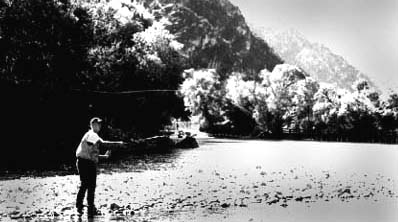
Eric Nixon, 17, of Logan, fishes in Logan Canyon in early October. He is trying to catch a rainbow trout. / Photo by Hiroshi Kita. Editor's note: This story was produced for the USU mass communication class "Beyond the Inverted Pyramid," COMM 3110. The sun majestically sets behind a thick wall of purple mountains. Gnats and mosquitoes swarm about. Crickets chirp. The river, like the drawing of a bath, gurgles vaguely in the distance. Traffic rolls down U.S. 89 through Logan Canyon in sounds like waves raging against the shoreline. It's the beauty of the canyon that draws more than 10,000 visitors to the Logan Ranger District Visitor Center and countless more to the campgrounds and fishing holes each year, according to Ann Judkins of the Visitor Center. The canyon road, which is 37 miles long, was declared a Scenic Byway in 1989. There are 10 campgrounds, four stocked fishing sites, many picnic and viewing areas, hiking, biking and many other outdoor activity opportunities throughout the canyon. Camping is one of the most popular activities in Logan Canyon and many people frequent Tony Grove Campground, 27 miles into the canyon. Judkins believes it's the most sought after camp site because of its magnificent view. "It's the prettiest area in the entire district," Judkins says. The Grove was formed by powerful glaciers many years ago when Lake Bonneville was the only thing Utah had to offer. Tony Grove got its name not from someone named Tony, but because the early residents of Logan who visited the Tony Grove area were called "tonies." This was a nickname that described the "high-toned, uptown set" of people. This is according to A Scenic Guide to Logan Canyon, a brochure published by the Bridgerland Travel Region. There are 37 camp units available within it. Visitors have been know to see an occasional moose while camping there. Dr. Mike Sweeney, an assistant professor of communication at Utah State University, once saw 13 moose near Tony Grove one night in July 1996. Judkins, of the Visitor Center, says that Sunrise Campground overlooking Bear Lake is another popular site. This, like Tony Grove, has a great view, which is why it's well-liked by canyon visitors. Its 28 camp units are usually open from Mid-June through October. Campgrounds fill up quickly, which is why the Visitor Center recommends making reservations. Although the canyon climate doesn't allow a long camping season, it does produce a busy and profitable one. The rates for each campsite vary, from $6 to $11 per day. Camping isn't restricted to the campsites however; Laura Bohn, a senior at Utah State University, prefers to hike further into the mountain, rather than camp at a campground. "I don't like to car camp," Bohn says of campgrounds. "I like to get away from people and noise and everything." She usually camps at least three times a summer, sometimes more. Bohn generally parks at the base of the mountain and hikes in about two miles before she finds the perfect spot to pitch her tent and camp. She and her friends claim camping in the Logan Canyon as one of their favorite things to do. "We've been hiking and camping as long as I can remember," says Bohn. She once spent 16 days in the wilderness. A typical camping experience for Bohn is quite different from the average camper. She stuffs a 25-pound backpack equipped with: a purple, Mt. Hardwear two-man, simple-to-pitch tent; a blue Marmot, mummy sleeping bag that handles 20-degree temperatures; plenty of water, a water filter, dried food, and a stove to cook it on. "We practice the 'leave no trace' camping techniques," Bohn says. "That means we don't build fires and cook smores." She says they usually just sit around, drink beer and watch the chipmunks until it's time for bed. Bohn and her friends would rather sleep under the stars than in a tent, but sometimes the weather just doesn't permit that. Other campsites available for "car-campers" include Bridger, Preston Valley, Righthand Fork, Guinavah-Malibu, Woodcamp Hollow and Spring Hollow Campground. Spring Hollow is at Third Dam, which is one of three dams constructed to harness power from the Logan River for electricity. Although camping is not available at First and Second Dams, fishing is. Logan River offers exceptional fishing opportunities as it is stocked twice yearly, once in early summer and again in July, according to Judkins. First, Second, and Third Dams are great year-round facilities. On any given day you can stop at any of the three Dams and observe the art of fly fishing, which is what Logan River is known for. Second Dam is the best site for children who are learning to fish, according to A Scenic Guide to Logan Canyon. There are many places to fish right from the shoreline. A fishing pier is there as well, which is convenient and accessible for wheelchairs. Chet Cannon knows that fly fishing takes years to learn, practice and master. Cannon is a Utah resident and has been fly fishing for more than 13 years. He grew up in Salt Lake and has fished many places in Utah, including the Provo and Logan rivers. "They just taste better. Usually though, I just let them go." He has been fishing the Logan River since he moved to Cache Valley last year. Cannon generally uses a caddis fly or a may fly to catch rainbow and brown trout in the Logan River. The brown trout are rare and are Cannon's favorite to eat. "They just taste better," Cannon says. "Usually though, I just let them go." He advises that early morning is the best time to fish. He and his roommates drive up the canyon about once every week, barely beating the break of dawn, to cast lures at Tony Grove Lake, one of Cannon's favorite fishing spots. "I generally catch about two fish whenever I go there," he says, "but sometimes more. It just depends on where I go and how early I get there." Cannon also likes to fish at Guinavah-Malibu Campground. Cache Valley residents have been visiting this spot since the early 1930s, when the Civilian Conservation Corps built a limestone and timber amphitheater there. Today, the Logan Ranger District provides a series of evening lectures at the amphitheater each summer. Cannon prefers Guinavah-Malibu as a fishing source because that's where he had his most memorable fishing experience in Logan Canyon. One day last year he caught two 18-inch rainbow trout, while wearing his waders and standing in the cold river. "I'll never forget it," Cannon says, "one right after the other." Typically he'll catch trout ranging in size from 12 to 15 inches. He most often just fishes from the shore, wearing shorts, sandals and sunglasses, but sometimes like that memorable day last year, he'll wear his waders and get in pretty deep. "It's relaxing, you don't have any worries," Cannon said of his love for fishing. "It's just fishing." Like so many other regular fishers, Cannon enjoys the year-round beauty of the canyon. Although fishing does slow down during the winter, it doesn't keep him, or any others, from standing outside in the freezing cold weather artfully casting, hoping for a fish. Fishing is only one of many year-round activities available in the canyon. You can go tubing, sledding, snowmobiling or skiing. For more information about Logan Canyon contact the Logan Ranger District
Visitor Center at 1500 E. Highway 89. |
Archived Months:
September
1998 |
||