|
||||


 |
Dams mean electricity, wildlife and the occasional duck-junkie toddler
By the USU Communication Department
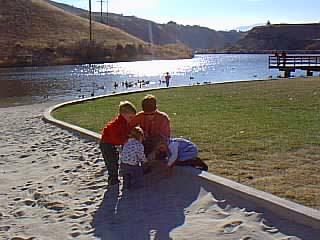
The children of Martha Peters play at First Dam on an Indian summer afternoon. Another mom, SueAnn Ray of Providence, takes children there to chase ducks and let off some steam. / Photo by Paul Kendall. Editor's note: This story was produced for the USU mass communication class "Beyond the Inverted Pyramid," COMM 3110. "Aaaaah! A duck!" squeals 3-year-old Kylie Ray. "Where?!" asks Ty Ray, her cousin, who is almost 4. Actually, there are ducks and geese everywhere, and they've been here at least as long as Kylie and Ty have. In fact, Ty was feeding them no more than three minutes ago. Nonetheless, the kids, arms flailing and legs flying, rediscover their feathered friends with all the excitement their little bodies can muster. And that's a lot. The cousins have come to Canyon Entrance Park at the Logan River's First Dam on a warm October afternoon--what may be the last warm day of the year--for, basically, a day of sand-sculpting and duck-chasing, interrupted only by Grandma's insistent picture-taking. Ty and Kylie have been chasing each other back and forth on a viewing deck that reaches over the water. This section of the Logan River has become a popular recreation spot for many residents of Cache Valley, everyone from families to elderly fishermen to college students. Volleyball nets and viewing decks, courtesy of Logan City, are just a few of the popular attractions at this grassy park, the closest thing to a beach Cache Valley has. The kids had just sat down, cross-legged on the dock, five seconds before Kylie's observation. But now they are up again, running along the sandy shore to where their aunt and her boyfriend are feeding a flock of deafening ducks and geese bits of bread. "They like to feed the ducks," says Kylie's mom, SueAnn Ray of Providence. Ray says she brings Kylie and baby Hunter, almost 1, to Canyon Entrance Park about once each week. Today, Kylie is here not just with her mom, dad, and sister but with her grandmother, who lives in Layton, her aunt and her aunt's boyfriend, of Salt Lake City, Grandma's best friend, of Hyde Park, and Ty, who is from Nevada but is staying with Grandma. Baby Hunter has just been let out of her stroller. Now she crawls in the grass independently, deftly maneuvering around duck droppings like a pro. This is nothing new to her. Hunter has obviously been here before. As the adults watch from the shade of a nearby tree, Ty and Kylie have made a small mound of sand with a stick in the top. Apparently, this is Kylie's birthday cake, though it's not Kylie's birthday. A technicality. "Make a wish!" Ty says. Kylie serves the stick an obligatory blow. "Let's eat now." * * * First Dam is one of three hydroelectric dams built to generate electricity for Logan City. Unlike the other two, First Dam was not built by Logan City but by Utah State University. About two miles further up the canyon, Second Dam, site of the Logan City Power Plant and the Morgan Smith Turbine, is less of a beach and more of a secluded getaway. According to a brochure from the Cache County Chamber of Commerce, it is still fully accessible and is popular for fishing and picnics. Logan City has been using Second Dam for power since the beginning of the 20th century. According to a Cache Valley tourism Web site, at http://bridgerland.com, the monthly cost for electricity then was 20 to 50 cents per light. The Web site says a "checker" visited each house in Logan and counted the light bulbs in use to determine the charge. Third Dam is still another two miles away, and it abandons the guise of park altogether. Instead, Third Dam is the location of Spring Hollow Campground. "With easy access and a plentiful supply of fish, Third Dam is a great spot for young and young-at-heart anglers and fly fisherman," the Cache Chamber brochure says. The dams have greatly changed the shape of the Logan River and of the canyon itself. They have also changed the environment surrounding the river. Third Dam has particularly created a unique environment, "teeming with cattails, willows and the chattering of birds and insects," the brochure says. It also serves as a sort of storage for spring runoff. Water filters into the ground and is "stored" there until it is needed in the drier months of summer. Wildlife thrives at each of the dams. All three are home to many kinds of fish, insects, mammals, and birds. A day without a duck at First Dam is by far the exception, not the rule. * * * The dams impact the environment in more ways than just wildlife. In fact, without the dams to produce electricity, Logan City would possibly be adding more pollution to the air. Jay Larsen, resources manager for Logan City Light and Power, said about 9 or 10 percent of Logan's power comes from the hydroelectric plants at each of the dams. "(The dams are) a very valuable resource to us," Larsen said. In fact, hydroelectric power is apparently thought of as important across the country. Larsen said almost all hydroelectric power in the country has already been bought. The 90-or-so percent of electricity Logan needs and can't get from the Logan River, it buys from hydroelectric dams across the United States. Without the dams, Logan would have to use coal or other fossil fuels to produce electricity, Larsen said. "Electrons just flow to the path of least resistance." "In my mind, that's much more damaging to the environment," he said. "Fish might appreciate it, but you'd pollute the environment and might get black lung disease." Second Dam is by far the biggest producer of electricity of the three dams, producing more than 100 times more power than First Dam and more than three times as much as First and Third Dams combined. Larsen said he can't say specifically where electricity from the dams goes other than that it goes somewhere in Logan, probably mostly to the east side of the valley, including Utah State University. "Electrons just flow to the path of least resistance," he said. Electrical service to the city can be thought of as a sort of loop or circuit that goes underground, Larsen said. All the sources of power for Logan hook into the loop at some point, so electricity from the dams becomes just a few more drops in an enormous underground river of power. * * * Ty Ray is running through the sand, under a volleyball net, over to the small leafy tree where the adults are clustered, chatting with one eye on the baby, who is now swatting at a bouncing bug, and the other on the giggling children. "Did we bring any clean clothes for me?" Ty asks. The cuffs of his jeans are a little wet and muddy, certainly no more than what would be expected of any almost-4-year-old at the beach. When Grandma asks why, Ty warily points out that he's gotten dirty. When Grandma says it's okay, Ty's shy smile turns into an I-can't-believe-the-luck-I'm having grin. Aunt SueAnn asks Ty to explain why he has so much fun at First Dam. Ty's response is childishly simple. "I like to get in the water," he says. And, that said, he's off to do exactly that--play in the water, get a little dirty. Grandma seems to be saying it's all right, Kylie's down there getting away with it right now. The ducks are quacking, the geese are shrieking. . . . It's a fine day for getting in the water.
|
Archived Months:
September
1998 |
||