News/Features 9/21/99

Rock climbing sort of like bungee jumping . . . in the other direction

By Melissa J. Bloyer

Editor's note: This story was produced for the USU mass communication class "Beyond the Inverted Pyramid," COMM 3110.

"On belay?"

"Belay on!"

"Climbing!"

"Climb on!"

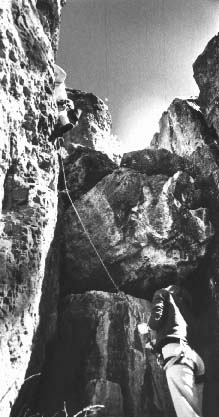
The climber then proceeds to ascend the route. One step at a time, slowly moving upward with caution and grace. The belayer stands beneath him, watching every move with much anticipation.

These are common terms one might hear while spending some time in Logan Canyon.

You won't hear them at a campground, a dam or a picnic site. These are things you might hear at Fucoidal Quartzite, China Wall Cave or The Betagraph.

But what does it all mean? What is a belay? Where is The Betagraph?

Rock climbing is a sport that not only challenges a person physically but also mentally. Rock climbers tell you that mental strength is often more important than physical strength in the art of rock climbing.

"I like to go climbing before a test," says Troy Knighton, accounting student. "It sharpens my brain."

This might sound a little kooky to a person who has not yet experienced the rush of the rock. Many people see rock climbers as crazy, on the edge people who are just looking for another thrill. Sort of like bungee jumping, only in the other direction.

In some ways this is true. A person does experience quite a thrill when climbing. But it is not a mindless rush. Rock climbing is a mixture of trust, power, and well thought out moves.

Trust in your partner, your shoes, your hands and your mind. Power in you muscles. And moves that are contemplated long before you even touch the rock.

Hannah Brown, beginner in rock climbing, said that her first lesson in climbing did not even involve any upward motion. Her trainer, Russell Slaugh, has a major in exercise science and was a climbing instructor at Adventure Sports Rock Gym.

"He is amazing," said Hannah. "He would move up a wall like it was no problem at all. He's massive."

But according to Russ, massiveness has hardly anything to do with how good a person can climb. He uses the term "ingrams." An ingram is like a mental dance. Each move is pictured in the climber's head beforehand so that when he is on the climb he will not have to waste his energy deciding what the next move should be.

"Before you even start on the problem [the climb] you must play out each move in your head. You must know exactly where you are going to place your hands and your feet. You must be able to tell exactly which way your body is going to move."

"This importance became apparent," said Hannah, "I was pretty green when I started up my first climb and ingrams were the last thing on my mind. That is until I experienced a barn door." This happens when you are supported only by your left hand and left foot, or your right hand and right foot. Without realizing it the inexperienced, unsuspecting climber will swing out in the motion of a barn door. This could cause all sorts of complications.

And speaking of climbing terminology, this is also a whole lesson without upward motion.

The most commonly used terminology is probably the characters involved and the equipment. Rock climbing should involve two people: The climber and the belayer. A few climbers feel they do not need a belayer, but this practice is quite risky and is definitely not recommended.

The climber is referred to the person ascending the route. This may seem like an important person in the equation, but most climbers would not exist today if it were not for the belayer.

The belayer holds the rope. Usually the belayer stands at the bottom of the climb, although you can belay from the top of the climb. The belayer ensures the climber does not take a 20-foot fall, or anything more catastrophic than that.

"When I was trying out climbing for the first time I did not know how protected I was," said Elizabeth Kent, student and amateur rock climber.

"My first climb was Tiny Toons at Fucoidal Quartzite. I was really scared because I thought that if I fell I would fall right to the ground. That is, until the belayer explained how belaying works."

People come from all over to world to climb in Logan Canyon. The limestone walls provide excellent routes and many different grades.

Melisa and Justin Crane head up to mile marker 385 in Logan Canyon, where climbers of all abilities can test their skills. / Photo by Michael Hamblin.


Tim Monsell, professional climber, wrote a climbing guide for Logan Canyon, which is now in its third edition.

Although Monsell does not claim to have climbed every climb in the guide, those who have seen Tim up the canyon know that many years of climbing experience have made him is a great and wise climber. It is not uncommon to see Tim watching the climbers up the canyon, just to see what they are up to.

The first 14.b in America

is at "The Cave."

Only the elite climb

at China Wall Cave.

According to the guide, most of the climbs are moderately difficult. However, there are some great routes with low and high ratings.

The rating of the climb is extremely relative. The climber who bolts the climb, meaning to put up all the bolts and the chains, gets the honor of determining the rating of the climb. The easiest climb in Logan Canyon is a 5.4. The hardest is a 5.14b. This is using the American system. All the grades are five-point-something. Once you get to the 5.10's, a, b, c and d are also used. For example a 5.10d is harder that a 5.10 b.

One of the most popular climbs in Logan Canyon is called Community Effort.

Community Effort is at Fucoidal Quartzite. It is graded a 5.9. Many beginner climbers start out by top roping this climb. It is not uncommon for a climber to starr out on 5.9's in their first year. Usually the hardest climb a person does in the first year of climbing is a 5.10c or 5.10d. It seems that once a person reaches 5.10d there is some sort of wall that it hit. It is hard to go from climbing 5.10's to 5.11's.

Avid climber and student Sean Gerard explains this.

"Many people reach a 5.10d and then stop. Climbing in this grade is challenging and fun, and many people don't seem to feel the need to move on," said Gerard. "This is fine with me because it keeps the harder climbs less crowded."

A month ago, Gerard was working on successfully leading a 5.13a at China Wall Cave.

"The Cave" is probably the most popular place in Logan Canyon for the hard-core climbers. The first 14.b in America is at "The Cave." Only the elite climb at China Wall Cave. The easiest climb there is a 5.11a, and many climbers just don't get up that far.

Driving up Logan Canyon you will always see the same cars there, whereas you will see a variety at other climbing destinations.

Click here to learn

more about climbing

terms and methods

Casey Heyer speaks with much enthusiasm about "The Cave."

"Right now I'm working on Super Tweak (5.14b). The climb starts out at about a 12.c, which is really just a stretch for me. The top part is quite a bit harder though." He says this with a sparkle in his eye of anticipation. "One of these days . . ."

Fucoidal Quartzite, 385 and The Betagraph are probably the climbing destinations that receive the most traffic. The reason for this is the variety of grades at these climbs, and their easy approach. The approach is the hike a person must take to get to a climb. Sometimes the approach can be scarier than the actual climb.

Fucoidal Quartzite, at mile marker 383.20, is were a lot of people learn to climb, and stay climbing. Just by spending time at Fucoidal, one can meet a variety of people.

Matt Thorne, who has just moved here from Alaska, frequents Fucoidal Quartzite. He says that he came to Logan because he thought it was great that he could climb year-round here.

Most climbers here probably would not agree with that, but if you are from Alaska it might feel like summer here during the cold months of winter. He may, however, have a hard time finding a belayer. "385" got its name from its location. It is right at mile marker 385. The variety of climbs here is not as good as Fucoidal, and they tend to be harder. But during the hot summer months, when all the other climbs are in the sun, "385" is in the shade.

The approach at Betagraph, which starts about 400 yards form "385"' is a little more difficult. It is a 15-minute hike with the last 50 feet or so being very steep. However, climbers say that it is worth the hike. All the routes are located on a ledge and the view is incredible. The easiest climb here is a 5.9 and the hardest is a 5.11c. There are a large number of 5.10's here, making it a popular place.

In addition to these, there are about 15more places to climb in Logan Canyon with hundreds of climbs of all ratings. One can purchase Monsell's guide, Logan Canyon Climbs, at the ranger station or any sporting good store in Logan.


MS
MS

Archived Months:

September 1998
October 1998
November 1998
December 1998
January 1999
February 1999
March 1999
April 1999
September 1999
October 1999
November 1999