|
||||


 |
Car, computer or bike? Easy question when you're aching for a Kona Mula
By Casey Hobson
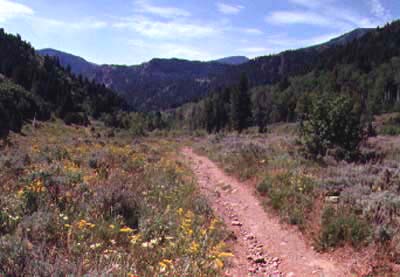
The Jardine Juniper Trail is one of the favorite destinations of mountain bikers who have the right equipment and stamina. But as in all forms of exercise, it's best to start slowly and relatively cheaply, and work your way up. / Photo by Mike Sweeney Editor's note: This story was produced for the USU mass communication class "Beyond the Inverted Pyramid," COMM 3110. A computer, a home entertainment system or a small, abused used car. Those are just some of the things Josh Perks could have bought with the money he spent on his bicycle. Perks, a sophomore at Utah State University, spent $1,100 on his current bike - a blue and silver Hawaiian-made Kona Mula that he purchased in Salt Lake City. "(The Kona Mula) has a good reputation for being an all around good bike, but when I rode it, I really liked the way it felt," Perks said. "It was nice and comfortable." While it may sound crazy to some people, $1,000 is about the average amount mountain biking enthusiasts will spend on their bikes. Ben Kofoed, a bicycle salesman at Al's Sporting Goods in Logan, said his last bike, a Schwinn, had a retail value of $2,000. However, he said those interested in taking up the sport could get a good entry-level bike for $400 and advised people to stay away from four digit price tags. "You don't know what you're going to like (until you ride for awhile)," Kofoed said. "You don't know if you're going to like an aluminum frame or a steel frame or a carbon frame. You don't know what you want to get into, whether you want full suspension or a hard tail (bicycle)." Kofoed suggested that new comers to the sport gradually work their way up to the $1,000, fully suspended bicycles. Most riders spend between $200 and $300 more every time they purchase a new bike. When Perks first began riding, his original bike cost him $300. Now he's on his fifth bicycle: three have been stolen and one has been retired. The constant abuse from rough trails wears out the components on the bike. If the trails don't wear out the bike, then time will, as parts become outdated. "Parts and stuff start to wear out and it costs more to actually rebuild (the bike) than what it'd be worth to buy a new one," Perks said. So what's the difference between everything? To the less experienced rider, there's not a big difference between an aluminum body and a steel body, between a fully suspended bike and a hard tail. However, to a veteran, those features sometimes make all the difference in the world. Aluminum frames are lighter than steel frames and provide a little more durability. Kofoed said bikes with steel frames give a little softer ride. However, if a comfortable ride is the objective, then some sort of suspension is the best way to go. As for suspension, Kofoed said beginners probably shouldn't invest in the fully suspended bikes either. These are the bikes that have shocks on the front and back ends. He did recommend a bike with a suspension fork on the front end. Suspension forks look like miniaturized car struts and absorb a lot of the up and down motion caused by rough trails. They reduce strain on the body, especially to the wrists and arms, which allows most bikers to ride longer before fatiguing. "(Front suspension) is very important," Kofoed said. "It's pretty much a necessity, I think. It's easier to hold on to the bike with front suspension." Perks, who's been mountain biking for 10 years, agreed. "Buy a bike that fits well and has decent components on it," he said. "Preferably, if you can, buy one with a suspension fork on it. That helps a lot. "If you find one you like, that's what you should buy. Bikes change
from year to year, so you've got to keep your options open."
|
Archived Months:
September
1998 |
||