|
Disneyland, oranges and second grade shape speech communication
professor's life
|
By Holly Scott
May 3, 2005 | He didn't have
good enough grades to get into a four-year college.
He didn't even know he wanted to go to college.
Professor John Seiter now has a doctorate in speech
communication and is a professor at Utah Sate
University.
He grew up in Garden Grove, Calif., half a mile
from Disneyland.
"I tell people it gave me a real distorted
perception of reality to grow up near the 'Happiest
Place on Earth,'" said Seiter.
He is the youngest of three children and describes
himself as the "devious little sibling."
|
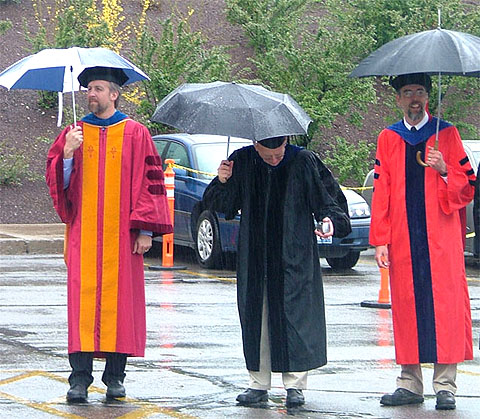
RAINY RECEPTION
John Seiter, left, along
with colleagues Harold Kinzer, center, and Charlie
Huenemann, attend asgraduates file into the Smith
Spectrum. / Photo by Mike Sweeney
|
"I'm allergic to oranges, but there was a bunch
of orange groves in Orange County, so my friends and
I would hop the fences and have orange fights. I would
come home all swollen. . . . It was a pretty happy childhood,"
said Seiter.
Seiter asked his friends what their plans were after
high school. They all planned to go to college, so he
did too.
He attended Cypress College in California for two
years.
"Fortunately I had some professors that took
hold of me and pointed me in the direction and taught
me," Seiter said. "They discovered something
in me . . . a desire to learn."
His desire came from the professors he encountered
who had an enthusiasm for their subject matter. Seiter
found it contagious, and that's when he dived into academics.
After his two years at Cypress College, Seiter transferred
to California Sate University, Fullerton, also known
as Cal State Disneyland by its students.
It was a good thing Seiter discovered his love for
learning and followed his friends to college, because
that is where he met his wife, Debbie.
She was the student coach for the speech and debate
team. She tried recruiting Seiter to the team, but was
unsuccessful. She was, however, successful in recruiting
his best friend Scott. Scott, in turn, was successful
in recruiting Seiter.
Seiter explained his dating with Debbie as a taboo
romance where debate coach and student fell in love.
"She is a terrific person," Seiter said of his wife.
She worked to put him through graduate school so he
could eventually become a professor.
"She told me once I got my professor job all
she wanted was a front porch and a rocking chair,"
Seiter said. "She doesn't have her porch, and she
works harder than me, raising our son, Christian."
Seiter knew he loved learning when he would get into
his text books and find himself "thirsty" for the knowledge
in them. Being a part of the debate team also sparked
a passion for his love of communications. He received
bachelor's degrees in speech communication and psychology,
as well as a master's in speech communication at Cal
State Fullerton.
He went on to receive his Ph.D. in the department
of communication arts and sciences at the University
of Southern California.
"It seemed like a natural fit that someone who really
loves to learn would be in an institution of learning,"
Seiter said.
After receiving his doctorate, Seiter was offered
his dream job at Cal State Fullerton as a professor
of interpersonal communication.
Then it fell through.
That is what brought him and his family to Utah, the
opportunity for a different position to teach what he
had become so passionate about, his field of speech
communication.
Seiter has been teaching for 20 years. He taught as
a graduate teaching fellow at Cal State Fullerton and
lecturer/teaching assistant at the University of Southern
California, as well as California State University,
Long Beach. He has been teaching at Utah State for 11
years.
He is passionate about what he teaches. That is what
makes teaching so fulfilling for him. He loves the communication
field because communication is how our world evolves,
and it continues to fascinate him.
"It is the way that we connect with other people.
Imagine if we weren't able to communicate. It was erased.
What would society be like, or life be like without
that?" Seiter asked.
"People are fascinating. If I've got ideas in my mind
and want to share them with someone, telepathy would
be the best way to do it. I can't do telepathy so I've
got this imprecise tool of communication. The idea of
how to tune that to be more effective to share ourselves
with other people is amazing. Communication is the vehicle
by which culture is transmitted. We couldn't have culture,
history, philosophy, just about any subject short of
maybe hard sciences, but even scientists have to communicate
and persuade," he said.
"He makes you really think," said Rachel Johnson,
one of Seiter's students. "When he gives you the answer
to a question you remember it because you've gone through
this process of discovering it with him. It's not just
a lecture, it's a discovery."
Seiter said he believes he is a creative person but
he thinks he's creative because his students are. He
likes to enable his students to be creative and allow
them to discover things on their own.
"I think allowing students to make a connection to
a theory or concept, and see the application and usefulness
of it, excites them," said Seiter.
Seiter proves that his teaching excites his students
through his teaching evaluation scores. For the Spring
2004 semester Seiter scored a 5.8 on the section which
evaluates overall quality of the course and a 5.9 on
his ability to effectively teach the subject matter.
The evaluations are based on a 6.0 scale.
Johnson said she wishes more professors could be like
Seiter.
"His friendliness toward everyone is what definitely
makes him an awesome professor. Students like his classes
because he is so enthusiastic about what he teaches
and that is an important thing for a teacher,"
she said.
Professor Seiter teaches Interpersonal Communication,
Intercultural Communication, Persuasion and Speech Theories
for the Speech Communication department. For his Persuasion
class he is the co-author of the text, Persuasion
Social Influence and Compliance Gaining. He dedicated
the book to his second-grade teacher.
"I loved her, I had a huge crush on her," Seiter said.
"Her name was Miss Gordon, she's not Miss Gordon anymore
but she still lets me call her that."
When the book was published he took a copy over to
Miss Gordon's home for a Christmas gift.
"She saw this book with my name on it and she was
so happy and I said to her, 'Well open the cover,' she
started crying. It was a really nice moment," said Seiter.
Inside the cover the book reads, "To 'Miss Gordon,'
my second-grade teacher, for knowing that self-concept
is the proper starting place." "It was nice to pay tribute
to an important teacher in my life," Seiter said.
One of Seiter's main goals as a teacher is to have
his students walk away and feel inspired.
"The most flattering thing would be for all of them
to say, 'I'm going to major in communication now because
I'm so inspired.' I want students to be successful and
do what they want to make them happy."
Johnson said she notices Professor Seiter has a real
desire to fulfill his dreams. For example he likes to
experiment in different styles of writing and is currently
working on a spy novel.
"He does things not because he has to, but because
he wants to. He kind of goes the extra mile to fulfill
his goals," Johnson said.
One of Johnson's dreams has been to illustrate children's
stories. One of Seiter's aspirations has been to write
them, so together they are accomplishing their goals.
They are working on a story about a cricket that is
afraid of the dark. Their goal is to help children who
are afraid of the dark conquer their fear.
"John is going to be the type of person that
is a well known researcher and professor," Johnson
said. "He is well-rounded and is going to accomplish
the things he wants in life because he is energetic
and enthusiastic about whatever it is he does, and whoever
he meets."
MS
MS |


