|
||||


 |
Zion's mandatory shuttle service a response to Americans' crushing embrace of national parks By
Reuben Wadsworth
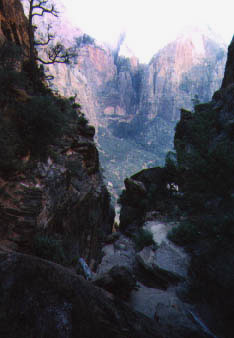
Dawn lights the trail below Angels Landing in Zion National Park in this file photo from 1999. / Photo by the USU department of journalism and communication Tracie Cayford, communications director of the Utah Travel Council, says the national parks are facing an imminent problem -- they are being loved to death. As a result of exploding visitation, many parks around the nation have had to implement measures to decrease the number of cars entering into their confines. The problem is anything but new. James Bryce, a British ambassador to the United States, warned the National Park Service as early as 1912 of the dangers automobiles would bring to national parks after a visit to Yosemite National Park. "If you were to realize what the result of the automobile will be in that wonderful, that incomparable [Yosemite] valley, you will keep it out," he said. Now, 88 years later, Secretary of the Interior Bruce Babbitt is heading Bryce's counsel by pushing for a comprehensive plan that would cut automobile traffic in Yosemite by 60 percent, the Los Angeles Times reported. In three weeks, Zion National Park will implement a mandatory shuttle system, one of the first of its kind in any NPS administered site, said Cayford. Visitors during the peak season will no longer have to fight for a parking space, but will be dropped off at trailheads and picnic areas by bus. Other national parks such as Grand Canyon, Yosemite and Utah's own Bryce Canyon have started their own shuttles, Cayford said. But unlike Zion's, those shuttles are voluntary. Grand Canyon has both shuttle and train systems to carry visitors through portions of the park. A bus system operates on three different loops. In addition to shuttle buses, visitors coming to the Grand Canyon's South Rim may ride a train. The train operates once a day from Williams, Ariz. Grand Canyon Railway, the company operating the rail line, claims to displace as many as 30,000 automobiles in the park each year, National Park magazine reported in 1992. Though the shuttle system in Zion is new to most visitors, it is not new to the park. A shuttle was the only way to see the park in the 1920s, Tom Haraden, assistant director of interpretation in Zion, said. It has taken a number of years to reach the point where the shuttle system in Zion could begin operation. Haraden said the shuttle plan has been talked about since 1993. The inception of the shuttle could not begin until the completion of other major construction projects, such as the opening of a new visitor center, bus loading stops and a new bus maintenance facility, said Kirk Scott, general manager of Parks Transportation, the company that contracted to operate the shuttle service in Zion. Any major construction project such Zion plan takes a significant amount of time to come to fruition, said Scott. Shuttle service will be inaugurated May 26. Buses will operate from 6:30 a. m. to 11 p. m., Scott said. During the early morning hours and other less busy times in the day, the shuttle will run every 30 minutes, said Haraden. It will run in 15-minute intervals when visitation increases later in the day and at peak times it will pass every six minutes, he said. The last shuttle will leave the visitor center at 9:30 p.m. and depart from the Temple of Sinawava, the stop furthest into Zion Canyon, at 10:15 p.m. The shuttle will mainly operate within the six miles of Zion Canyon. There will be three shuttle routes, Scott said. One will operate in Springdale, one will go up the scenic drive in Zion Canyon to the Temple of Sinawava and the third route will operate between the two campgrounds and the new visitor center. During the busiest hours on the canyon route, the buses can carry up to 680 seated persons per hour each way, Scott said. The shuttle will cost the park $2.5 million per year that will be paid for by entrance fees, Haraden said. The shuttle system should substantially reduce pollution in the portions of the park where the buses run exclusively, Scott said. In addition to there not being cars in those areas, the busses are powered by clean burning propane engines which will further rectify the pollution problem, he explained. Haraden said the shuttle system will not only reduce pollution in Zion Canyon, but will also decrease noise pollution and decrease the damage to plant life. Most visitor feedback to the new shuttle system has been positive, Haraden said. Many visitors have said "it's about time [for the shuttle]," he added. However, there are those living close to the park that say by implementing the shuttle plan, the park service is shutting the park off to its visitors, Haraden said. Some tourists have been resistant to the new shuttle system, Cayford said. Their thinking is that the West should be wide open and free of restrictions, she explained. She said the NPS argues that the shuttle will improve the visitor experience, but some see it as an inconvenience. Babbitt said that despite new measures to control the amount of cars in many of the national parks, visitors should still feel welcome. "People are welcome in their park," Babbitt said in a recent Los Angeles Times article. "We don't manage national parks by taking the easy step of saying, 'stay home.' That would just further the breach between Americans and their natural world." "We can improve the visitor experience and at the same time we are recovering and restoring the landscape to something more approximating its original condition," Babbitt added. The shuttle should have an immediate positive effect on the landscape and litter alongside the roadways, Scott said. According to him, there won't be the line of cars and other vehicles parking on the vegetation alongside the roadways as there is now. Representatives in rural communities neigboring Yosemite have expressed the same fears of their counterparts near Zion -- they think there are too many restrictions by the park service. "The American people are in love with their vehicles and it is going to be very hard to get them out of their cars and on a bus, especially with strollers and picnic baskets," said Mariposa County Supervisor Garry Parker, who lives near Yosemite, in the Los Angeles Times. "I think the traveler might look at this and say 'It's just easier to go somewhere else.'" Zion will not know if the shuttle service will send potential visitors to other areas of the park or to alternate destinations until it has been in service for an extended period, Haraden said. "I would think the plan does not cause a significant redirection of traffic," Scott said. Even with the inconvenience, Scott said tourists will still come to Zion in droves. "I don't think they are projecting any significant decrease in patronage of the park with the shuttle service," he said. Springdale, which lies adjacent to Zion's south entrance, is constructing additional parking areas to ready itself for the beginning of shuttle service. Cayford thinks that because visitors will be forced to park in Springdale, it might help tourist-related businesses in the town. Another benefit the shuttle may have is encouraging visitors to stay longer, she said. To prepare for the new buses the park service is adding the shuttle service information to their 1610 radio broadcast, Scott said. They are taking groups of travel agents, tour bus companies and others through the park to explain the new transportation system, Haraden explained. The park has also had numerous contacts with the media to get the word out on the changes, Scott said. The shuttle system is one more step in the continual management process of the park, with many more to come. Overall Haraden thinks is preserving well the natural beauty of each park while also trying to preserve it for future generations. He said the NPS is continually searching for ways to accommodate large numbers of visitors without hurting the superb scenery. One thing Haraden likes is the "spectacular support" the park service receives from the public. He said Zion constantly receives letters and oral comments about the wonderful work the NPS does. He said he is pleased that many visitors are conscientious in their effort to take care of the park during their stay and have also donated extra money on top of their entrance fee. Haraden said the NPS takes its work of preservation seriously. He thinks the park service is good at what it does. "We are not bureaucratic government employees," he said. "We are working for ideals." He said he doesn't work for the park service for the money. If he was looking for a large paycheck, he would work elsewhere, he explained.
|
Archived Months:
January
1999 January
2000 |
||