|
A cold night and a fight for
life with the lambs of Ewe 3022
Text and photos by Joseph Sheppard
March 26, 2006 | The two lambs in the pen with Ewe
3022 weren't yet an hour old. The white one prodded
and jabbed at the ewe's udder, trying to find a teat.
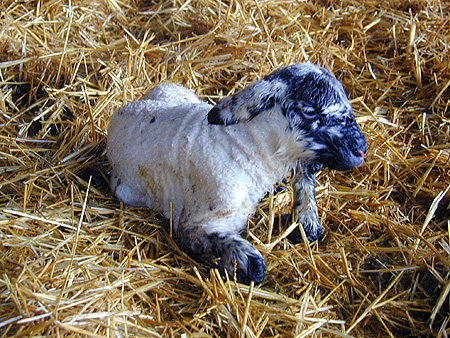
The other, still yellow and goopy, lay on the straw,
shivering.
It had been a tough delivery. The lambs had been tangled
inside the ewe and one had begun to come out backward.
Randall Apgood, a student instructor for Utah State
University's sheep production class, pulled on shoulder-length
rubber gloves, covered them with a lubricant and plunged
his arm into the ewe up to his armpits as he struggled
to sort out and turn the lambs. Once they were untangled
and he found two front legs, he began to pull.
Derek Trauntvein, an animal science major, held the
ewe's head to hold her still. She wasn't too happy about
any of this, he said.
Trauntvein and Apgood are spending the night at the
barn as an assignment for the production class. Students
in the class take turns staying at the barn from dusk
to dawn in case the ewes experience dystosia, or difficulty
birthing. Trauntvein and Apgood will pass the night
in limbo between a cot in the office and shivering through
their turns at hourly checks on the sheep.
It's a good thing they were there. They were able to
pull these two lambs out and probably saved their lives
in the process. But one of the lambs isn't in the clear
yet. It is matted with goop and has a dark yellow stain
across its stomach -- iodine used to cauterize the wound
from when the umbilical cord was pinched off.
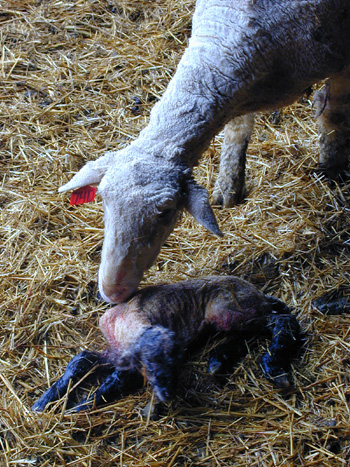
The ewe, steaming afterbirth still hanging from her,
steps on the lamb, not seeming to notice it. The barn,
although heated, can't have cleared 30 degrees by much
on this bitterly cold night. Outside it is about 5 degrees.
Some ewes aren't too bright, Trauntvein says. This one
hasn't even cleaned one of the lambs off yet. He picks
up his limp patient and carries it into the office to
try to warm it up.
On the way to the office he passes a whiteboard where
the thought of the day is written: "The vast majority
of lamb deaths can be prevented by a watchful shepherd.
Check to be sure lambs are nursing and not hypothermic.
A chilled lamb is a dead lamb."
Trauntvein places the lamb in a box with a heater
where it lays shivering, its sides heaving.
Back in the barn, the lamb's mother is given a shot
to help her pass the afterbirth quickly. She will eat
the afterbirth, says Adam Summers, president of the
USU Sheep Club. He and his wife, Eden Summers, have
joined Apgood and Trauntvein on the night watch. The
ewe licks off the lambs and eats the afterbirth to hide
the scent from predators, such as wolves, he says. Ewe
3022 and her lambs are in one of several "jugs" or pens
in the barn. Perhaps 20 ewes with their lambs are fenced
in on one side of the barn, while 70 more are on the
other side of the barn and in the adjacent barn. Most
of these ewes have a green dot on their back, indicating
that they are pregnant.
A garage door is partially open to allow the pregnant
ewes to pass from one barn to another. About 20 ewes
crowd under a large heating vent. The ewes have been
roughly shorn and are covered with wooly uneven ridges.
Eden Summers, the "first lady" of the Sheep Club, explains
that they are shaved before lambing because the heavy
wool gets in the way. That is kind of sad because it
is so cold, she says.
Adam Summers scans the herd for other ewes ready to
deliver. When they're ready, they separate from the
herd and stop chewing their cud. They develop a sort
of hourglass shape and paw at the ground and try to
get comfortable, he says. The teats get really swollen
and "if you're lucky," they'll start dripping, Summer
says.
"This is a possible candidate," Summers says, pointing
to ewe 320. The ewe is wandering around the barn uncomfortably,
pawing at the ground. Summers points out that her udder
isn't swollen and speculates that she probably has mastitis.
"Yeah, she will lamb tonight," he says.
He returns to the office with Apgood and Trauntvein.
On their way back they talk about a ewe that bled to
death earlier that week. Summers interjects, "I'll tell
you a story about internal bleeding..." and the door
closes behind them.
All is quiet now in the barn, except for the snorting
of sheep that have straw caught in their nose. Steam
rises in the breath of each animal. A llama sleeps near
the door of the barn, here to protect the sheep. The
air is thick with the odor of sheep, hay, and blood,
an odor that sticks to your clothes hours after you
leave. Ewe 320 makes her way to the group of sheep clustered
around the heating duct and kicks irritably at the ewe
in front of her and forces her way into the center of
the group.
In the office, the newborn lamb in the box has stopped
shivering and has begun to move around. "In about a
half hour that lamb will be ready for the elements and
his mother," Summer says.
Sure enough, not much later Trauntvein carries the
lamb back to its mother's jug and sets it inside. Its
mother now assumes its duties and the lamb staggers
around the jug as the ewe tries to lick it off. The
lamb searches under the mother's legs for a place to
suck. Trauntvein says this is a good sign that the lamb
is going to be OK.
The lamb bloodies its nose in the mother's still-hanging
afterbirth. Then there are audible sucking noises. The
lamb has found the teats. Its little tail begins wagging
excitedly in circles.
Trauntvein bends down to see and says, "Yeah, he's
sucking good. He says of the lambs, "These last two
might not have made it if something hadn't been done,"
and heads back to the office where he may get another
hour or two of sleep.
MS
MS |