|
||||


 |
Walking the Mormon Trail puts author in touch with American spirit
By
Toby G. Hayes
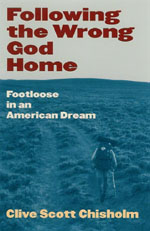
The Mormon Trail is 1,300 miles across the plains and rugged Rockies blazed by Brigham Young and thousands of LDS faithful. Scott Chisholm walked it too. He is neither LDS nor a pioneer, but made the trek in search of the American dream. "Walking across Nebraska was hell," Chisholm said. "If LDS people want to get a feeling of their heritage, then (The Mormon Trail) is where they need to go." Chisholm was raised in an RLDS (Reorganized LDS) home and held many of the same beliefs as Latter-day Saints. But those beliefs began to dull even before he was expelled from an RLDS college in Iowa for challenging doctrine. Despite his fading faith, Chisholm admired the Mormon pioneers for their exhaustive journey to what was then Mexico in 1846. "It's so unique a faith," he said. "They put aside their worldly goods and decided to march west." Chisholm says the pioneers were following their American dream, one rooted in religion. What is the American dream? Chisholm asked himself. A Catholic convert and native of Canada, Chisholm didn't believe such a thing existed. "It's false advertising," he said. "No one ever told me they had a Canadian dream. I've never heard of an Australian or a Swedish dream. Americans like to believe their tunnel is the one with the light at the end of it." Chisholm decided to walk the Mormon Trail in 1985, in search of the answer to the American dream and has written a book about his journey, the history of the trail and what he discovered along the way. Following the Wrong God Home: Footloose in an American Dream was released this month. The American dream has two parts, he says, individuality and community. "I used the idea of the Mormon Trail as community," Chisholm said. "And while I was walking I was thinking about individuality." He developed a theory as to why Salt Lake City and the LDS Church thrived in the arid northern Utah deserts, establishing their American dream. While the West was mostly tamed by individual homesteaders, Salt Lake City became a cooperative community. Theoretically, individualism and community cannot work together, except in the case of the early pioneers, Chisholm said. The LDS Church welfare system is an example of successfully meshing of those two ideals. Because of its success, the church system has become an example to other churches and other nations, Chisholm said. More than in search of a dream, Chisholm wanted to experience what life was like on the trail for the pioneers. That's just what he got, an experience. He walked past almost forgotten graves, peeking just above overgrown fields. He could even see the ruts left by the wheels of handcarts and Conestoga wagons. He experienced the harsh temperatures of summer and 6 inches of Wyoming snow in June. Chisholm even pulled a handcart along the trail, sort of. "I wanted to duplicate the journey as much as possible, but I couldn't find a handcart," he said. "The closest I could find was a golf cart." It would have to suffice. So he strapped his backpack to it and kept walking, soon finding out how rough the trail really was on him and especially handcarts, or golf carts in this case. "Here's an American product made from metal that you think would last for 60 miles, but it didn't. It collapsed," he said. It took Chisholm 91 days to arrive in Salt Lake City. His plan was to stand where Brigham Young stood and end his journey at the "This Is the Place" monument. It did end there, but not like he planned. "It was closed. It made me so mad," he said. "So I climbed the fence hoping to be arrested. I thought it would be a good ending." To some Chisholm might seem anti-American, or even anti-Utah. But 18 years after walking the trail, Chisholm as retired to the southern Cache Valley town of Paradise. And in a book written by noted author and Chisholm's college roommate at Missouri, William Least Heat-Moon says Chisholm may seem anti-American, but puts up that front for fear of having to pay up bets he made when he first came to the United States decades ago. More than just a search for the American dream, Chisholm hoped the walk on the The Mormon Trail would finally subdue the religious beliefs he left behind long ago. "I thought this book would put it all to rest. But I can't let go of it," Chisholm said. "It was the one piece of the Mormon dream left unfinished. And that's the piece I walked on foot."
|
Archived Months:
We've published stories since 1998. We've saved them all. Click the link below to take you to the Archive home page. We have no search engine on the archive, so if you're looking for a particular story, you'll need to search month by month or use keywords from the story in Google.com |
||