|
||||


 |
Freedom requires defending free press, especially in wartime, says Terry Anderson By
Shante' Tinsley
and Nicole Rusher
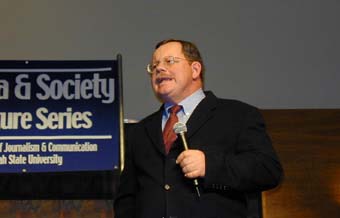
Terry Anderson fields questions Monday during a JCOM Media & Society Lecture. / Photo by Nicole Rusher "When they try to shut you up, speak in a louder voice." Terry Anderson came to USU to speak Monday, advising that a journalist's job is to watch government and make sure it does what it is supposed to. He says the government likes to keep secrets and will do so unless journalists keep reminding the government that "We The People run this nation." Journalism is a dangerous job. Some journalists "go to work not knowing if they will be alive at the end of the day," he said. Last year, 37 journalists got killed and 118 were jailed. "You have to really believe in what you're doing," Anderson said. Anderson said the American government has shown itself willing to sacrifice certain rights in pursuit of the war on terrorism. Not only has this occurred in America, but America is telling other countries to muzzle their press, he said, as when Secretary of State Colin Powell encouraged press controls in the Middle East. "You cannot have a free society without a free press," Anderson said. It's been just over 10 years since Anderson was released as a hostage by the terrorist group Hezbollah, or Islamic Jihad. Beaten, blindfolded and physically tortured, Anderson learned how to survive each day, never knowing if he would see the next. While working as chief Middle East correspondent for the Associated Press in Beirut, Lebanon, Anderson was stopped one day by a gunman who forced him out of his car and into a van. He spent nearly seven years as their prisoner. Anderson delivered a Media & Society Lecture, sponsored by the journalism & communication department, in the Taggart Student Center Ballroom. Anderson speaks little about his experiences in public forums. Instead he has focused his attention on aiding the release of journalists who have been wrongfully imprisoned. As honorary co-chair of the Committee to Protect Journalists, Anderson works to bring awareness to attacks on the press. He believes that the press need extra protection because in the case of war and political conflict, the press are always the first target. "If they need silence, they go for the journalists first because they are afraid of them," says Anderson. The role of the CPJ is to get journalists out of jail and other dangerous places. The organization is a vital tool in aiding journalist around the world and saving many from a fate such as Wall Street Journal reporter Daniel Pearl, who died last month when he was brutally shot in Pakistan. Anderson's reaction to Pearl's death was of shock and horror. He said he believed that Pearl's captors never intended on letting him go. According to Anderson, Pearl was used as a weapon to embarrass the leadership of Pakistan, and unfortunately, his murder was a problem that could not have been solved. Anderson also commented on the Sept. 11 World Trade Center attacks. In a question-and-answer session, one audience member Monday suggested that the media attention played a part in furthering terrorist action. Anderson does not believe this is true. He said that journalists are there to serve those who have a right to know. "What would you have me do? Ignore the World Trade Center? Because they [the terrorists] want that is a reason I should not report it? No. You have the right to know who is attacking you and what they are saying," said Anderson. "Believe it or not, we are on the side of angels -- we are the good guys,"he said. Anderson said that the state of relations between the press and military is bad, and stays that way because the military is in charge in any war. The military wrongly blamed the press for losing the Vietnam War, he said, and claimed that American public opinion turned against the armed forces because of journalists' freewheeling, uncensored coverage. After the Vietnam War, its veterans who became generals and colonels over the next 20 years began changing the rules that allowed journalists access to combat zones. "Information is currency to them, and they like to hide it," Anderson said. He said the military has restricted access to the war zone in Afghanistan and refused to give out information that it dislikes -- such as "collateral damage," the term for civilian deaths. "We still don't know how many Afghan civilian casualties there have been because that information has not been released," he said. "To them, it's collateral damage." During the war on terrorism, the Bush Administration is trying to take rights away from American citizens "that we've spent 50 or 75 years establishing. They will be allowed to put a wire tap on any phone they'd like," he said, saying the laws were established after widespread abuses. "The press needs to get out and remind people," Anderson said. "We are basic and vital to any free society." Journalists need to know their point and purpose. It's not a philosophy -- journalism is all about finding and telling the truth, he said. "We have to be willing to take chances to get important information. It can be the most exciting career in the world, but it takes dedication," Anderson said. After his release from captivity in late 1991, Anderson became an author and an activist for social justice, including his role at the Committee to Protect Journalists. CPJ is financed by private donations and media organizations. It has an annual dinner to recognize journalists that raises close to a million dollars. It features one journalist in jail each year -- "every time they have done this, the journalist has been released," Anderson said. "Publicity is a weapon, that's all there is to it," he said. Anderson is the author of Den of Lions, written the year after his release from Lebanon. Anderson has also written an award-winning documentary, Return to the Den of Lions, after his return to Lebanon. Currently, he resides in southeastern Ohio with his wife, Madeleine. He has two daughters, Gabrielle and Sulome. To learn more about the Committee to Protect Journalists, visit its Web site at www.cpj.org.
|
Archived Months:
January
1999 January
2000 January
2001 |
||