|
||||||


 |
Hungry, wild horses find homes through BLM adoptions; some are real pussycats By
Samantha Nicholas
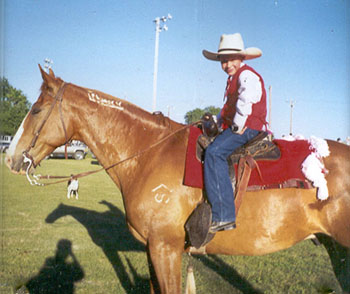
Old Thundering Bob, looking good. Photo coutesy of the Earl family. Old Thundering Bob was a part of the Earl family for 13 years. Calm, hard-working, tough and four-legged. When Bob ran, it sounded like a giant draft horse was coming at you instead of a wild mustang. Bob was the first of a half-dozen horses the Earls have adopted through the Bureau of Land Management's Adopt-A-Wild-Horse-or-Burro Program over the last 15 years. "Old Bob worked as hard as any horse I've ever had," said David Earl.
Kyle Hansen, wild horse and burro specialist with the BLM's Salt Lake District office, is responsible for the Cedar Mountain and Onaqui Mountain herds. He performs an aerial count of one herd each year, alternating between the two herds in his care. According to Hansen, the appropriate management level, or herd size, is determined and a low, median and high number of animals are established. The median at Cedar Mountain numbers around 270 head, the high is 380. The last aerial survey of the herd counted 585 head. This over-population causes severe damage to the land, and also to the horses. Droughts are another problem for wild horses. They can forage only a short distance from a water source. When the feed resources in that area are depleted, the horses are literally stuck between a rock and a hard place. Increased snowfall in the winter translates into more feed and water next spring and summer. However, until the snow melts it will be difficult for the animals to find enough feed to make it til spring. "Believe me, they're suffering (this year)," Earl said. In many cases, the animals have a poor diet before round-ups are organized. Feed resources are few and far between. For some, starvation is imminent even with round-ups occurring regularly. Once animals have been rounded-up and put into the adoption program, the BLM is responsible for improving their condition before adoption. Earl has visited adoption centers in Utah, Idaho and Nevada and believes they do a good job. "All of the horses I've seen at least qualify as in good condition," said Earl. Some wild horses find it difficult to adjust to domesticated life and a new diet. Instead of sage brush, most horse owners provide alfalfa or grass hay. For young horses that have recently been weaned, adjustment is even more difficult. Earl has adopted a couple of weanlings (young horses recently weaned from their mothers) and says it is amazing how much they improve when they get a few more "groceries." Many potential adopters express concern about the "soundness" or quality of wild horses. Lack of adequate nutrition during the formative years can seriously affect growth and future performance. Earl maintains wild mustangs are no different than domesticated horses. Some are calm and easy-going and others are a little more nervous and require more time and attention. Each has its own personality. "I've got some mustangs you'd never know was mustangs, they're tougher than hell," Earl said. The federal government requires the BLM to hold round-ups for each herd every four years to maintain the desired number of animals. Following the round-up, horses and burros are evaluated by a veterinarian and given vaccinations and de-worming medication. Studs (males used for breeding) are carefully chosen for each herd. A herd is chosen to be returned to the wild and the others enter the adoption program. Horses in the program are held by the BLM for a minimum of 30 days, at which time they are given a booster shot to complete their vaccination schedule. If horses are deemed healthy by a veterinarian at that time, health certificates are issued and they are offered to the public for adoption. Geldings (males that have been castrated), mares and foals are all available for adoption. If a mare is still nursing a foal, they are offered as a pair. According Hansen, 80 percent of horses rounded-up are adopted. Horses that are not adopted here in the West are shipped to the Eastern States office where many are able to be placed with adopters. The unadopted animals are sent to "sanctuaries" in the Mideastern states. Sanctuaries are like a retirement home for horses. A retirement pasture is a better description. They wander through belly-deep grass, receive vaccinations every six months and other healthcare as needed. That is a much better future than they faced on the range. If their population remained unchecked, they would face gruesome death by starvation. Regularly scheduled adoptions are held across the United States. A few years ago, the adoption process required adopters to fill out a form, hand over $125 and pick the horse they wanted. Today, the procedure is a bit more complex. There are still forms to fill out, and minimum requirements for facilities and equipment to meet, but now the minimum bid for adoption starts at $125. The adoption is just the beginning. During the first year adopters are subject to surprise visits from BLM officials. At the end of the year-long trial period, adopters must have a local veterinarian or other qualified individual sign a form assuring that the animals have been well cared for. If all requirements are met at that time, title to the horse is turned over to the adopter. Earl believes the BLM Adopt-A-Wild-Horse-or-Burro Program is worthwhile and says the officials are "really good to work with." Improvements in management of wild horses such as selective breeding and integration of new studs into existing herds will continue to increase the value of this resource. Remember Old Thundering Bob? When he wasn't moving sheep herds around, he was "babysitting" Earl's small children. According to Earl, he could put his kids on Bob's back and never worry about them. It takes a very special horse to earn that kind of trust. Some horses are never suitable for young riders. Maybe that is why Earl is a believer in the BLM Adopt-A-Wild-Horse-or-Burro Program.
|
Archived Months:
January
1999 January
2000 January
2001 |
||||