|
||||


 |
Hurry up, please, it's time -- time to make memories green and blue • Part Four of a series By
Bryce Petersen Jr.
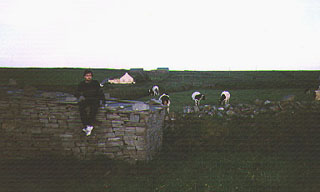
"Ireland is so peaceful; look at the cows," I said, mocking the other tourists at the Cliffs of Moher. Later we saw a postcard with grazing horses. "Peaceful Ireland," it said. We did take this picture for the farm scene, as well as the stone fences -- built by starving citizens during the Great Famine -- that snake across the Irish countryside. / Photo by Kenna Dyches "I don't want to grow old," he said. "I don't want to get frail and sick and impotent. I think 50 years is long enough." I remembered my grandpa on top of a desert mountain, a speck in the distance as he waited for us, 60 years younger, to catch up. I remembered the old man with his walker, wife by his side, struggling along as she holds his arm and smiles next to him. "I do. I want to see all of life." Bridge
is closed, he told me, Newgrange is bordered by farms and fences. The only way in is a two-mile bus ride. The bus was full. Near the front, a small boy was being shushed by his mother. Many on the bus were in their golden years. To Newgrange, we were all the same age. We live but a season. An hour. But the ancient monument was not old. It did not age. "I can't help but overhear your conversation," said a wrinkled woman one seat up. "I am 75 and I can tell you, it's wonderful." She was from Wisconsin, her husband had died a few years back. She was on a three-week bus tour through Ireland with several others, mostly American seniors, with whom she had had a "wonderful time." She told us of the beautiful lakes, the seashore, the lovely cottages and delightful breakfasts served in country homes along her way. I forgot about nursing homes, Alzheimer's, lung cancer and Parkinson's. Old age was a goal, the capstone of a wonderful life. I determined to make memories for porch-swing reminiscences. I determined to make memories even from my porch swing. My next stop was Stranraer, Scotland, a short ferry ride from Belfast. Stuart, a wild-eyed, hard-drinking Scot, another City Manor alum, had told me of epic hikes to castles, islands that move in the sea, Volkswagen Beetles at the bottom of the ocean, a postman who delivered his last letter in a snowstorm before succumbing to hypothermia and a banker who had left the world to live in a cave near Stuart's home. I had to see this place, and Stuart was home for a time. I saw them all: The hike to the castle, pretty, wasn't as long as it seemed in the story; the island, Ailsa Craig, did seem to drift a bit as we drove by; the postman's marker in the field seemed small and lonely; the pier that launched the watertight Beetle, a television stunt gone awry ("It's at the bottom of the ocean to this day") was speckled with old cans and Styrofoam; and a plaque was all that marked the life of Snib Scott, the hermit who died in 1982, when Stuart was 11. Stuart's mother thought he should leave his traveling and stay at home; help her run her little antique shop. His father didn't think much anymore, his life-of-the-pub days had been put to a stop by I-don't-know-what-makes-you-stare-with-black-eyes-at-whoever-comes-in-and-struggle-to-find-the-proper-pleasantries. The tour took one day, as Stuart drove to Glasgow to renew his passport. The next morning I left on a boat. The next week, Stuart left his mother and father for Spain. Back in Belfast, the taxi driver asked where I came from. Then he asked if I was Mormon. He'd seen those lads in black suits before. "But I always tell them we have enough religion here." I didn't plan to stop in Belfast. I'd had enough of cities. But there was a big parade, with 10-foot puppets from Africa, Jamaica, Cuba, Brazil. Lots of drums, dancing and costumes. So I saw a brass band from Cuba with a bottle of wine. Left my bag in a bush that night. They wouldn't take it at the train station; thought it might be a bomb from the Orangemen or the IRA. Met a girl, talked about big families, rebellion, music, art and potatoes. Slept on her couch. Forgot about my bag till morning. It was still there but my camera wasn't, and neither was the coat I hadn't worn once on the trip. Took the bus to Ballycastle. Slept in a hostel. So restful. Woke up early and had free bread and tea. Decided to walk all day. Stayed clear for the morning, passed herds of sheep (and one old farm truck) on detour through gently rolling hills with pockets of rocks where more sheep hid. I've never felt so fond of sheep as those that floated like low, white clouds through the landscape. I didn't know where this road was taking me. It didn't matter until I saw it: The tattered remains of an ancient castle were on a tiny peninsula that shot up to 100 feet above the ocean crashing below. A stone staircase plunged to the coast from a small parking lot and a narrow land bridge opened up to the lush cliff tops. At the pinnacle, I cut some bread and a hunk of cheese and rested. The sun still shone. Birds floated past the point. There were no buses, antique shops, fathers, sisters, music, parades, girls, preachers, razors, wines or trumpets here. Only me and the seagulls drifting by. Some time later, a family clambered down the slope and I let them have the spot. I resumed my journey back past the sheep and followed this morning's road on. The next stop was a rope bridge, 65-feet long and 80-feet high, to a bird-filled island used as a salmon fishery. The rain had started and a man from last night's hostel offered me a ride to the next town. The bridge is closed, he told me, too much wind and too much rain. The slick wood and swaying ropes were too dangerous. I said thanks, but I'd like to see it anyway. The island stands right in the route of migrating salmon. Its placement pushes the fish nearer to shore for a moment and when they return, the nets await. A quick little fisherbird, called a fulmer, nests on the island and hundreds of them bat skinny wings like a sparrow to keep their fat bodies aloft. The water is no different from the air to these creatures. They swoop and dive after fish, then swim after them without losing speed. I watched them from under a raincoat. I waited at the bridge, watching the ocean over 80 feet below reveal three shades of blue, three shades of green and two shades of brown. The rain swirled down in the wildly shifting wind. A fulmer came up with a fish in its beak. Gorgeous. A family tromped up -- the girls in high heels complaining about the walk, just under a mile, the boys complaining that it was closed -- and left. A few members of a bus tour walked up, cursed their luck and hurried onto the next site of the well-planned journey. I watched the rain. I drank tea with a Dutch teacher on a bike tour. We thought we'd wait and see if it cleared off. We shared stories and dried off in the shop, then walked back to the bridge when the rain subsided. One at a time, we crossed, staring down at the ocean as we swayed. The island was small, the birds were plentiful and the vegetation was thick. Then we parted. I couldn't walk as fast as him. I didn't need to, he only had three weeks. At 5 or so, I checked into a hostel overlooking a beach. It cost too much and it was too clean, but I got to put down my backpack. A man named Chris was telling everyone loudly that he was headed to the Giant's Causeway that night. He'd found a ride and he was looking for a companion. He had a flashlight but it shouldn't take more than a couple of hours, it's less than a 5-mile hike. Without my pack, it would be a cinch. He was right, it was less than 5 miles. I tagged along. We hop over a fence because we think they close the trail when the visitor center closes. Up the first incline, Chris is wheezing. "Whew," he says. "I just wanted a walk, not a mountain climb." Oh boy. Then, we come to a spot where the trail is covered with rocks. It begins to look like the gate was there for a reason. No one has cleaned this trail for ages. The trail follows the middle of a 300-foot cliff. Chris slips on the wet rocks but catches himself. Has to stop for a moment to "collect myself." He is panting. While we wait he tells me thoughts on Mormons. "I like the Mormons. My mom's a Mormon. I go to that church to study the Bible sometimes. They try to get me to stay for sacrament meeting, though, and lessons. I can't handle no three-hour meeting." We press on. He keeps saying how beautiful it is. How we came the real way, the way nobody else dares to go and such. He's right, I suppose. But I'm having a hard time concentrating when every few steps Chris slips, hundreds of feet above the ocean. Sometimes I notice the stark rocks, trailside flowers and crashing waves, but often I imagine his broken body lying on the beach. "So, what do you do for a living?" "I sell pot." Ha, ha. But then he's asking me how much I could get rid of if he came to Utah. "None." I see the merging with the real trail and scamper up a couple of boulders to safety. After a few minutes of watching Chris struggle with the footholds, asking, "Where did you put your right foot first?" and such. He finally gets up. I let out a cry of triumph and relief that echoes to the sea. Finally on flat land, Chris still puffs and whimpers occasionally, but in between, he tells me that we are the luckiest, best hikers on the planet and that we saw a view that is better than all the rest. He's bored now. He looks for a path back to the middle of the cliff. No. It's dark and I am happy to be safe. After a while the trail hits the road. I vote to walk along the beach some more, follow the trail. Doesn't he have a flashlight? Well, he does, but it's a pen and the light is red. Useful for illuminating which type of bug just bit your arm, I suppose. We walk the road. Back at the hostel, my bed is full. I sleep on the floor and in the morning Chris demands my money back. I get it. I love that Chris and that hostel and buy myself a dinner of salmon the next day. We walk to the road and stick out our thumbs. He is headed west, I am headed east. I ride with a daddy and a daughter from Boston to Dunluce Castle. I wanted to see this one because part of the servant's quarters collapsed into the sea while it was still in use. "Servants and a night's dinner were lost," according to Lonely Planet. I'm rather tired of castles, but it has a nice view. In Portbradden, I see St. Gobban's church. At 5 by 10 by 8 feet, it's the smallest in Ireland. My next driver, who turned out to be a mechanic in a customer's car, said, "Where you goin'?" "Londonderry." "Derry? Hop in." He took me part way; said I was lucky, he'd known people who had never left Portrush. A trucker picked me up next. "Derry," I shouted up at him. "Londonderry? Get in. Time. Time." Time? Time?
|
Archived Months:
January
1999 January
2000 January
2001 |
||