|
|||||||


 |
In a converted barn west of Smithfield, 371 pairs of eyes watch you in the 'doll room' By
Angela Johnson
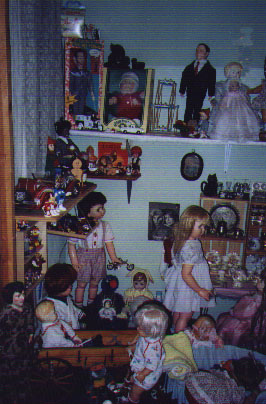
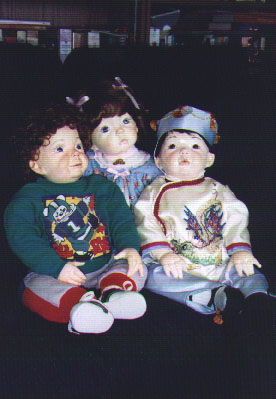
Some of the dolls in Annette Van Natter's doll room. / Photo by Angela Johnson If you drive west approximately six miles from Main Street on 100 North St. in Smithfield, the road takes you to an old barn converted to a house with two newer additions, one of them a garage. The gravel driveway leads to the new garage, which was added about three and a half years ago, and just behind that is a new greenhouse, "where the berries are." The cement-made cobblestone path leads to the miniature, wooden bridge over the foot deep canal that takes water to the backyard, the path then follows to the front door. The vibrant yellow and red tulips are blooming and the wind is always a little stronger here than "in town." The only sound is the gentle breeze. Standing in the front yard you can see numerous mountain ranges, the Wellsvilles being only one of them. Aside from a neighbor on the south side of the couple mile-wide block, the only other things around are the fields that stretch out for miles. This is where Annette Van Natter, a doll maker, lives. Her "doll room," which is in the upstairs of the converted barn portion of the house, is about 4 feet by 9 feet. When you enter, 371 pairs of eyes greet you at the door and your eyes don't know what to settle on first. Perhaps the three girls having a tea-party, complete in appropriate tea-party attire, sitting around a table with cups setting on matching saucers. Then you spot "Rambo," the 18-inch Sylvester Stalone look-alike, sitting upright in a chair that seems to fit his macho demeanor, created by the bandana on his head and camouflage uniform. You don't know where to start or end; the small room holds the 371 dolls, figurines, bears and other animals that Annette has either made or collected. There are so many details in every corner, you eyes go in circles around the room -- you think you've spotted everything, then you see another doll specifically tucked in a corner or on a shelf, and the head-turning begins again. Annette doesn't have a favorite doll that she's made; she said she likes all of them. Her newest creation is a "Gypsy Peddler" doll with a chair made from willow branches and a handcart full of toys. She looks as if she is a peddler in Europe selling homemade toys from her cart, says Kathy Peterson, Annette's sister. She wasn't always a Gypsy Peddler though. "She laid there for almost a month," Annette said. "I didn't know what to do with her." Then Annette found a silk scarf and made it into a dress for the 14-inch china doll. Then she made the handcart that holds the toys that the doll is going to sell on the main street. And it's winter so she will need a coat, and she will need a chair to sit on when she gets tired. The first step to make a doll is to pour the liquid stoneware or porcelain into a plaster mold to make the head, hands and feet, depending on what parts you want to be cloth or ceramic. After the liquid stoneware, which looks like a watered-down gray mud, is poured into the mold, you "just let it sit for a few minutes." Sometimes more than a few minutes depending on the humidity, which usually isn't a problem in the Utah climate. The mold absorbs some of the moisture making it possible to pour most of the stoneware back into its gallon size container, which makes the doll parts hollow. Then you take the rubber band off that hold the two halves of the mold together, to allow the doll part to dry for one to two days. After the doll parts are dry, there are seams from where to two halves of the mold were joined, so you have to sand them down to create a smooth surface. If the doll has glass eyes then openings have to be cut for the eyes to fit into from inside the doll's head. After the ceramic pieces are fired, it's time to make the rest of the doll's body. The Gypsy Peddler has a breastplate, which is a portion of stoneware that extends from the head and neck of the doll that fits snugly inside a cloth, stuffed body. The Gypsy's hands and feet are done the same way, with the cloth fitting around the forearms and calves of the doll. Now is where the muse begins its work. "When the muse shows up, then you create," Kathy said. "You don't know where you get the ideas, they just start flowing. A creative 'something' shows up and it just takes over." Kathy says when Annette finds her muse, she is almost in a trance, occasionally taking a break to eat. Sometimes Annette comes downstairs at 8 or 9 a.m. and she's been up there since 2, because she couldn't sleep. "I can work on something and it will be six hours later and I didn't even know it," Annette said. That's usually how it goes. First a mold, then maybe an idea, then the muse, then a doll with a complete personality, possessions and maybe even a name. "She (Annette) says, 'I know what the doll needs,' and she'll start whipping out stuff. And it's right." Kathy said. "She can't do other things; she doesn't have an interest in other things. Normal things just become so hum-drum." Annette didn't seriously start making dolls until 1983, when she was in her 40s. At least 1983 is the first year mark she has found on the dolls she has made she said. "I always loved dolls and always wanted them," Annette said. She remembers the Christmas when she was 15 and it was the first year that she didn't get a doll. It just ended the excitement for her when she realized her parents thought she was too old to receive dolls for Christmas presents. The first doll she probably ever made was when she was 17, for her younger sister, Alice, who was 6. Annette drew her name for Christmas and made a set of rag-doll "farm twins." They were cloth dolls, a boy and a girl, with yarn hair, made complete by two to three different outfits each. Forty years later, Annette still has the pattern to the farm twins, she says with a small grin. Annette doesn't know what kind of doll she wants to make next. She says after she made her "Mimei Leibling," which is German for "my darling," she feels "fulfilled, just kind of finished," she said. "I just haven't seen anything else, but there will probably be something," she said with a laugh. Many times Annette has altered doll molds she already has to create new faces. She can use the same mold to create several different dolls to complete the personality she gives to them. Using this technique of altering original molds by placing stoneware on the inside of the mold, she can make higher or wider cheekbones. She can make noses longer, chins pointier, and lips fuller, thus making several face--several personalities from one mold. People have given her baby pictures and she has successfully made a doll that resembles the baby.
Her bathroom itself is unique with the towel rack having a rod suspended not by a typical end piece, but a ceramic hand holding a bird on each end of a metal rod--that is her towel rack. A ceramic head and neck of a turtle comes out from the wall and that is what is through the roll of the toilet paper, holding it on the wall. And at first glance in the corner behind the door you see a mouse, but realize it has on a pink dress and is sitting at a miniature table, sipping tea. Annette often has some kind of sewing project going also. Currently she is involved with a humanitarian group with her church making dresses for girls in need of clothes in other countries. She's not sure where the dresses go to, she just puts them in a box and when the box fills up, she takes it to church. "We've done things like gather hygiene items for victims of war, floods, earthquakes, things like that," she said. "Then they announced that there is a shortage of little girls dresses. I thought, 'Yeah, I could make little girls dresses.'" She has made a total of 38 dresses each with its own uniqueness. Some have three little buttons just under the neck opening; others have a row of trim around the hem, some in floral print, others plaid, but all are from the same basic pattern. She says she has appointed herself to do things like this because
she not only has the interest and ability, but because a lot of people
don't just have boxes of fabric lying around waiting to be used for
something. She has also made quilts that were donated to the Deseret
Industries, for the same humanitarian group. |
Archived Months:
January
1999 January
2000 January
2001 |
|||||