|
||||


 |
Simple computing on the cheap: Introducing the Simputer By
Leon D'souza
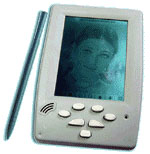
It looks deceptively like one of those trendy Palmtops that the upwardly mobile flaunt in this age when technology has become the newest fashion accessory. But the Simputer is more powerful than a Palm, and it is not targeted at the affluent few. This inexpensive pocket computer is the brainchild of seven scientists and software engineers from India's very own Silicon Valley -- Bangalore. For the past couple of years, this small team has labored zealously to create a low-cost mass access device to bring local-language Information Technology to India's rural citizenry. The Simputer or Simple Computer is their contribution to the massive effort to bridge India's widening digital divide. Priced at an affordable $200, the Simputer is powered by three AAA batteries and an Intel strong-arm chip, known for its low power consumption. The basic design facilitates use even in areas without reliable electricity. With 32 Megabytes of Random Access Memory (RAM), 16MB of Flash memory, a graphical touch-screen interface, a GNU/Linux operating system and Internet connectivity, the Simputer is more advanced than most handheld devices. However, what really sets this small wonder apart is its "SmartCard" reader. The reader enables the machine to be used on a shared basis. This has special relevance in a developing country where even $200 is a lot of money. It is hoped that the government will buy and distribute these machines at the village and district levels so that each community has at least five Simputers. A villager will only need to purchase a SmartCard, expected to cost a paltry $1 or $2. The SmartCard will contain a "roaming profile" required to log into a Community Server which will maintain personalized user data. But what about the fact that most of India's rural masses are illiterate and will not be able to comprehend the information displayed on a Simputer screen? Enter the Information Markup Language. IML-an XML application- enables the Simputer to understand several Indian languages by using a stored library of sounds. It converts text to speech and reads out the information to the user. So, an illiterate user simply taps icons on the screen and the device explains out loud what each one is for. The Simputer can currently "talk" back in four Indian languages namely English, Hindi, Tamil, and Kannada. The Simputer's inventors hope that technocrats from different parts of the country will tinker with the software to include their own language. The open source software is available for download on the Internet at http://www.simputer.org/simputer/downloads/. Cost minimization was an important consideration in the design of the Simputer. To make the device affordable, the team had to adopt an innovative development strategy. According to Professor Swami Manohar of the Indian Institute of Science, one of the project's prime movers, "in any large corporation, such a hardware design would have cost several million dollars." To keep the price tag low, the group formed a nonprofit trust, scrounged funding and technical facilities, and used free software. Rather than manufacture the Simputer themselves, the group will license the design to commercial producers for a one-time payment of $25,000 in the case of developing countries and $250,000 elsewhere. Nonprofit use of the design will not be charged. Several Indian companies are already considering mass production. For India's information impoverished, the Simputer is a step in the right direction. It is now up to the country's political leadership to support the initiative by investing in the distribution of this technology. If it receives adequate support from industry and government sources, the Simputer could well transform the fate of India's rural poor.
|
Archived Months:
January
1999 January
2000 January
2001 |
||