|
||||


 |
President's panel on stress finds pressures can build far too easily
By Heather Wardle
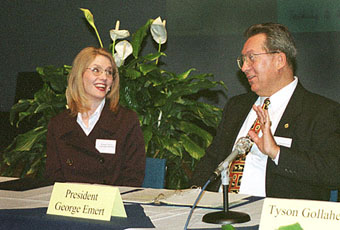
USU President George
Emert makes a point with Brandy Quarez during a panel on stress Wednesday
on campus. Panelists discussed everything from cycles of abuse in families
to reasons for success or failure in stress management in the home.
To read about the panel, click the photo or the link below. / Photo
by Michael Hamblin When parents abuse their kids, the kids often abuse their pets, a psychology department member told a USU audience Wednesday. In the USU president's special forum, President George Emert along with other panelists discussed their concern about stress, as well as their commitment to finding ways in which society can better cope with it. Emert opened the forum by explaining the relationship between stress and violence. He called the slayings at Columbine High School last year one of many "manifestations of stress" in the nation. He said he was disheartened by such drastic acts, and hoped that the audience would be able to have a conversation to avoid repetitions. Dr. Frank Ascione of the psychology department spoke on the topic of child abuse and domestic violence. He said that three major studies done on child abuse and neglect in past years indicated rising statistics. Ascione also spoke about the relationship between child abuse and animal abuse, and noted that oddly enough, the two go hand in hand. He said one might take a walk down the grocery store aisle, and note the amount of space dedicated to food for animals. Statistics show 75 percent of the nation's population own a pet. "Pets are very much a part of the family," he said. Ascione said a study by college students found a relationship between spanking and animal abuse. As spanking by parents went up, so did animal abuse. Ascione noted that animal abuse can be a barometer for child abuse. Many children display characteristics of things they have seen among family members or other siblings. For example, a child may watch his father beating his spouse, and in turn do those same things to his bird or dog at home, Ascione said. Children who grow up in violence have or can display characteristics of violence," he said. Yet, he cautioned, that is not always the case. Steven Vigil, director of the Intermountain Specialized Abuse Treatment Center, also represented the panelist members, and did an exercise with the audience emphasizing the way in which humans process other people, and how they see themselves. Vigil noted the importance of both empathy and tolerance of others and their situation. Progression, he said, comes by "you understanding who you are, what you are about, and how you process your world." The forum also presented two case studies. Engineering student Tyson Gollaher, a panelist, was introduced by moderator Deborah Ascione, wife of Frank Ascione, as "someone with a lot on his plate." Tyson is married, has two kids and works full time while still attending school full time. Tyson was asked to speak to students about how he copes with stress and positive ways in which to do so. He told the audience, "When we experience chronic stress in one area, it will affect other areas in our lives." Tyson attributes his success to his wife, who is very supportive; good communications skills; a budget of both money and time; and mutual love and respect. Then there was Brandy Quarez, a representative of Community Abuse Prevention Services Agency. Quarez gave personal testimony of someone who had suffered an abusive relationship. Quarez is a single mother, raising four children after leaving an abusive husband. Quarez said she was married young and became pregnant only two months after being married. She said she noted a lot of "red flags" going up but felt trapped. "It's different," she said when your involved in the situation. "You have children, a mortgage, bills." Quarez said she believed that her now ex-husband suffered from a lot of stress trying to pay the bills, take care of the children and participate in religion as fully as they had hoped. She cautioned students to watch for warning signs and to follow their best instincts, as those were things she wished she herself had done. In closing, Quarez insisted, "Under no circumstance is the choice to abuse another human being all right."
|
Archived Months:
September
1998 |
||