|
||||


 |
Truth to tell, he knows when you've been fibbing
By Emily Parkinson
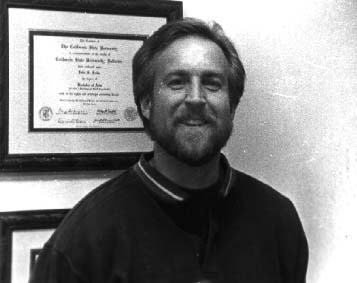
No foolin' -- USU's John Seiter is an expert on detection of deception. / Photo by Mike Lindsay Editor's note: This story was produced for the USU mass communication class "Beyond the Inverted Pyramid," COMM 3110. It is one of a series on USU professors who are experts in their field, or world-class creators or performers. Nothing can change the fact that lies are floating among us, bouncing in and out of casual conversation between friends, acquaintances, and loved ones. Research has shown that people lie almost daily. Lies are presented in all shapes and sizes. Lies are told out of convenience, they may be told to protect or benefit oneself. They may also be told to hurt another person. Ultimately, they are meant to deceive. Every person is different, but one can become educated to look for signs that a person is being untruthful. There are some that have become experts in detecting this deception. John Seiter, assistant professor at Utah State University, has based several studies on deception. "Most of our attention is focused on the positive sides of communication instead of the dark side of communication," Seiter said. "We talk a lot about honesty and trust and openness, but my guess is that deception is actually a pretty common form of communication." Seiter smiles warmly through his beard. His words flow smoothly, each one emphasized carefully and articulately. He speaks with enthusiasm. Seiter's interest in deception was sparked after listening to a lecture in graduate school that spoke about various forms of communication. "Quite a bit of research shows that deception is very common in our day-to-day lives," Seiter said. "So my thought is that if we really want to understand the process of human communication, we need to be looking at not only the good and the peachy, but also the darker sides of communication too." The accuracy of deception detection is based on several factors. It depends not only on the person telling the lie, but also on the severity of the lie. "White lies are super difficult to detect," Seiter said. "When a person is telling this type of lie, they feel no guilt or anxiety. However, when a person is telling a high-stakes lie, they are very afraid of getting caught, creating more nervousness, and easier detection." According to the book Persuasion, Social Influence, and Compliance Gaining, by Seiter and Robert Gass, people can alter the amount of information they reveal, the quality of the information, the relevance, and clarity of their information. In other words, there is infinite variety in forms of deception. Not only is lying a common form of deception, but nonverbal connotations can be deceptive as well. "We
talk a lot about honesty Seiter completed a study in January, 1998 that examined the effects of nonverbal reactions on viewers' perceptions of a speaker's credibility. According to the study, students watched one of four versions of a televised debate. One version used a single-screen format, showing only the speaker, while the other three versions used a split-screen format in which the speaker's opponent displayed constant, occasional or no nonverbal disagreement with the speaker. After watching the videos, students rated the speaker's credibility. Analysis indicated that the speaker was given significantly higher character and competence ratings when his opponent was not shown or indicated moderate or no disagreement. Moreover, the speaker was given significantly higher ratings for composure and sociability when his opponent was in constant disagreement than when his opponent was not shown or when his opponent indicated no disagreement. Seiter found two possible explanations for this finding. First, it might be that constant nonverbal disagreement was perceived as inappropriate, leading the audience to contrast the speakers or identify more strongly with the candidate who behaved inappropriately. This explanation is consistent with past research, which showed that debaters were "turned off" by such negative styles. Second, it might be that the opponent who constantly disagreed was perceived as a distraction. Interesting results were found after completion of a study conducted by Seiter and Richard L. Wiseman in 1995 on ethnicity and deception detection. The study included six Euro-Americans, six Latin-Americans and six Asian-Americans who answered truthfully and deceptively in videotaped interactions with one another. Two hundred Euro-Americans, Latin-Americans, and Asian-Americans rated their perceptions of the taped participants' truthfulness. Results of the study revealed that individuals generally detected the deception of members from other ethnic groups more accurately than their own ethnic group. Also, Latin-American participants were found to be more accurate in detecting deception. Seiter has two possible conclusions on the results of this study. His first explanation is the possibility that people know how to deceive members of their own ethnic group, since they are accustomed to the behaviors that people may look for. His second assumption is that people may pay closer attention to a person outside of their own ethnic group, since their actions may be unfamiliar. Seiter has conducted several other studies, and is currently working on two involving acceptance of deception and the effect that time has on the accuracy of deception detection. Seiter's teaching emphasis is on interpersonal communication, intercultural communication, and persuasion. Seiter grew up about a half mile away from Disneyland in California, so he tells people he has a "really distorted perception of reality." "I lived next to the happiest place on earth," Seiter said. He shares his office with a ceramic pig that stands about 18 inches tall. The pig seems to be smiling. "Antonio likes it here. He fits right in. As you can see, my office is in the barn. I don't know whether I'm in the office or a stall," he said with a laugh. Seiter received his Ph.D. in the department of communication arts & sciences at the University of Southern California in September 1993. Seiter was awarded "Teacher of the Year" at Utah State University in 1996-97. "He is really my role model on being a good teacher," said graduate student Ann Bluemlein. "He does a lot to make his class interesting. He communicates very well, using a lot of in-class activities that make the subject material easier to understand." "John is an excellent teacher and communicator," said Diane Michelfelder, department head of languages and philosophy. "John has a way of being able to present very difficult material in a simple form." When asked what it is like working with John, a huge smile lights up her face. "He is a delight to be around, a practical joker," she replied. Seiter even uses his free time to make a difference. Turning one of his hobbies into a good cause, Seiter went on a fundraising excursion for the Holy Trinity Lutheran Church in order to raise money for the land to build a new church. The fundraiser was a bike ride that began in British Columbia and continued down the West Coast, ending up at the Mexican border. "I couldn't have done it without my wife, Debbie and my son, Christian," Seiter said. "They drove along with me the entire way, carrying my supplies." Aside from the money raised, said Trinity Lutheran Pastor, Robert Weller, it meant a lot to have someone so dedicated to the cause. Seiter was able to raise nearly $2500. He said the thought that his efforts were adding bricks to the building helped keep him going up the coastal hills of Highway 1 in northern California. Seiter also raced in the Lotoja, which begins in Logan Utah, and ends in Jackson Wyoming. "The race was 203 miles long, using the slogan: 'three states, one day, no sweat.' But for me," he said, "it was a sweat." At least he's honest. # # #
WANT TO SPOT A DECEIVER? HERE'S HOW Taken from the book Persuasion, Social Influence, and Compliance Gaining, by John Seiter, and Robert Gass. Results are based on several studies including (DePaulo et al., 1985; Kraut, 1980; and Zuckerman and Driver, 1985).
* Blinks: Liars blink more often than people telling the truth. * Adaptors: Liars move their hands more (fidget, scratch) when giving responses. * Speech Errors: Liars make more errors when speaking. * Message Duration: Liars' messages are more brief than truth tellers' messages. * Pupil Dilation: Liars' pupils are more dilated than truth tellers' pupils. * Irrelevant Information: Liars include less relevant material in their responses than truth tellers. * Negative Statements: Liars' responses contain more negative expressions than truth tellers' responses. * Shrugs: Liars shrug more than truth tellers. * Immediacy: Liars communicate less involvement in their communication. * Pitch: Liars' vocal pitch is more anxious than truth tellers' vocal pitch. * Hesitations: Liars, compared to truth tellers, hesitate more when communicating. * Leveling: Liars use more leveling terms than truth tellers (i.e., make more overgeneralized statements). * Message Discrepancy: Liars' messages contain more discrepancies
than do truth tellers' messages. |
Archived Months:
September
1998 |
||