Fish not biting under the ice, but Scouts catch on to winter fun
By Jacob Moon
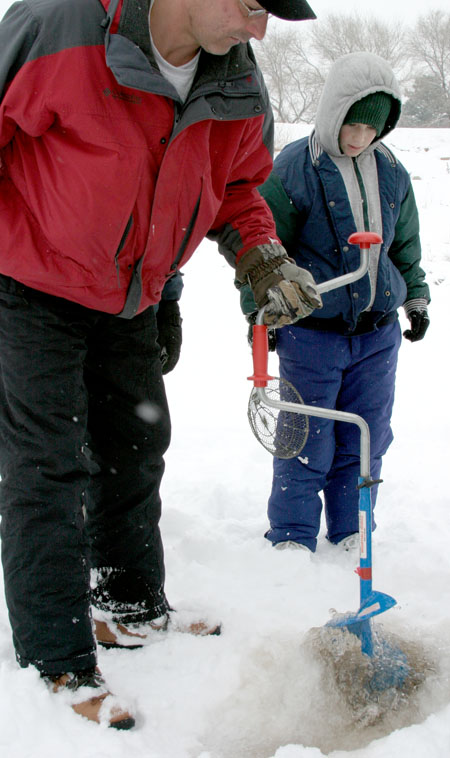
BSA Troop 1 Scoutmaster John Matson shows Dan Hogan how to use an ice auger. The ice auger cuts an 8-inch diameter hole in the ice so the fisher can fish. The ice at Hyrum dam ranges in thickness from 8 to 13 inches. / Photo by John Zsiray
Freezing temperatures and a lack of fish didn't keep the Boy Scouts from Troop 1 from having good time Saturday on the ice at Hyrum Reservoir.
"Even though we didn't catch any fish, it was fun because I got to talk with my friends," said Ryan Parkinson.
And talk they did. Parkinson and some of the other Scouts made the most of the day on the ice gossiping with friends and engaging in snowball fights.
Parkinson has been with the troop for six years and has been on a myriad of outings, most of them much more fruitful.
The Scoutmasters from Troop 1 organized the trip to Hyrum Reservoir to teach the Scouts ice safety and how to ice fish.
Before heading down to the frozen lake, Utah Parks and Recreation Rangers Lee Gyllenskog and Floyd Powell gave the Scouts a quick lesson on ice safety. Powell related a story of when he fell in the freezing water while setting up cones to mark weak spots in the 4-inch ice.
After falling through, a few nearby fishermen quickly came to his rescue with a long pole and ropes.
"It was a textbook situation," Powell said. "[The fishermen] did exactly what they were supposed to do."
The reason Powell fell through the ice was two-fold: First, he already knew the ice he was on was dangerous. He also made a mistake by putting all of his weight on one foot while trying to reach to place a cone.
After being pulled from the freezing water, Powell drove himself home and sat in a warm bath.
"It took six or eight hours for the core of my body to feel completely warm again," he said.
Powell and Gyllenskog also showed the Scouts some gear required for any ice fisherman. The most unusual, but likely most practical, were "bear claws." Two blocks of wood with 3-inch nails coming out of one end are tied together by the other end and hang around the person's neck. If a fisherman falls through the ice, the bear claws can be used as spikes to grip the ice and pull himself out.
The other precaution the rangers stressed was the buddy system. For the Scouts from Troop 1 this wouldn't be a major problem because there were eight or 10 of them together at one time.
"Even though you will all be together today, you need pair up with a buddy," Gyllenskog said. "A fisherman should never be alone on the ice."
Scoutmaster John Matson showed the Scouts how to use an auger to drill an 8-inch hole in the ice. He stressed the importance of using body weight to press the auger into the ice as the blade turned.
Being one of the oldest and biggest Scouts in the troop, Parkinson helped the younger Scouts get the pressure they needed to get the blade through the 10 inches of ice.
"Hold up four fingers," Gyllenskog told the group before they started drilling. He said the four fingers would remind them that the ice needed to be at least 4 inches thick to be safe for foot traffic.
All of the ice on the lake this winter is between 8 and 13 inches, Powell said.
In just a minute or two, Parkinson had drilled the first hole, and murky water came through the surface.
For the next hour and a half the Scouts drilled their own holes 30 or 40 feet apart and waited patiently, but with no success.
Matson had brought an electronic fish finder, which indicated there were fish about 20 feet below the surface, but the fish still weren't biting.
The lack of luck hasn't just been with Troop 1.
"We haven't been seeing much luck this year," Gyllenskog said. More than 10,000 fish had been put in the lake the previous fall, he said, but not many people had been pulling them out.
Gyllenskog said he hoped the snow on Saturday and change in pressure would have made the fish livelier, but still, luck was down.
Parkinson wasn't discouraged though. With a monthly activity like ice fishing or camping, Troop 1 will continue learning what it takes to be a Boy Scout.
They have a trip planned to build snow caves later in February and yearly summer camps to look forward to.
MS
MS |


