|
Photo 101: How to take better
pictures
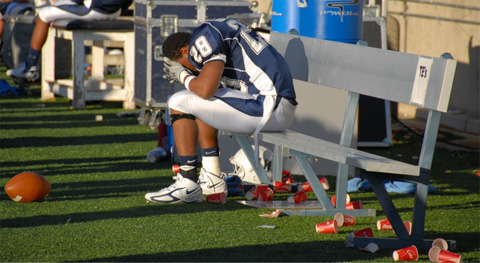
THE AGONY: A USU football
player realizes the pain of defeat. / Photos by
Patrick Oden
|
By Patrick Oden
December 17, 2008 | I am often asked as a photojournalist,
what makes a great picture? That sounds like a
simple question to answer, however, things are
rarely as simple as they seem. If I had to sum
it up in one word, that word would be emotion,
but I have to be a realist, and one word can't
answer that question.
I have written about what an individual who is
interested in becoming a photojournalist should
consider in the way of education and equipment,
but let's peel this orange, and get a little deeper
into the juicy center, that's where we'll find
the separation of desire and success.
Emotion in a journalistic photo is a powerful
thing, but this isn't always the emotion seen
in the face of a lost infant, it could be the
emotion invoked by a well illustrated car crash,
or a brooding storm.
|
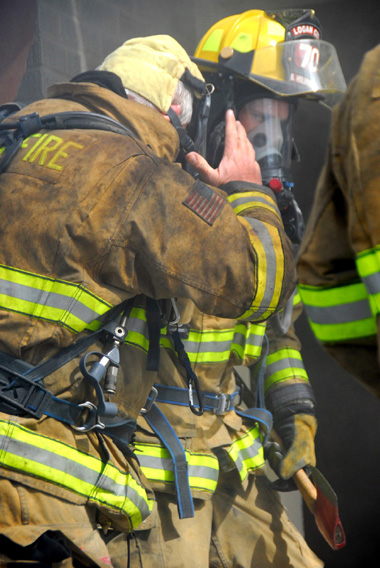
READY FOR ACTION: The
Logan Fire Department respondis to a fire at Serendipity
Salon in Logan.
|
No matter the shot, it is important
to remember as a photojournalist that journalism
is still at the heart of what we do. We are not
artist, while there is a place for creativity
and style, our job is to tell the story, to put
the viewer in the time and place, to bring forth
the feeling of the moment in a way that allows
the viewer to feel as if they were right there.
|
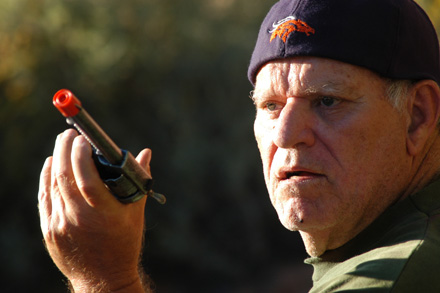
BANG!: Larry, a
client of Common Ground Outdoor Adventures plays
with his cap gun during a four-day rafting trip
for the disabled in southern Utah. |
Sometimes it's all we can do to get one or two frames
before the moment has passed, sometimes forces beyond
our control prevent us from taking time to plan or to
utilize the fundamentals of journalistic shooting.
This was the case for me one cold winter morning at
the reservoir in Hyrum, Utah. I was sent on assignment
to cover the Polar Plunge, a charity event where people
pledge money for others to jump into freezing waters
through a hole cut in the ice.
I arrived 30 minutes or so before the first group was
scheduled to jump and took my place with the other photographers
from various news sources and rescue divers who were
on standby just in case they were needed. The first
group, the local Sherriff department's S.W.A.T. team,
clad in flip flops and Speedos, took their place at
the edge of the ice. Leaping into the air and allowing
gravity to guide them into the freezing waters, I framed
and fired. Several frames were captured and when the
next group took their place and I prepared to shoot,
nothing. My batteries had died from the freezing temperatures
outside. With no spares charged I had to leave with
what I had, one group of jumpers and maybe 10 frames.
This represented a lack of readiness on my part, an
amateur oversight.
The photo that I selected from that series made the
front page of the Utah Statesman the next day,
and went on to be selected as the Utah Press Associations
first-place winner of News Photo of the Year. I like
to think of situations like this as happy accidents,
but that is really far from the truth. Whether situations,
circumstances, or stupidity prevent you from taking
your time and exercising your trade with careful precision,
a well understood and practiced set of basic skills
will help insure your success as a photojournalist.
Be prepared. Don't show up to a shoot with dead batteries
or no memory cards. Make sure to take everything you
could conceivably need, and then take a few extra things
just in case. I always take a moment before I head out
to make sure my batteries are fresh, my memory card
has been formatted, and my lens(s) are clean.
Make a point to be a little early if you can, take those
extra moments to check out your environment and set
up your gear. Run through all of your camera settings.
It is a common mistake of an anxious beginner to forget
to adjust things like ISO or white balance. Check your
light, consider your desired depth of field and your
subject and make the necessary adjustments to your F
stop and shutter speed. Fire a few test shots. Is your
lighting working as it should if you're using speedlights
or strobes? Is your color good? Now is the time to fine
tune things.
Eye pressed firmly to the viewfinder, it's time for
the money shot. Composition is key, I repeat, COMPOSITION
IS KEY. Most professional or semi-professional digital
SLR cameras will have a grid viewable through the viewfinder.
Two horizontal and two vertical lines which divide the
image based on the rule of thirds.
Use these, not only to weight the focal point of the
image, but to insure you're holding the camera straight.
I like to approach a shoot with distance and angle in
mind. Think of a compass, with its eight positions.
North, south west, etc. and treat your subject, to the
best of your ability, as if it were in the center of
the compass. Try to shoot from each of the 8 points
around it. But don't just stand there. Squat down, climb
up something, and don't be afraid to shoot too many
frames. Give the viewer a perspective they wouldn't
normally see. This will make your photos more interesting
and captivating.
Tighter is better. While wide angle and medium range
shots have their application and should be taken in
every case for variety, a tight, well composed shot
will offer the most detail and interaction with the
subject. If you were shooting a fireman saving a cat
in a tree, would you want to see the whole tree, the
fire truck, and the mailbox? No, you want to see the
cat, a leaf, and the callused hand and weathered face
of the fireman, that's the story and in the tightness
of that shot your viewer knows exactly what is going
on.
Once you sit down to edit your photos, pay attention
to detail. Crop when needed, again paying attention
to the rule of thirds, and to distracting parts of your
image, don't overdo it though. We're not graphic designers,
so don't go crazy with Photoshop. Some adjustments to
your curves
or levels may be needed, but that's generally it.
Clarity and sharpness in your image is very important,
a great shot that is out of focus is not a great shot.
One of the things I find most rewarding about photojournalism
is that every shoot is different and no matter how prepared
I think I am, I find myself having to think on my feet,
rising to unforeseen challenges and walking away with
a great image. Believe in yourself, be a perpetual student
of your trade, and never forget the basics.
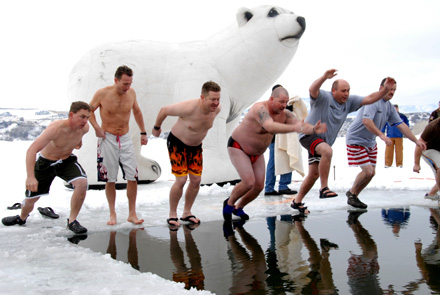
FREEZE FRAME: Members
of the Cache Sheriff's Department SWAT team participate
in the Polar Plunge for charity.
NW
MS
|


