|
Student teaches nuances of deaf
communication
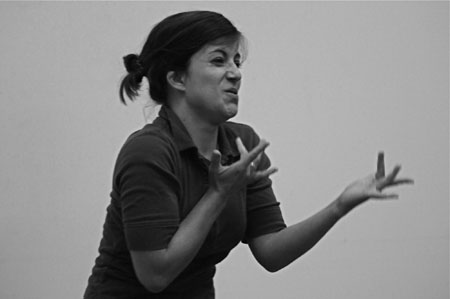
DO YOU GET IT?: Ellen
O'Hara makes a point at Joke Night during Deaf Awareness
week. / Photo by Leah Lopshire
|
By Leah Lopshire
December 12, 2008 | The basement of the Lilly
White Building is as quiet as a house at midnight.
It seems that everyone has left for the day. Yet
all the rooms are occupied with silent students.
This is where Ellen O'Hara spends hours each day
assisting in the progress of education.
All of the students and teachers recognize Ellen.
From the light smile on her lips to the slump
in her shoulders as she sits back in her chair
she looks relaxed in her familiar environment.
|
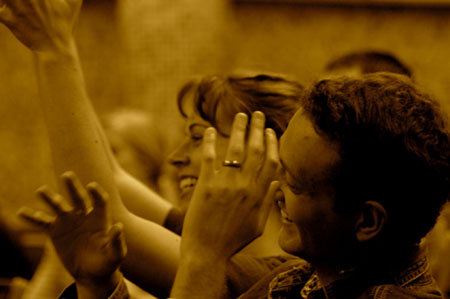
SHOWING APPRECIATION: The audience "claps"
at the end of the performance. / Photo by
Leah Lopshire |
It is 5 p.m., and time for her lab session to start.
She stands between the dry-erase board and her three
to five students seated in a horseshoe. The students
are very intent, never taking their eyes off of Ellen's
hands. As she starts to teach there are still no words,
only a fluid motion of her arms, hands and fingers.
Ellen, however, is not a teacher, but a deaf student
and lab instructor at Utah State.
Having a deaf child was not something new to Ellen's
parents. Three out of the seven children are unable
to hear. "My oldest sister Molly and my second oldest
brother Toby are deaf." Not only does Ellen have deaf
siblings, but also her father and his mother are deaf.
Surprisingly Ellen's grandmother and father were not
the first to learn ASL (American Sign Language) in Ellen's
family.
"My mother was the first to learn ASL in my family
and she taught all of the kids. My father, like his
mom, does not consider ASL a language. My grandmother
never learned ASL growing up. She learned to read lips
and speak and taught my father to do the same. To this
day my father knows some ASL but is not fluent, and
my grandmother only knows the sign for "I love you"
and the ABC's."
Growing up it was important to Ellen's father to teach
his children to read lips and be able to speak. Speaking
is "so unnatural with deaf people that it is highly
uncommon for those is the deaf community."
The division in her family between ASL and English
speakers was a pushing point of Ellen's mother, and
now Ellen, for deaf people to have a bi-lingual and
bi-cultural education, so that they will be well rounded.
Finding a school that offered both bi-lingual and bi-culture
was rare. In order for her daughter to get the proper
education Ellen and her family moved often in the first
18 years of her life.
When it was time for Ellen to go to college she, like
all high school seniors, had a lot to consider. First
trying BYU, Ellen decided that it wasn't the school
for her. Going into deaf education, Ellen said, "the
main reason I came to Utah State was the deaf education
program here."
When Ellen got to Utah State she realized that campus
life was not going to be an easy place for her to live.
She was first placed in an all-hearing dorm. After two
weeks a spot opened up on the deaf floor in Moam Hall,
but even then Ellen's roommate was not deaf nor did
she know any sign language. "She was only a deaf education
major and had not started her classes yet." This, however,
quickly became the least of Ellen's problems.
During her first year in Logan Ellen was among a group
of students who sued the school for lack of services
provided. Deaf Services Coordinator Angie Olsen said,
"The school was in violation of the Americans with Disabilities
Act, by not providing enough interpreters."
In that first year Ellen said that many times the
interpreter who showed up would be a student, or a note
taker; both are unequipped to translate the amount of
information necessary.
Since the lawsuit the school has hired two full-time
and four part-time interpreters, and when needed they
hire out from other agencies. Olsen said that the school
is still looking for a third full time interpreter.
The problem with getting a third interpreter Olsen said
is that "there is a nationwide shortage of ASL interpreters,
and Logan is not a place that many people want to re-locate
to."
A fighter for fair treatment and deaf awareness Ellen
said that, " The situation on campus has improved since
the lawsuit, but Utah State is still no a deaf friendly
campus." Ellen feels that there are more aspects on
campus life that need improvement. One such improvement
is to "train workers in public places on campus, like
the library or the Hub, in some basic ASL so that they
can communicate what they need to when deaf students
come by."
At any deaf related function Ellen is always present.
Being the Deaf Ed Student Association and vice president,
and ASL liaison keeps her active. Adding on to her busy
schedule Ellen has been a lab instructor for the deaf
education program for the past three and a half years.
Last year she was named lab instructor of the year.
In the labs she gets a chance to teach students, who
are mainly hearing, how to take what they have learned
in class and apply those skills.
In the labs no talking is allowed. This rule is used
in all ASL classes on campus to help motivate students
to learn the language faster.
One of the biggest problems that Ellen has to break
her students of is body language when they communicate.
Watching two people communicate using ASL you will see
a large difference than those who speak. ASL, unlike
any other language, relies solely on the visual aspect
of communication.
"Facial expressions are key to getting a meaning across,"
Ellen says. Many signs will have two different meanings
with just a lift in the eyebrow. When her students aren't
grasping the importance of this, she will often give
them an example of their stiff version saying something,
and how it should look. Facial expressions and body
positioning clarify meaning, and they are visually more
appealing, Ellen said. It substitutes for fluctuations
in the voice.
As a member of Logan's deaf community, Ellen also
takes the formal vocabulary taught in class, and teaches
the students how to use it in social situations. "Sometimes
what we learn in class is the technical way to say something.
Ellen teaches us the 'slang' way to sign it. The things
that aren't necessarily in the textbooks," on lab student
said. "It's nice because she is our age so many times
it's informal and we spend a lot of time just talking."
As the end of lab approaches, Ellen opens up the Webster's
dictionary to a random page. She closes her eyes and
points to a word. She looks up at her students and spells
the word out with her fingers. Her quick pace leaves
many of her students with a puzzled looks as they try
to remember key letters they saw. Ellen waits a second,
then tries again. After the third spelling, one of her
students fingerspells the word back to her. Ellen waves
her hand, queuing the girl that she has permission to
leave. Then it's on to a new word until all of her students
have correctly signed different words back to her. Then
she is left alone waiting for her next lab group to
come in and start the process all over again.
MS
MS
|


