|
||||


 |
What's in a name? At a Utah park, you might be looking at the Schoolmarm's Bloomers By
Reuben Wadsworth
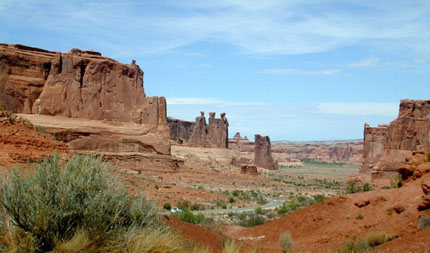
Can you park along Park Avenue? Or is it park-like? One of many roads through Arches National Park, this one overlooks the back end of the Park Avenue trail as it comes out near the Courthouse formations. / Photo by Nancy Williams Planning a trip to Chimney Rock or Devils Garden in the near future? Better check a map to decide which one to go to. Capitol Reef National Park, Grand Staircase and Kodachrome Basin State Park claim a "Chimney Rock." A Devils Garden stands in both Arches National Park and Grand Staircase-Escalante National Monument. The Devils Garden in Arches National Park is an area of "unusually shaped sandstone features," John W. Van Cott, former supervisor of the botany laboratories at Brigham Young University, said in his book Utah Place Names. Van Cott described the Devils Garden in Grand Staircase-Escalante as "sandstone sculptured into strange, distorted dwarf and mushroom-like figures." What is the reason for the identical names? "Names are duplicated anytime the circumstances that evoke the name are present," said Gwendolyn Zeta of Bryce Canyon National Park Reception. "How many Main Streets do you suppose there are in the United States? How many Chimney Rocks and Black Canyons all over the West?" she said. "There are three of each right in this vicinity. In this area we also have Death Ridge, Box Death Hollow, two Death Hollows, Phipps Death Hollow, Little Death Hollow and a Death Valley -- distinct from Death Valley National Park -- of course." Cindy Doktorski, interpretive park ranger at Capitol Reef National Park, has her own theory on why so many chimney rocks have made their way onto the maps. "In the late 1880s and early 1900s, pioneer homes all had chimneys as open fires were the only means of heating and cooking," she said. "Fireplaces were an integral part of homes. A solitary chimney was a dramatic, recognizable and easily-referenced sight. It was part of the era's imagery and visual vocabulary so many spires were named 'Chimney Rock.'" "Various landforms reminded people of obvious names, like balanced rock, hence they end up with duplicate names," said Judie Chrobak-Cox, visitor information assistant at Grand Staircase-Escalante National Monument. "It's as simple as that." She has a point. There are two balanced rocks on the maps of Utah -- one in Arches National Park and one in Grand Staircase-Escalante. "In pioneer times, travel between areas took days, or longer, so early explorers or pioneers may not have even been aware of similar names in other areas," Chrobak-Cox said. Along with a chimney rock, Capitol Reef is also home to a set of "Goosenecks," a popular name for formations of their kind around the state. "'Goosenecks' was a common name given to narrow, twisting canyons and river bends throughout the West," said Paul Henderson, chief of interpretation in Canyonlands National Park, who also has a set of "Goosenecks" in his park. "You can probably find numerous times that the term has been applied in Utah." In addition to the many duplicate place names in Utah's national and state parks, there are many others that enjoy their own unique story. Hickman Bridge in Capitol Reef bears the name of Joseph Hickman, former principal of the Wayne High School and a prominent Wayne County resident, Doktorski said. With his brother-in-law, Hickman created a club to boost tourism in 1921 that publicized the scenic beauty of the area between the towns of Torrey and Hanksville, known locally as Wayne Wonderland. After being elected to the state legislature in 1924, he introduced a bill in an effort to set aside land in the Fremont River valley as Wayne Wonderland State Park, she said. Unfortunately, Hickman died in a drowning accident in 1925, more than a decade before the area he loved became a national monument. Another of Capitol Reef's landmarks, Cassidy Arch, derives its name from the infamous western outlaw Butch Cassidy. Cassidy frequently passed through Capitol Reef during his hey day during the late 1800s on the way to one of his well-known hideouts, Robber's Roost, which is just up Highway 24 near Hanksville. The name doesn't even reflect Cassidy's real name. He was born Robert Leroy Parker in Beaver on April 13, 1866. Two other landforms in Capitol Reef, Navajo Knobs and Navajo Domes, may seem to bear the name of the Navajo Indian tribe. In reality they derive their name from the type of sandstone from which they are formed. "The Navajo Sandstone is a rock layer that exists throughout the Colorado Plateau, but lies exposed along the 90-mile length of the Waterpocket Fold within Capitol Reef National Park," Doktorksi said. "The Navajo Sandstone, because of its chemical and physical composition, typically erodes in rounded domes." The Frying Pan Trail in Capitol Reef did not receive its name from what it looks like, but from its temperature. "The top of this trail is hot with little shade," said Doktorski. "On a summer's day, hikers may understand personally why it is named the 'Frying Pan' trail." Capitol Reef is also home to a spot called Sunset Point that sits less than a mile from the Goosenecks. At dusk the various hues of the sandstone surrounding the location paint a colorful picture for park visitors. The spot varies greatly from its counterpart in Bryce Canyon National Park. The setting sun cannot be seen at Sunset Point in Bryce -- there is a mountain in the way. "It is named Sunset simply to make a neat pairing with Sunrise," said Zeta. Sunrise Point is aptly named. The rising sun can be seen from the point. Like Sunset Point in Capitol Reef, the light reflects the distinct shades of Bryce's hoodoos, which the park service defines as spires, fins, and pinnacles shaped from the erosion of colorful limestones, sandstones and mudstones. Arches is home to Delicate Arch, which is "one of the grandest and most photogenic of Utah's natural arches," said Van Cott in his book. Early cowboys called the arch "The Schoolmarms Bloomers," but the present name demonstrates a more artistic, aesthetic approach, he said. But Delicate Arch might have been a more accurate name for the park's Landscape Arch and Skyline Arch. Large slabs of rock have fallen from both their spans in the last 60 years. The loop trail that once led hikers underneath Landscape Arch is now closed because the landmark is so delicate. Skyline has yet to face such treatment. Another arch that is delicate in the park is Broken Arch, which has a narrow crack in its crest. Grand Staircase-Escalante contains Moody Canyons and The Blues. The names didn't come from the rock 'n' roll group but are due to the bluish color of the geologic strata in the area, said Chrobak-Cox. Bryce Canyon is home to a name stemming from a mythological hero's weapon and a location bearing the same name as the place from which the Dow Jones industrial average fluctuates daily. Some say the hoodoo christened "Thor's Hammer" doesn't even look like the item the name suggests. "I don't personally think Thor's Hammer looks like a hammer, but it was an interesting idea for a name," said Zeta. Bryce also has a Wall Street, but it isn't named after the one in New York. "Wall Street is named that because of the narrow high vertical cliffs through which the trail winds," said Zeta. Inspiration point in Bryce might have been named because of the feelings it may evoke upon a visitor, but Zeta is unsure. "Inspiration Point is another example of an imaginative name attached to a lovely spot," she said. "I'm sure it is inspirational for some." In contrast to Thor's Hammer in Bryce Canyon, Henderson said many of Canyonlands' landform names closely resemble what they actually look like. "Angel Arch, Whale Rock, Washer Woman Arch and Elephant Hill all resemble the things that they are named for," said Henderson. "The White Rim does indeed look like a 'white rim' which runs around the Island in the Sky. Monument Basin refers to the large spires of stone standing in a basin, which must have reminded folks of man-made monuments elsewhere." Henderson said generally early cowboys came up with the names for places within the park in the late 1800s and early 1900s. The vast majority of these names were in common usage long before the establishment of the park in 1964, he said. Most of the names used by the early settlers came from men, and sometimes were somewhat embarrassing, said Van Cott in the preface to his book. "If a name cannot be used in a polite society, a change may be required," Van Cott said. One such name in Canyonlands that has been embarrassing to many is Paul Bunyan's Potty. Van Cott said the name went through some controversy, but still remains unchanged. According to Henderson, the landmark is one of those names that preceded the establishment of the park and has stuck. Like Capitol Reef, Canyonlands has its share of landmarks bearing the names of early settlers or those who contributed to the history of the park. Musselman Arch in the Island in the Sky section of the park was named for the late Ross Musselman, who operated a tour business out of Moab in the 1950s. Chesler Park in the Needles section was named for the stockman who ran cattle and sheep there in the early 1900s. In order to name a place after a person in a national park, the person has to be deceased for five years and have "a transcendent relationship with the park," Henderson said. Place names are somewhat subjective. Names used locally might not be the official place names, Henderson said. Kodachrome Basin State Park is full of unofficial names. In Kodachrome a visitor will find Sherlock Homes Spire, Fred Flintstone, The Hamburger and The White Buffalo. Most names in the park stem from old timers who have run cattle in or near the park, said Tom Shakespeare, who hails from the nearby town of Tropic and has worked at Kodachrome for the last 24 years. One of the monuments in the park that may be the most controversial is known as "Big Stoney." Other names in use for the gray sandstone cylinder standing about 15-20 feet high which greets visitors near the entrance of the park include "Fair Maiden's Dream" and "Paul Bunyan's Boot," said Shakespeare. According to him, the landform is clearly a phallic symbol. One official name the park does possess is Ballerina Spire, which clearly looks like a ballerina's leg, Shakespeare said. The official name of the park came from National Geographic Society photographers who named it after Kodak's color film. The park was formerly called Horley's Pasture, Shakespeare said. Shakespeare has left his own mark on the park. One which will stand for generations to come. There is an arch named after him that he discovered in 1976. When he stumbled on to it, he asked the local old timers if they knew of its existence and they didn't. So now it stands -- Shakespeare Arch -- a name that derived neither from early settlers nor the English playwright, but from a long-time park ranger of more recent memory.
|
Archived Months:
January
1999 January
2000 |
||