By Jackson Olsen
|
Note: This story was produced for JCOM 2160, Introduction to Online Journalism, which emphasizes hand-coding HTML. April 30, 2008 | As the warmth of summer emerges from its prolonged hibernation and becomes a more familiar friend, there is a certain sense of anxiety that still lingers in the air for the majority of the students at Utah State University. Summer's almost here, but finals have just begun. Evidence of this clear: no parking in the B lot on a Saturday night, private rooms in the library are full to capacity (and have been for three weeks) and the university's cleaning staff has been overwhelmed by unrecycled cups from Starbucks. Now, more than any other time during the semester, procrastinators are hitting the books in a frenzy. This destructive lifestyle of delaying responsibility is not new or unique in any way. |
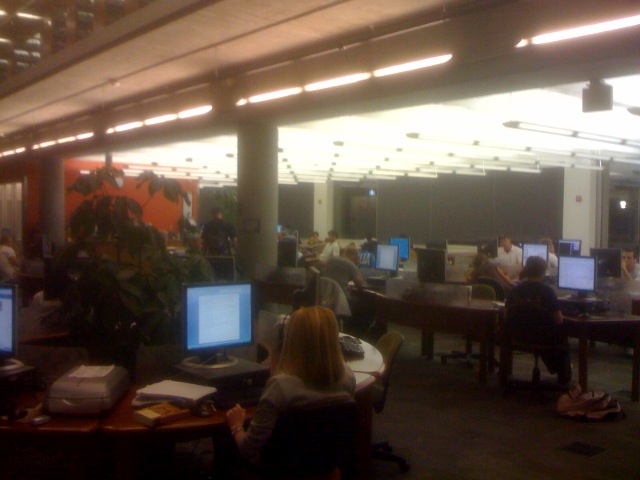
Merrill Library experienced heavy traffic last weekend. / Photo by Jackson Olsen
|
It has existed for thousands of years, and will continue to do so until medicine or science comes up with a solution. Unfortunately for the majority of high school students, college students, attorneys, CPA's, doctors, insurance salesmen, politicians, teachers, engineers and astronauts, that solution has yet to be discovered. The question is: why do we do it? If we know it will only cause stress, pain, hunger, anxiety, sleep deprivation and a bundle of other agitators to our human experience, why on earth would we procrastinate, and procrastinate voluntarily? Seeing as this author is finalizing his article on the day before deadline, he has no useful insight to share regarding the matter. Luckily, he met some people who did. |
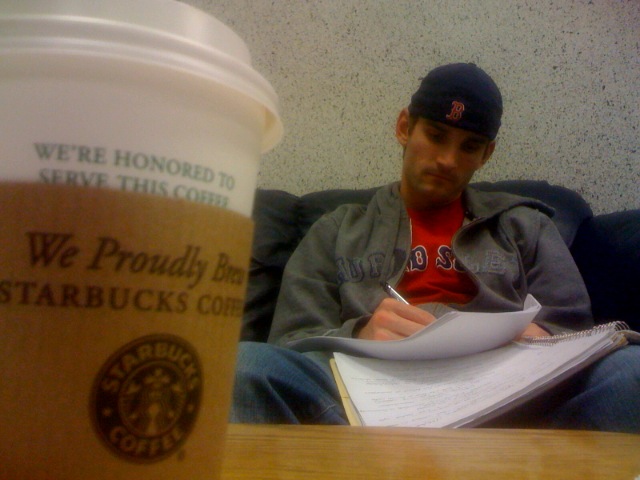
| Brian Watts studies hard before taking a final exam. / Photo by Jackson Olsen |
"Many people procrastinate out of fear – both fear of failure and fear of success," said Dr. David Bush, a professor of psychology at Utah State. "People are afraid of what might happen, so they decide to wait until the very last moment to find out." Bush went on to say how unhealthy the behavior can be, and how often it leads to emotional highs followed by staggering lows. "I purposely find distractions," said Brian Watts, a senior majoring in public relations. "I know exactly what I have to do and by when, but I'll find any reason not to get started, like holidays or the [NBA] playoffs. According to a 10-year study conducted by Piers Steel, an industrial psychologist at the University of Calgary, procrastination is on the rise. According to the study, the number of people who consider themselves chronic procrastinators has skyrocketed over 500 percent over the last three decades. Steel cites technological advances as partly responsible for the growing number, namely cell phones, video games and iPods. Back at the library, keyboards rattle like heavy raindrops on a tin roof. Luckily for these students, the storm won't last long. |
MS
MS