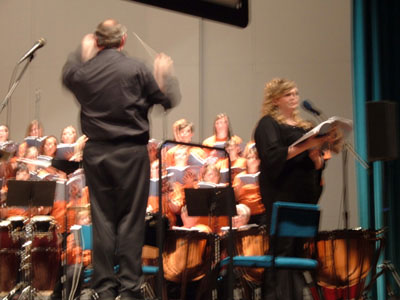
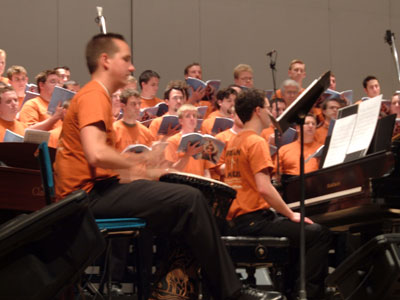
| Note: This story was produced for JCOM 2160, Introduction to Online Journalism, which emphasizes hand-coding HTML. April 30, 2008 | African chants, Islamic calls to prayer, thundering percussions, and the sounds of primitive instruments filled the Kent Concert Hall on April 23 as the combined choirs of Utah State University performed African Sanctus. African Sanctus is a complex unique work in which live performers coordinate rhythmically with audio recordings that were recorded over 35 years ago by composer David Fanshawe during his now legendary cross-shaped trip down the Nile River in Africa. Fanshawe traveled through Africa for approximately four years recording the indigenous ceremonial sounds, celebrations, and rainstorms that surrounded him. Upon his return to England, he composed an unorthodox Latin Mass that fused different sounds, religions, and people through its 13 movements. "This has been a technical challenge," said Dr. Cory Evans, Director of Choral Activities at Utah State University, "I think next year we'll just do an a capella concert of hymns from the hymn book, it would be much easier." |
![]() |
The 82-voice USU Chorale joined with the 28 USU Chamber singers and the 35 students and community members of the Northern Utah Choral Society to harmonize their voices and instrumental talents with those who Fanshawe encountered and captured on his journey. As they performed in their specially designed orange T-shirts, a slideshow of images of those featured in the recordings played above the stage on a large projection screen.
"The slide show that accompanied the performance did much to show the great diversity and color of the African people and the land in which they live," Evans said. "I hope the world feels a little smaller, and a little less strange." Evans said the performers began learning the piece last semester and spent every rehearsal since mid-March working on it. He said that some schedule conflicts between the different choir rehearsals made it difficult, but adjustments were made and "somehow it all came together." Evans said most of the rehearsals were spent synchronizing live music with the recordings and it is quite difficult to keep all of the live performers completely on the beat with the tape. Evans said bringing it all together requires extra effort on everybody's part. Evans said the effort is worth it. "I hope all, both performers and audience, develop an appreciation of Fanshawe's musical style, and his fearless attempt to fuse different cultures and religions with music," Evans said.![]() |
African Sanctus was first performed in 1972, and Evans said he has wanted to direct African Sanctus since he performed it as a student. Evans got the opportunity when he suggested it to Elaine Thatcher of USU's Mountain West Center for Regional Studies when she approached him about doing a large choir work for the closing concert of the Mountain West Songfest. The theme of the songfest is "Songs of Faith and Healing," and Evans said Thatcher was excited for the piece to apart of the songfest. Evans scheduled the additional performance on April 23 so it could be performed for the students of USU. Evans said the April performance might be a bit larger than the one that will be done in June because some of the students will be going on missions, or working out-of-state during the summer, but master drummer, Obo Addy, will be joining the choir for the June performance. Fanshawe will also attend the summer performance and will lecture on his work at the songfest. Evans said Fanshawe will travel from England and it "should be fascinating." |