It's
Fenway vs. Wrigley in battle of ultimate ballparks
By Trevor Brasfield
April 17, 2008 | People enjoy a good hearty
debate, whether it is over politics, religion
or which type of cold cut is best on whole wheat
bread. So with this in mind we will debate one
of the most important topics of all time: which
ballpark is better Fenway or Wrigley. Let's get
it on!
Luckily for you, the reader, I have attended
games at both stadiums, and I will give you an
unbiased answer to this great debate. (Just in
case you did not know, I am a huge Cubs fan, so
take the unbiased part with a grain of salt!)
|
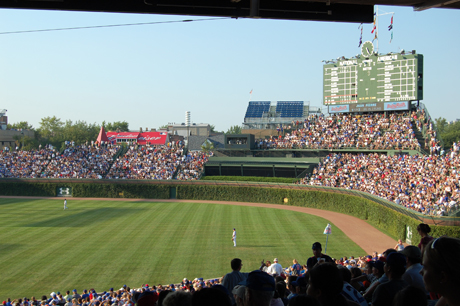
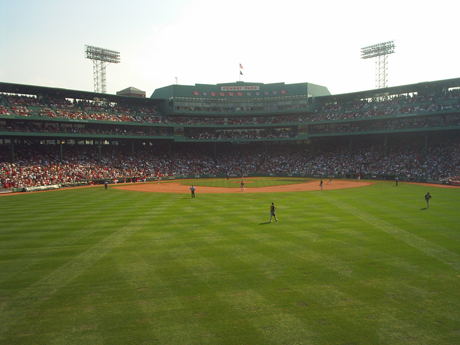
HOW TO CHOOSE?:
Wrigley, above, or Fenway, below. / Photos
by Trevor Brasfield
|
Lets start our journey with Fenway Park, situated
on 4 Yawkey Way Boston, Mass. This park is the oldest
standing ballpark in the Major Leagues, opening its
doors to the Boston Red Sox since April 20, 1912. Over
the years this stadium has become larger than life,
and inside its hallowed walls many pieces of the stadium
itself have become folklore.
There's the lone red seat, which signifies the longest
homerun ever hit inside the park by Ted Williams on
June 9, 1946. The blast measured a whopping 502 feet
from home plate, and could have traveled a considerable
distance more if a fan's head had not been in the way
during the ball's flight. So from now on the fan's seat
where the ball landed is red in honor of this historic
feat.
Then there are Pesky's Pole in right field and Fisk's
foul pole in left field, which was part of one of the
most endearing postseason moments in history. In Game
6 of the 1975 World Series, Carlton Fisk strode to the
plate in the bottom of the 12th inning with the score
tied 6-6. Fisk hit a ball off Reds pitcher Pat Darcy
that seemed headed foul down the left field line. Fisk,
instead of running toward first base, danced down the
first base line trying to direct the ball fair. The
ball ricocheted off the foul pole, winning the game
for the hometown Red Sox. Unfortunately there was no
late-inning magic for the Red Sox in Game 7, which Cincinnati
won.
Bad luck is definitely one of the mystiques of both
stadiums -- and teams for that part. From 1918 to 2003,
Fenway never housed a World Champion. Now the stadium
can lay claim to two champions in recent years.
Fenway has seen many great ball players play within
its hallowed walls, Carl Yastrzemski, Ted Williams just
to name a few.
Yet players aside, the stadium itself has a certain
air about it. The old school flavor of baseball is all
around you in this park. The insanely weird dimensions
of this park, from the Green Monster in left to "Williamsburg"
in right field, this park has names for about anything.
That is the charm that Fenway has, along with some of
the most die-hard fans in the world. Red Sox fans are
a different breed. The city itself bleeds Sox colors,
and the baseball off-season is like a personal hell
for each and every New Englander. Every April is looked
at as almost a national holiday. Opening day becomes
a day that schools and businesses close and bars stay
open a few hours past last call just to celebrate the
upcoming season.
Now what I witnessed at Fenway was nothing short of
a near religious experience, to not only set foot inside
the oldest park in all of professional sports but to
watch a game in deep center field and see and touch
the Green Monster. The fans in center field were tremendous.
They were full of jokes; witty banter and beer -- yes,
lots and lots of beer. In fact I still remember what
one fan sitting behind my friend Kevin Borth said. When
the topic got to beer after we had ordered what could
have been our fifth or sixth tall frosty beverage, was
the price for one of these sudsy treats. They were a
whopping $6 apiece, and this one fan said, "Why
do you think my son was in diapers till he was 18!"
This being a direct reference to him using his son's
diaper bag to smuggle beers from home in. I think that
in its own right is hilarious and ingenious.
Wrigley Field: the friendly confines nestled in Northern
Chicago just off Lake Michigan at 1060 W. Addison St.
Chicago, Ill. Wrigley opened its doors almost two years
to the day after Fenway on April 23, 1914. At the time
it opened it was known as Weeghman Park. It was not
named Wrigley until the gum magnate bought the team
and then proceeded to name the ballpark after himself.
Construction of the park was a measly $250,000, while
Fenway cost $650,000 -- a steal if you ask me. Now Fenway
has its cute names for every weird pole or story, which
is neat, but Wrigley Field has its own traditions. One
is the white flag, which flies over Wrigley on the scoreboard
after a glorious Cubbies victory, and a blue flag in
defeat. Also the scoreboard in center field is completely
devoid of any modern accoutrements; it is completely
hand turned. The first thing one sees upon entering
the friendly confines is how green it is -- this was
one thing that struck me when I finally got to my seat.
Not only is the grass superiorly green, but so is one
of Wrigley's most famous inhabitants -- the ivy that
lines the outfield wall. Yes, the outfield is walls
not a fence as in most ballparks; under the ivy are
bricks lining the entire wall.
Wrigley is also famous for many years for never hosting
a night game. Lights were never added at Wrigley until
Aug. 8, 1988, which was not a full game as it got rained
out after 3 1ž2 innings. So officially the first night
game was played Aug. 9, 1988.
The seventh-inning stretch is also a Wrigley staple;
beloved sportscaster Harry Caray started the tradition
of singing Take Me Out to the Ballgame during
the middle of the seventh inning. Now that he has passed
on, celebrities such as Ozzy Osbourne and Billy Corgan
come to Wrigley to sing the song. At the end of the
song Harry added a now-famous catch phrase, "Let's
get some runs!" Also in the song the lyric goes,
"Root, root for the home team." It is sung
at Wrigley as "Root root for the Cubbies."
The neighborhood that surrounds Wrigley is aptly named
Wrigleyville and is a certain mecca for any Cubs fan.
Fans will mill around the stadium wandering into and
out of various bars and restaurants in the neighborhood.
You can even visit Fire Engine 78 just across from the
left field wall on Waveland Avenue.
One of my own favorite traditions at Wrigley is when
an opposing team member hits a home run. At Wrigley,
the fans throw it back onto the field. If this is not
done, you or the person catching this ball will be severely
booed until you do so.
Now, my seats at Wrigley were awesome, much better
than the ones we (me and the wife) had at Fenway. The
fans were not as friendly as the ones at Fenway. They
were nice, but I think we were sitting in the non-locals
section of the park. The beer was just as good if not
better, Old Style in the can at Wrigley is definitely
like nectar from the gods of baseball. The atmosphere
was electric at Wrigley as the Cubs had just moved into
first place in the Central Division days before we arrived,
and a huge roar and cheer went up over the crowd when
the scorekeeper turned over the final score of the Milwaukee
Brewers game. (The Brewers were in first place almost
the entire season until the Cubs overtook them, eventually
winning the Central Division.)
So having accomplished one huge goal in life, to see
not only the Red Sox at Fenway Park and the Cubs at
Wrigley, I would say it is really difficult to pick
which stadium was better. They are both dipped in history
and folklore. So to find the ultimate answer one would
have to use a scientific method to determine which park
is better. So the method I will be using is, "If
my buddy got a free ticket to a game at Wrigley and
my mother got one at Fenway which one game would I go
to?" Well, sorry, Mom, I would go to Wrigley --
the best place on Earth to watch a baseball game.
So there you go, Red Sox fans. Fenway is a great park
to have but it comes in second in a close race for best
ballpark in America. Plus Ernie Banks, Billie Williams,
Fergie Jenkins, Ryne Sandberg and the list goes on and
on. So Go Cubs Go and let's get some runs!
MS
MS |


