Public debate needs to return to civility, Last Lecturer tells USU
By Emilie Holmes
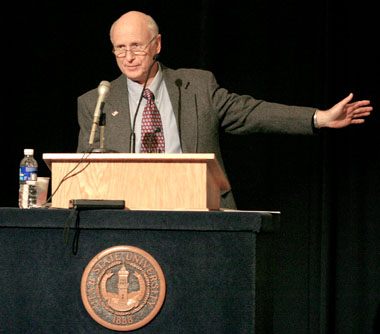
April 16, 2004 | Dr. William Furlong presents the annual Last Lecture. He was chosen by students in the Honors program at USU. Furlong is a professor in the political science department. / Photo by John Zsiray
His dad told him to never speak about politics or religion in public.
He became a professor of political science, though, so, it really couldn't be avoided.
William Furlong on Thursday became the 29th professor to give the "Last Lecture," an end-of-year talk organized by the Honors department at USU.
Furlong, a political science professor and adviser to Pi Sigma Alpha, the political science honor society, was chosen from a group of professors nominated by Honors students to speak.
Every year, Honors secretary Kay Gamble says, three of the top Honors students are chosen to go through the professors nominated by Honors students and chose one to speak at the end of year. The lecture, called the "Last Lecture" because the chosen professor is supposed to act as if it's his or her last speech at the university, is an honor to the professor chosen, Gamble said.
Furlong titled his lecture"Academic Freedom and Political Correctness: Teaching Controversial Topics Constructively," and spoke about freedom of speech, professors' ideologies and classroom open-mindedness, among other issues.
"If political correctness means that we can never offend anyone, I'm not sure we can teach humanities, arts and social studies," Furlong said.
The world -- especially the teaching world -- is always dealing with controversy, he said. To do so, Furlong said there needs to be a commitment to be civil.
"Today's society has lost much of its civility," he said. "That has helped put a damper on free speech. We need to resurrect the concept of civility."
Much of that civility is tested in the classroom, he said, where teachers and students need to give each other equal respect.
"Students have a responsibility to hear the teacher out," he said of when there is a teacher/student disagreement.
Some students act as if they already know the truth, Furlong said, but he asked why would they take the class if they already "know" the information.
Furlong said he has hardly ever had his freedom of speech limited, except when in South America. The author and co-author of multiple South and Central American books said when working with the United States Information Agency (USIA), he spent time in Argentina, immediately after the coup in 1957.
"I felt that my security was threatened there," he said because of the lack of freedom of speech. "I gained a real appreciation for the First Amendment."
Furlong cited USU's recent brush with freedom of speech because of its allowance of the gay marriage debate. U.S. News and World Report magazine reported the incident and commented that it was surprising the university let something like that happen that "might hurt feelings," Furlong said.
"I've never had any problems with freedom of speech at this university," he said. "But, there are some problems with judging professors . . . by their ideology."
That, he said, is wrong. Ideas that have been thrown out about hiring one conservative professor for every liberal professor, are not only wrong, but also illegal.
"Current hiring practices say you cannot ask what that person's political ideology is," Furlong said.
Furlong said most political science professors are more liberal than conservative because studies show those who are more educated lean more toward being liberal.
"We have a lot of conservative students in the political science department," he said, "but they're usually going to go to law school."
Conservatives, Furlong said, tend to be more interested in property and money than people, which explains why they become lawyers instead of professors and researchers.
Concerning religion, Furlong said there are teachers in several fields who try to teach of a lack of God's existence, which he disagrees with.
"I don't believe it should be [a professor's] goals to make converts," he said. "We, as teachers, should be as open-minded as we expect our students to be."
Furlong said he was notified about three weeks ago that he would be speaking. He gave the Honors students a theme for his speech, Gamble said, so they knew what he would be speaking about.
"I think I opened up some issues that need to be opened," he said. "I don't usually pick on my classes with this kind of stuff."
MS
MS |


