|
||||||


 |
Teens preparing experiments for shuttle launch By
Kevin King
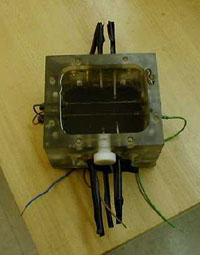
Students from Shoshone-Bannock and Moscow high schools in Idaho and Box Elder High School in Utah gathered recently at Utah State University to prepare their science experiments for travel on a space shuttle mission. Students went through finalization plans and paper work for their experiments. Most of the efforts will be to determine if the experiments meet weight restrictions and how they will fit into the required canister. According to USU faculty adviser and physics professor Jan Sojka, students must complete exhaustive testing and paper work for NASA before their cargo is deemed flight-ready. Box Elder High School students Steve Berkley and LeAnn Moody planned a nucleic boiling experiment, to study the effects of microgravity and temperature gradients as water is heated to boil during space flight. In the first stages of boiling on earth, the bubbles appearing in the heated water are very small because the water is under pressure from the atmosphere and gravity. The students want to see what the bubbles do in space without those pressures. Teens Naomi Sanders, Simon Story, Cody Aichele and Annette Windley from Moscow High School are conducting a crystal growth experiment, using six chemicals found in the human body. That will study the formation and growth of crystals in microgravity for medical purposes. "I think it's very cool," said Sanders. "It's a great opportunity for us -- we're still in high school. Not a lot of people get to do stuff like this," said Aichele. Students Reana Yazzie, Angelina Rodriguez, Reynese Ridley, Eric Johnnie, Edred Jay, Grayson Nagashoah, Rossie Longhair, Amber Larkin, Skyler Smith and Summer Baldwin from Shoshone-Bannock Junior/Senior High School devised an experiment that examines the solubility of phosphates in microgravity. Using phosphate ore mined on their Fort Hall Reservation home, these students reasoned that phosphates widely used in fertilizers might be an important component of food growing during future long-term space missions. "I am very excited about this experiment," said Yazzie. "Not many Native Americans get to do stuff like this." These students' experiments are tentatively scheduled for space shuttle flight No.108 in late November. That is, if everything runs smoothly and according to schedule.
|
Archived Months:
January
1999 January
2000 January
2001 |
||||