|
||||


 |
Logan firm's experimental carpal tunnel surgery has patients recovering in a hurry •FDA's control of who gets the surgery is sort of like Russian roulette By
Lucy Boone
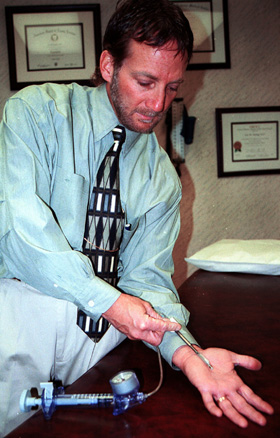
Dr. Brad Larson demostrates the use of the Carpal Tunnel Balloonoplasty device, a new treatment for patients suffering fom carpal tunnel syndrome. / Photo by Justin Berry Editor's note: This story was produced for the USU mass communication class "Beyond the Inverted Pyramid," COMM 3110. Dave Harrison, 54, of Wellsville, woke up one July morning with discomfort in his wrist. The discomfort, and occasional numbness and tingling, made holding a book or a newspaper or gripping a steering wheel difficult. The feeling was normal for Harrison. What wasn't normal was that three hours later, he sat gripping the wheel of his `57 matador-red Chevy, cruising to a car show and feeling fine. That's because at 10 a.m., Harrison underwent an experimental surgery to relieve carpal tunnel syndrome. He describes it as quick, easy and virtually pain-free. Now, 10 months later, Harrison said he's able to do things he hasn't been able to for the last six to eight years when his CTS started. Which giant medical center did Harrison visit for the state-of-the-art surgery? He didn't even leave Cache Valley. Little Logan keeps big company. Logan is by far the smallest of the four cities involved in the medical investigation Harrison participated in. The surgeries are performed at Western Medical Surgery Center. All the other experimenters in the study perform their surgeries in prestigious university medical schools or nationally recognized medical centers in Illinois and New Jersey. Raymond Olsen and Associates, a Logan-based drug and medical device tester, is responsible for bringing this experiment to Cache Valley. Olsen and Associates is testing a cutting-edge carpal tunnel surgical device. "It makes it even more exciting, just because we live in a small area, to pursue the newest and latest in medical technology. We don't have to travel to a big city," said Brad Larson, the orthopedic surgeon who has teamed with the company for the testing. "When you're working on the body, you are always robbin' Peter to pay Paul." Instead of Cache Valley patients going to the big city, people have traveled to the Valley for surgery, including one professional fisherman from Alaska. Because the surgery, so far, has yielded quicker recoveries than older methods, the Alaskan, who couldn't take much time off work for a lengthy recovery, opted to ride the wave of technology. The option worked for the fisherman. "He's happy as a clam," Larson said. "No pun intended." * * * Raymond Olsen is the man behind the company, but everyone from friends to business associates call him Ray. Though his company may be the only one for thousands of miles doing nationally recognized experiments in carpal tunnel surgery, Olsen is perpetually casual. He wears cowboy boots, blue jeans and a half-buttoned jacket as he leans against a wall with one hand in the front jean pocket, explaining technical, Federal Drug Administration studies and medical advancements, like a rancher might explain a cattle drive. He describes himself as a "local guy who likes to do what I do." Originally from Cache Valley, Olsen got his start with a bachelor's degree from Southern Utah University, then went to work in Salt Lake City. There he met Dr. Marlowe Goble, who was also interested in medical investigations, and the two of them headed north to do experiments together. Olsen got his masters degree in bio-veterinary science at Utah State University. Olsen's company coordinates the medical investigations. It gets the device or drug and works as the go-between for the company and the physicians. Participating doctors and their staffs do tests, and Olsen and Associates compiles the data and reports it. It also ensures testing is done according to FDA guidelines. The device the company is now testing, called carpal tunnel balloon plasty, is developed by Connecticut-based Surgical Dynamics. The concept behind the plasty is a simpler, less traumatic take on relieving the pain of carpal tunnel syndrome than previous techniques. The carpal tunnel is the name of the passage in the wrist formed by bones and a ligament. The bones and ligament form a tunnel about 1.5 centimeters in diameter. Protected within the tunnel are tendons and a major nerve, which run into the hand and fingertips. Carpal tunnel syndrome occurs when extra pressure is put on the nerve. This happens most commonly when regular wear and tear or repetitive motion causes the lining on the tendons to thicken. Because the bones and ligament forming the tunnel have no give, the nerve is squeezed. Then the hand, fingers and wrist may feel pain, tingling and numbness. This can also happen when a bone is dislocated or fractured or when fluid retention causes swelling. Harrison believes his CTS came from his 25 years at a desk job for Coca-Cola, where he said his position as general manager involved a lot of paper work and writing. In open carpal tunnel surgery, the oldest of the techniques practiced today, the palm of the hand and the wrist are cut open several inches. Then the ligament forming the carpal tunnel is cut. When the ligament heals with scar tissue, it is longer than before, making the tunnel bigger and relieving the pained nerve. Endoscopic carpal tunnel surgery, the next technique to come along, uses the same idea, but with two tiny incisions rather than one long one. The two tiny incisions make a difference. "Intuitively, there's going to be less pain [with endoscopic incisions] than with a hole this big," Olsen says, holding his fingers the distance from mid-palm to above the wrist, demonstrating the size of the cut produced by open surgery. While endoscopic's introduction was a step toward less trauma, the balloon plasty's concept is still another step. With the balloon, the ligament is stretched, not cut. That's part of the attraction of the plasty. It works much like the balloon in an angioplasty that stretches a heart artery to leave more room for blood flow. The CTS balloon stretches the ligament to leave more room for the nerve. Endoscopic-sized incisions are made, then a metal sleeve is inserted into the incision and under the ligament. The sleeve looks like the blade of a potato peeler with a long, skinny, clear plastic balloon in the groove. Water is pumped into the balloon according to a pressure gauge mounted on the end. The filled balloon expands, lifting and stretching the ligament. The water is released and the procedure is repeated several times. "Cutting [the ligament] has adverse affects," Olsen said, including losing up to 15 to 20 percent of the grip's rotational strength. But the sacrifice of strength for loss of pain is the give-and-take nature of medicine, Olsen said. "When you're working on the body, you are always robbin' Peter to pay Paul," he said. While the loss of grip strength could complicate opening pickle jars, perhaps the greater concern is that the cut ligament can muddle future surgeries. Once the ligament has been cut, if complications arise, attempts to re-do the surgery may be complex. If the ligament is only stretched, however, "you can always go back and cut it," Olsen said. Each advance in technology seems to cut in half the recovery time, Larson said. For open surgeries, it's six to eight weeks before patients can resume close to normal activity, for endoscopic, three to four, for balloon plasty, one and a half to two. "I have not seen any additional risks with the balloon technique. In fact, I think there's less risk because the ligament is not cut," Larson said. * * * While CTS sufferers may be eager to rush right out and get the surgery, it's not that easy. That's not the way the FDA works. "They tend to err on the side of caution," Larson said, referring to the extensive testing the FDA requires before new devices and drugs are approved. Not only is the testing painfully slow, being able to get it is uncertain. In fact, it's a little like FDA-sponsored Russian roulette. Your odds are 50/50 and you won't know the results until you wake up from the anesthesia. This is because even if a patient qualifies to take part in the test under the strict medical prerequisites, he still may not get the surgery. To ensure objective results, the FDA requires a control group to compare the balloon patients to. If a patient is willing to undergo the surgery and meets the medical criteria, she will not know until she wakes up from surgery if she received the balloon plasty or open surgery. The FDA provides sealed envelopes to the surgeon, who opens one at the time of surgery. The paper inside the envelope tells the physician which surgery to perform. This way, doctors cannot decide, for example, that a healthier patient receives the experimental surgery, while a higher risk patient receives the control group surgery. The FDA decided that the control group would receive open surgeries, rather than endoscopic surgeries, partially because open surgeries have been around longer - more than 30 years. With endoscopic surgeries, which have been around for eight to nine years, surgeons experience a learning curve and don't get really good until they've performed around a hundred, Olsen said. Larson has done more than 2,000 endoscopics. Still he has to follow FDA procedures in the investigation. The uncertainty of which kind of surgery patients get makes some patients wary, he said. They are often unwilling to take the gamble of waking up with a big white bandage on their hand covering a long incision. Harrison said he's not usually a gambler. He describes himself as "pretty conservative." But when he saw an ad in the paper looking for "guinea pigs - so to speak," he "figured if there's a new way, I ought to try it." The new way, "[The balloon plasty] is different from having your whole hand sliced open," Olsen said. "It's almost like getting a shot. There's not a lot of trauma." When patients know they can choose the tried and proven endoscopic surgery and know what they are getting, that more certain path is often the one they take. "It's hard to recruit patients," Olsen said. On the other hand, there are gambling carpal tunnel patients out there. "Some patients are very excited to be on the cutting edge," Larson said. "They're anxious to be involved and to volunteer." Part of what gave Harrison confidence in the investigation, he said, is that he knows Larson, who is a neighbor. "I knew his ability and didn't think he'd be doing anything not worth trying." Though he may be part of medical history, Harrison said his taking part was "no big deal - just a good surgery." To have the surgery approved, about 260 must be performed nationwide. In the year and a half the experiment's been going on, 10 have been done in Logan. Six of those were balloon plastys and the other four opens, said Shelly Olsen, Ray's wife and the main organizer in the investigations. Four of the six balloon surgery patients been completely satisfied and two have been redone, Shelly said. Of the two re-do's, tests on one showed no change in the syndrome, but the other showed the carpal tunnel syndrome had decreased significantly. Also, although the risks of the balloon technique seem small and the concept logical, research is limited on how much extra room the stretched ligament actually leaves in the tunnel and how well the ligament maintains its new length. Although he said it's early to tell, Olsen said he's "cautiously optimistic" that the testing will be successful and the device approved. Like most body repairs, however, the wrist "will never be as good as new," Ray said. "If we could repair everything to as good or better condition, I'd be out of a job. We can't even come close to the original equipment." Despite any shortcomings, Ray gave the experiment perhaps it's biggest
vote of confidence when he said, "I would do it if I had carpal tunnel
syndrome." |
Archived Months:
January
1999 January
2000 |
||