|
||||


 |
Professor Paul Crumbley knows the real Emily Dickinson By
Brook Cox
Editor's note: This story was produced for the USU mass communication class "Beyond the Inverted Pyramid," COMM 3110.
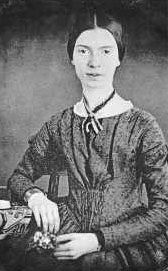
The only known photograph of E.D. Remembrance has a rear and front -- -- Emily Dickinson From what you've heard in high school English classes, you may think of Emily Dickinson as a quiet and withdrawn woman, someone a person may think of as a 19th century Miss Manners. Paul Crumbley, a USU professor, thought that at first too, but he found a whole different person. Not a person who only pressed flowers and knitted doilies, but a political dynamo. For 10 years, Crumbley, an assistant professor in the English department, has studied the works and life of Emily Dickinson (1830-1886). She didn't publish a lot of her poems. Instead she would send a poem with a letter to one of her 1,100 correspondents, Crumbley said. These letters and poems weren't just about the weather and flowers. Dickinson had a political agenda. She would talk about events of the day. Ownership and possession were subjects of concern to her, Crumbley said. She did publish some of her poems, but not many because she was not pleased with publishers. In the 19th century, printing presses were starting to standardize grammar and spelling. Publishers wouldn't have printed her poems how she wanted them, so she wouldn't give them any, Crumbley said. They would take out the dashes in her poems and change punctuation that gave them meaning. She preferred to have her poems read by sending them away with her letters to her friends. Crumbley's most renowned area of expertise concerning Dickinson is the way she used the dash throughout her poems and what its intended meaning was. In his most recent book "Inflections of the Pen: Dash and Voice," published in 1997 by The University Press of Kentucky, Crumbley states that dash let the readers take responsibility for how they read the poem. Dashes weren't just put there for no reason, they had a deliberate strategy, Crumbley said. The book has received good reviews, but critics say that it is more for a person who already knows a lot about Dickinson and wants to go into extreme depth. "It's fair to let potential readers know that 'Inflections of the Pen' is a highly specialized study," said Tim Morris, from the University of Texas-Austin, in an online book review from The 19CWWW Publishing Center. Crumbley has had over 10 publications about Dickinson in the forms of journals, books, anthologies and encyclopedia entries. "He has tremendous concentration. He can sit at the kitchen table with chaos breaking around him in the shape of two little girls, and still be able to think," said his wife,Phebe Jensen. Being the secretary for the Emily Dickinson International Society, Crumbley said he feels he can hear about the latest knowledge and research done about Dickinson. The society, whose members number about 420, has annual meetings usually in Amherst, Massachusetts, where Emily Dickinson lived. The meetings usually have a thematic focus. For instance, Crumbley said, he has seen plays performed about Dickinson's life and Dickinson's poems put to music and song. Each meeting usually includes a discussion led by scholars about a certain poem or letter of Dickinson's, Crumbley said. As you walk into Crumbley's office, about 10 feet by 6 feet, in the southeast corner of the fourth floor in the Ray B. West Building, you'll see little of the walls, because every possible place to put bookshelves has bookshelves and they are all packed with books. Books are piled horizontally in front of the vertically lined up books. Books are piled on his desk. Books can be found piled in corners of the room- and many of them are about Emily Dickinson. One holds his favorite poem by Dickinson, "We lose- because we win-." This poem shows an appreciation of winning and losing. Most forget we are in a game with rules and winners and losers. It shows that when you get tied up in winning you've lost, Crumbley said. Crumbley got his bachelor's in English and philosophy at Willamette University in Oregon in 1974 and went on to get three master's. His first in 1976 was in theology. His second in 1978 was in teaching English and his third in 1986 was in English. All were from different schools in California, Oregon and Vermont. In 1993, Crumbley received his Ph.D. from the University of North Carolina at Chapel Hill. He majored in American literature and minored in 20th century American and British literature. Out of all of his education, everything seemed to be about English, except his master's in theology. His mother was an English teacher and his father was a Methodist minister, Crumbley said. "I wanted to come to terms with it (religion) myself," Crumbley said. He also wanted to learn about the subject that inspired his father, Jensen said. And even though he didn't become a minister himself, he has used his theological education in unexpected ways. "I think there are lots of similarities between teaching and preaching: working with people, trying to teach them something and influence their lives," Jensen said. "He gives time endlessly to his students. He gives out our home number, talks to them for hours at home, and puts no limits on the time for conferences, which I think probably also derives from the mind-set of the minister: that you're always available, all the time." And the Bible comes up a lot in literature. Knowing the Bible stories helps in understanding a lot of different literature. Crumbley has also taught college English courses about the literature of the Bible. His love of Dickinson's work and the Bible have met too. "She [Dickinson] refers to the Bible more than any other literature," Crumbley said. Dickinson was a member of the Congregational Church, but she stopped going while in her 30s. A religious revival was sweeping New England at that time in her life. People were being encouraged to publicly announce their religious testimonies. Everyone in her family made a public confession of their belief in Jesus Christ, but Dickinson refused. She was determined to be independent, Crumbley said. While in graduate school at the Middleberry College in Vermont completing his last master's degree he met his wife, who also teaches in USU's English department. They were getting tired of the East and Phebe was offered a job at USU. "She had followed me around with my jobs, so it was my turn to follow her," Crumbley said. Once at USU, Crumbley was also offered a job. They have been at USU for five years. Jensen teaches courses in British literature and Crumbley teaches courses in American literature. They have two daughters, ages 7 and 2, whom Crumbley enjoys to spend time with. Every summer they travel for a month or more, visiting relatives and doing research. Jensen's mother lives in Massachusetts's near where Emily Dickinson lived, so when they are there, Crumbley finds time to slip away to do more research at her archives. He also enjoys visiting relatives in Boston, where there are many libraries, Crumbley said. During the summer, Crumbley also finds time do some recreational reading. Among his all time favorites is a 20-book series by Patrick O'Brien. The books talk about British naval life and Crumbley has read 18 of them and can't wait to get his hands of the other two. He usually just borrows them from friends, and since the last two just came out, he hasn't found any friends willing to give them up yet, Crumbley said. When Crumbley was younger he was always involved in physical activities, such as football. As he got older he wanted to continue to exercise, and running could be done alone and seemed inexpensive. In 1979 he ran his first and only marathon in Seattle, Washington. "I wanted to see if I could," Crumbley said. Now he tries to run six to eight miles a day when he can fit it into his schedule, Crumbley said. Sixteenth East Street above Hyde Park is his favorite area to run because of the view, he said. "I think it's an important way to relieve stress. He works through scholarly or pedagogical problems as he runs," Jensen said. As well as running, Crumbley enjoys hiking as a way of keeping in shape. Every year he tries to meet with some of his friends in Montana where one of his friends lives and raises llamas. They use the llamas to pack their gear into the mountains where they look for a spot that has access to a couple of climbable peaks. "It's pretty luxurious," Crumbley said. The llamas do all the packing and they take lawn chairs to relax in, Crumbley said. Since he's lived in Logan, Crumbley has also found an interest in brewing his own beer. After tasting some home-brewed beer of his friend Steve Simms, Crumbley wanted to learn how to brew his own. He and friends get together to brew their favorite beers, Crumbley's being Northwest Ales made with hops grown in the Northeast. But it's largely a social gathering for friends to have fun, Crumbley said. Fun and friendship are some things that Emily Dickinson would support. A shady friend-- for Torrid days-- |
Archived Months:
January
1999 January
2000 |
||