|
||||||||


 |
The devil in the details of precision drill and lathe work keeps planes in air and rollercoasters on track By
Tucker Heap
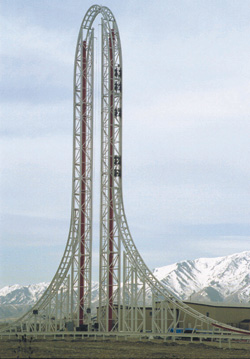
The "bigger" stuff that he's referring to includes a turbine for a jet engine. After Allied Signal in Phoenix, Ariz., has manufactured the turbine, it is shipped to BJT to have its blades shaped. Holes will be drilled in them and other grooves will be cut from all angles. To achieve this, BJT uses an axis machine. It grinds the shape of the blade with a tool connected to a mechanical arm. "Imagine cutting a sphere in half, then laying the flat part on a table," said Archie McWilliams, workshop manager. "Axis machines vary but the tool that forms that blade could follow the curved portion of the sphere almost to a 90-degree angle or a 45-degree angle." After the blades are formed, they are shipped back to Phoenix. "It's an expensive process," said Griggs. " It takes over 23 hours to make a single turbine so there isn't a lot of room for mistakes." Why would anyone send an airplane turbine from Phoenix to Hyrum for precision work? "Because I'm damn good." BJT also makes parts for S&S Sports Power, an amusement part ride manufacturer. Logan residents may have seen their prototypes off to the left while driving north on Main Street, just past Cinema 5 theaters in North Logan. The company builds some of the biggest and fastest amusement park rides on the planet. With 74 rides in more than 21 countries, S & S is one of their biggest clients. People driving by BJT's warehouse in Hyrum may not know but it is partly responsible for millions of smiles and screams from people around the world. The Space Shot is a rapid vertical ascent and descent amusement ride made by S&S. The passengers are propelled 185 feet straight upward, then pulled gut-wrenchingly downward on a uniquely designed passenger vehicle which completely and permanently encircles the entire vertical tower structure. On a typical Space Shot ride cycle, the passengers will rise from the loading position to just below the tower's top in a matter of two to three seconds, reaching 45 mph almost instantly after takeoff. The initial air powered ascent uses approximately a 4.5 G-force. Upon reaching the ride's top position, the passengers are immediately thrust downward at a force of -1 G. They are slowed on their descent by the naturally increasing air pressure in four cable powering air cylinders. A powerful air compressor provides the necessary air power. Condensed air is distributed throughout the ride on valves made at BJT. Unlike the airplane turbine, the valve for the S&S rides are completely manufactured at BJT. It's a complicated process, that begins by welding four pipes together in the shape of a plus sign that is 60 inches long and weighs 15,000 pounds. It is then taken to a boring mill, a lathe the size of two Ford Broncos, to have four grooves cut on the inside. Two of the grooves are to make sure it's airtight when connected to the ride and the others guide the piston as it pumps air. All on community where BJT is based to ask an inevitable question: Why would anyone send an airplane turbine or order an amusement part ride from here? "Because I'm damn good," McWilliams said as a smile creeped across his face. "They sent those turbines all over the country including companies back east and in Taiwan, and none of them could come up with a way to shape those turbines the way the company wanted and still make money or beat our quality. It's the same with the valves for S & S." Training for such precision begins at a trade school such as Bridgerland. Students majoring in machine operations learn how to operate a variety of machines in a field they have chosen. After graduating, companies will hire them, and if they need more specific and advanced training, pay for them to study at another school. Companies value employees that have experience in an industry that doesn't have room for mistakes. An employee who mistakenly puts the wrong drills into the wrong size holes in a product could cost the company thousands. "You have to have both training and work experience," Griggs said. "You can't screw up a $15,000 part." With such a small margin for error, some might argue a robot might do the job better but McWilliams disagrees. "There too much preparation and decision that need to be made during the process," McWilliams said. "Too many adjustments (for robots with specific calculations) to make. Besides, those valves weigh 15,000 pounds. You'd have to have a pretty big robot to throw one of those things around." Staffed with eight people, BJT will make parts for anyone - even if it's a farmer who wants to create a better blade for his combine, for example. "A customer is a customer," McWilliams said. "You never know where a good idea is going to go and you don't want to burn any bridges in the meantime. If they have the money and the plans, we'll make it for them." That mentality has helped get the company get back on its feet after tough times. "The economy went flat for a while," Griggs said. "For instance, we had one of our clients cut their orders by two thirds. It appears to be coming back now. Men that have worked here a long time," he said, pointing to an office with an empty chair across the hall, "will be hired back in. We're hoping to bring him back soon." The company was recently bought by LaVell Tippits and has a new approach to the business with its owner. It has hopes of increasing its clientele and output in the future. "We're certainly making it a serious business," he said.
Spence Huffaker
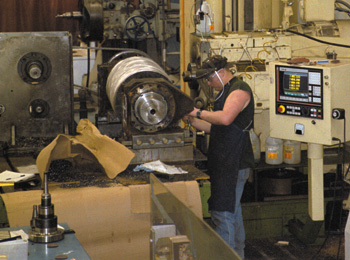
does finishing work on a set of ball rollers at BJT, Inc. / Photo
by Liz Maudsley
|
Archived Months:
January
1999 January
2000 |
||||||